




 Article fact-checked
-
Teacher adoption of AI surged from 32% in 2024 to 61% in 2025, a 29 percentage-point jump that signals a major shift toward mainstream classroom use.
-
AI usage intensity also rose in 2025: the share of teachers using AI “some” increased from 9% (2024) to 21% (2025), while “little” usage climbed from 21% to 37%.
-
Teachers most often apply AI to lesson creation and planning, led by brainstorming lesson ideas (31%) and creating or updating lesson plans (29%).
-
ChatGPT dominates teacher tool recommendations at 47%, nearly doubling the next most-cited option (Google Lens at 24%), making it the most recommended AI tool among teachers in this dataset.
-
Student AI adoption is already widespread in high school, with 58% reporting AI use compared to 42% who do not use AI.
-
Students primarily use AI for productivity and academic support, including brainstorming assignments (37%), summarizing (33%), and getting answers (33%).
-
Generative AI usage is strongly text-driven: 64% of students report using ChatGPT for generating text, while 39% use Grammarly for writing enhancement, and 36% use Kortext for summarizing and study support.
-
Reported performance impacts are measurable across multiple outcomes, including +34% in active learning time, +29% in reading fluency for students with learning disabilities, and a 25% reduction in higher-education course failure rates.
-
The global AI in education market size is projected to rise from $7.05B (2025) to $136.79B (2035), reflecting a decade-long expansion of $129.74B.
-
Market momentum remains high, with an estimated AI in education market CAGR of 36.01% (2025-2030) and 34.52% (2025-2035), indicating sustained high-speed growth through the next decade.
AI is increasingly being integrated into school workflows, influencing lesson planning, student support, and administrative tasks. But the real question isn’t whether AI exists in education. It’s how widely it’s being used, how fast adoption is growing, and what that means for classrooms right now.
In this data-driven report, we break down the latest AI in education statistics to answer a key question: how many teachers use AI today, and how their usage has changed year over year. You’ll also see what teachers use AI for most, which tools they recommend (including ChatGPT), and how student AI behavior is evolving in parallel.
Using clear charts and measurable indicators, this article shifts the conversation about AI in education from abstract to concrete, focusing on adoption rates, usage intensity, and real-world outcomes. Whether you’re an educator, researcher, journalist, or policymaker, these numbers provide a reliable snapshot of where AI in schools stands, and where it’s heading next.
Teachers using AI in the classroom: Adoption rates and trends (2023-2025)
The chart below illustrates the percentage of teachers utilizing AI in the classroom over the past three years. Using teacher AI usage statistics, it shows how adoption shifted from early experimentation in 2023-2024 to a sharp increase in adoption in 2025. This trend helps quantify how many teachers use AI as AI becomes more embedded in everyday classroom workflows.
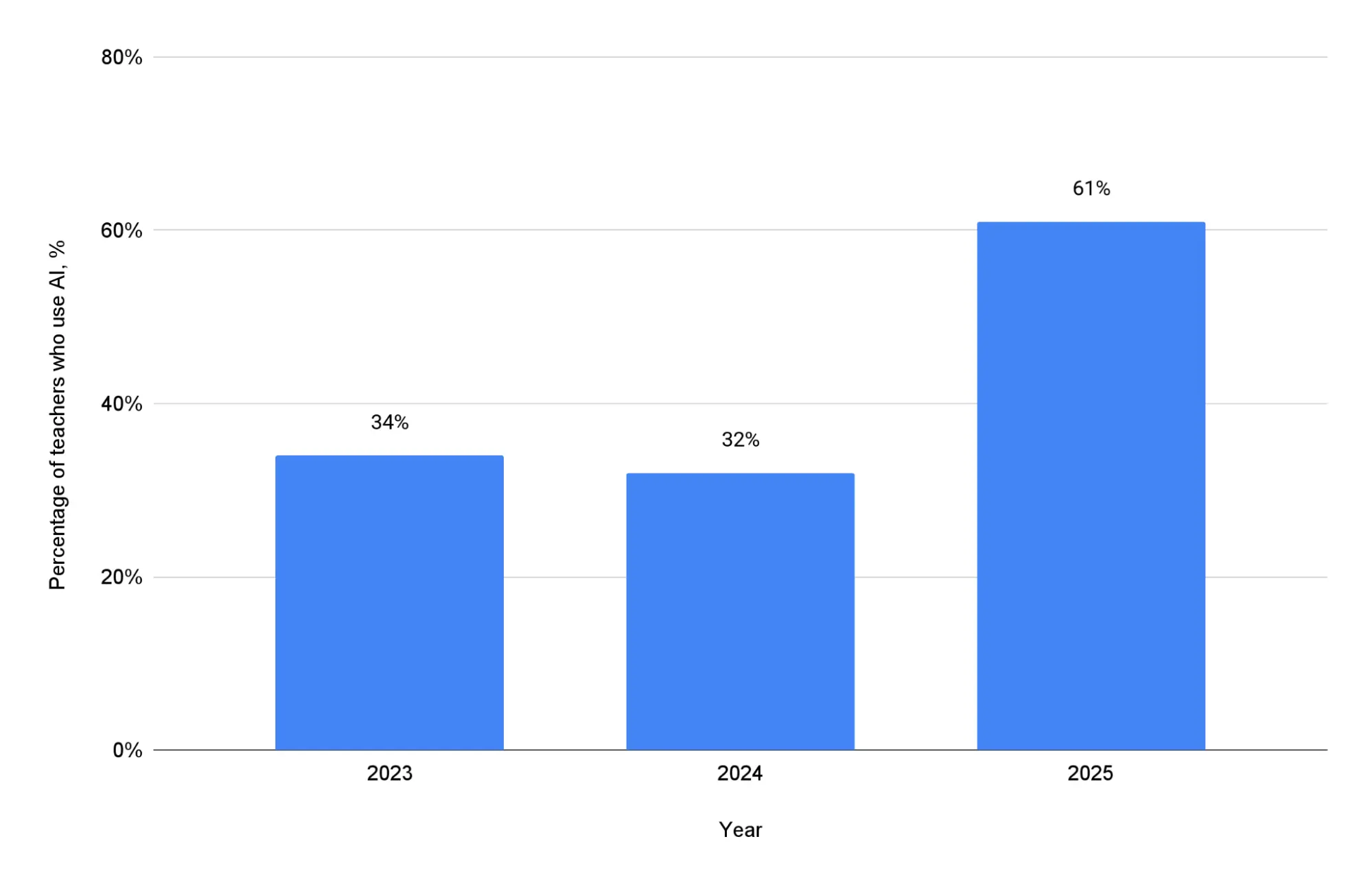
- The percentage of teachers who use AI increased from 32% in 2024 to 61% in 2025, a 29 percentage-point increase in one year.
- Between 2023 (34%) and 2024 (32%), teacher adoption dipped slightly by 2 percentage points before accelerating sharply the following year.
- From 2023 to 2025, the share of teachers using AI increased from 34% to 61%, representing a total increase of 27 percentage points across the period.
How many teachers use AI? A data-driven look at classroom adoption
Overall, the data indicate that teacher adoption of AI moved from a relatively stable baseline in 2023-2024 to rapid expansion in 2025. This supports the broader narrative behind teachers using AI statistics: the classroom has entered a phase where AI usage is no longer niche, but increasingly mainstream.
While adoption rates show how many teachers use AI, the next step is understanding how deeply AI is being used in day-to-day teaching routines.
How often teachers use AI: Usage frequency shifts (2023-2025)
The chart below breaks down how much/often teachers use AI across three years, showing whether educators report using it a “little”, “some”, or “a lot”. This frequency view adds important context to teachers using AI statistics, since adoption alone doesn’t capture the intensity of use. It also helps quantify the practical reality behind the percentage of teachers using AI in the classroom.
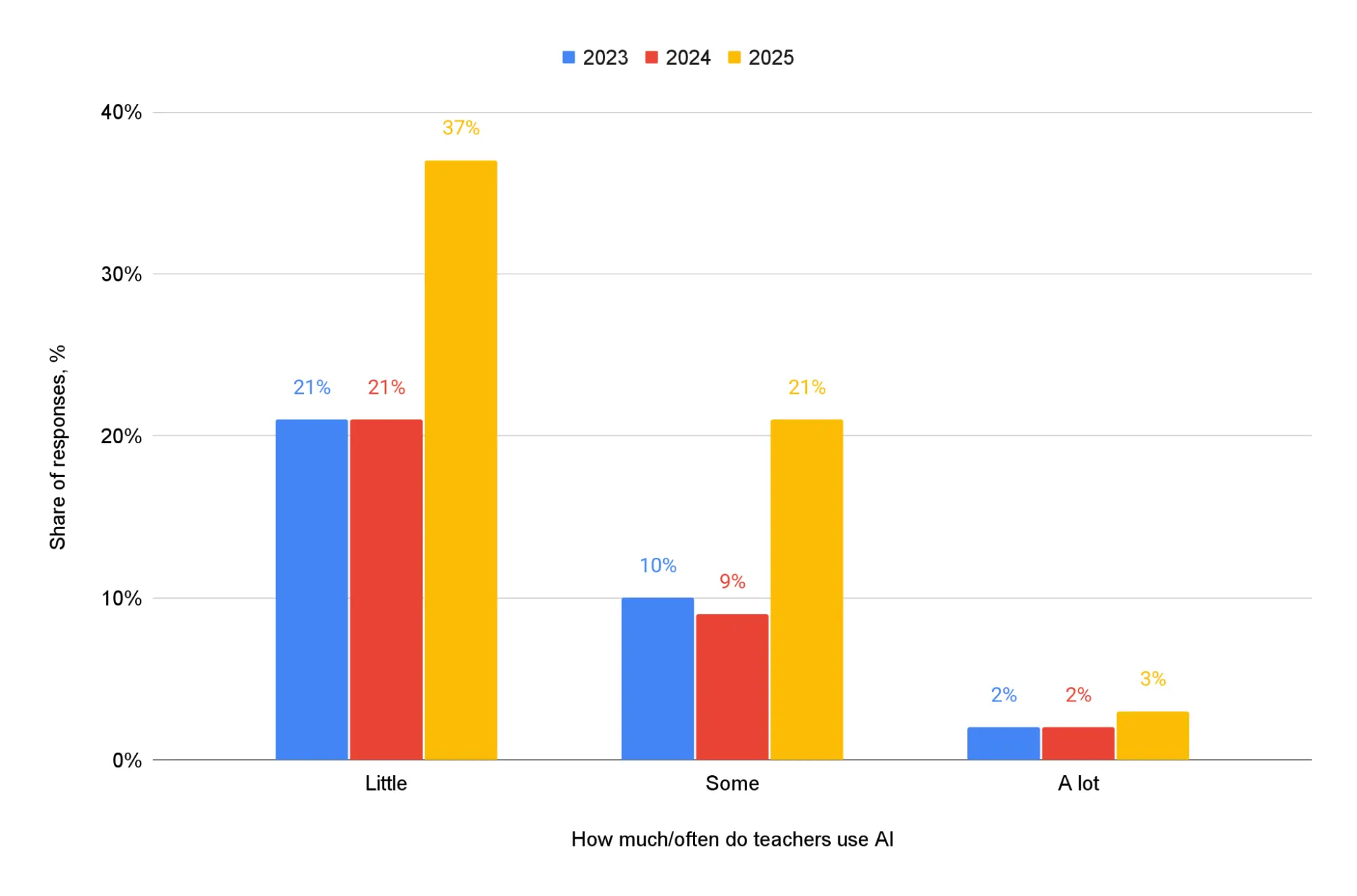
- The share of teachers reporting “little” AI use increased from 21% in 2024 to 37% in 2025, a rise of 16 percentage points.
- Teachers reporting “some” AI use grew from 9% in 2024 to 21% in 2025, an increase of 12 percentage points.
- Heavy usage remains limited: the “a lot” category moved only from 2% in 2024 to 3% in 2025, a gain of just 1 percentage point.
How much do teachers use AI?
These frequency categories reflect the share of all survey responses selecting each usage level.
Across 2023-2025, the data suggests that teacher AI usage is expanding, but mostly in lighter or moderate ways rather than intensive reliance. In 2025, more teachers reported using AI at least a little, and the “Some” segment also expanded noticeably, signaling broader experimentation and integration into routine tasks.
Beyond how often educators rely on AI, the next question is what teachers actually use these tools for in everyday instruction.
For what purposes do teachers use AI? Top classroom use cases
The chart below maps the most common AI use cases reported by educators, showing where AI delivers the clearest day-to-day value. This breakdown adds practical detail to teachers using AI statistics by revealing how AI supports planning, instruction, and student support. It also helps interpret the real meaning behind the percentage of teachers using AI in the classroom, not just whether AI is used, but how it is applied.
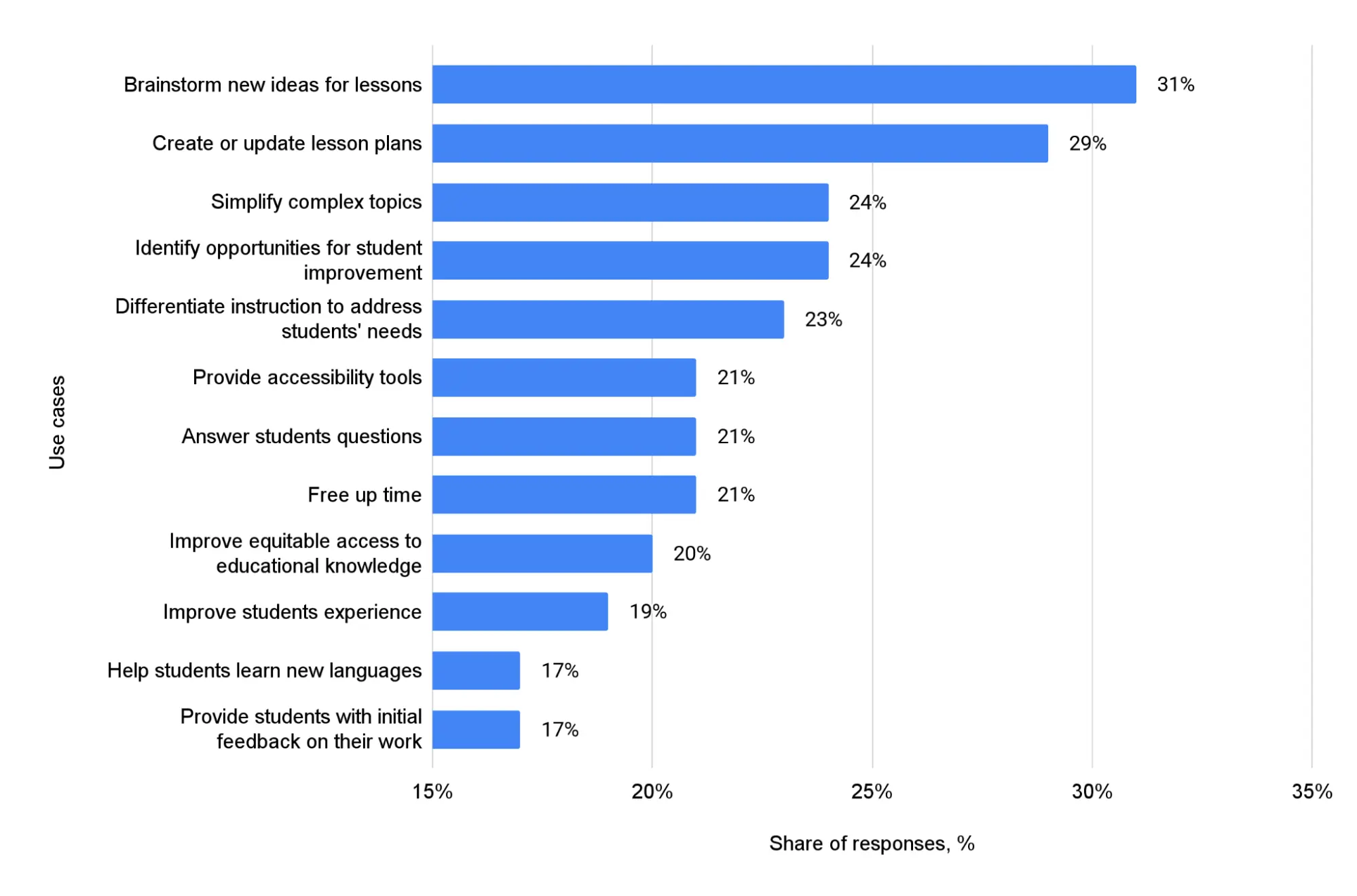
- The top reported use case is brainstorming new ideas for lessons (31%), making it the most common way teachers apply AI.
- Creating or updating lesson plans (29%) ranks second, only 2 percentage points behind brainstorming.
- Several instructional support tasks cluster tightly in the mid-range, including simplifying complex topics (24%) and identifying opportunities for student improvement (24%), showing AI is widely used for classroom-level personalization.
Teachers using AI in the classroom: Most common teaching applications
Overall, the data suggests that teachers using AI in the classroom primarily focus on high-impact, time-sensitive workflows, especially lesson ideation and planning, rather than fully automating instruction. A second tier of use cases centers on improving clarity, differentiation, and student outcomes, which signals that AI is increasingly positioned as a support layer for better teaching decisions. AI adoption is closely tied to practical classroom needs: saving time, improving lesson quality, and supporting diverse learners.
After looking at the main classroom use cases, it’s useful to see which specific tools teachers recommend most often for those tasks.
What AI do teachers recommend? Top tools educators use most
The chart below summarizes which AI tools teachers recommend, highlighting the platforms most commonly referenced by educators. This provides an additional layer of teachers using AI statistics, moving from general usage to specific tool preferences. It also supports searches like how many teachers use ChatGPT by showing how strongly ChatGPT leads among the recommended options.
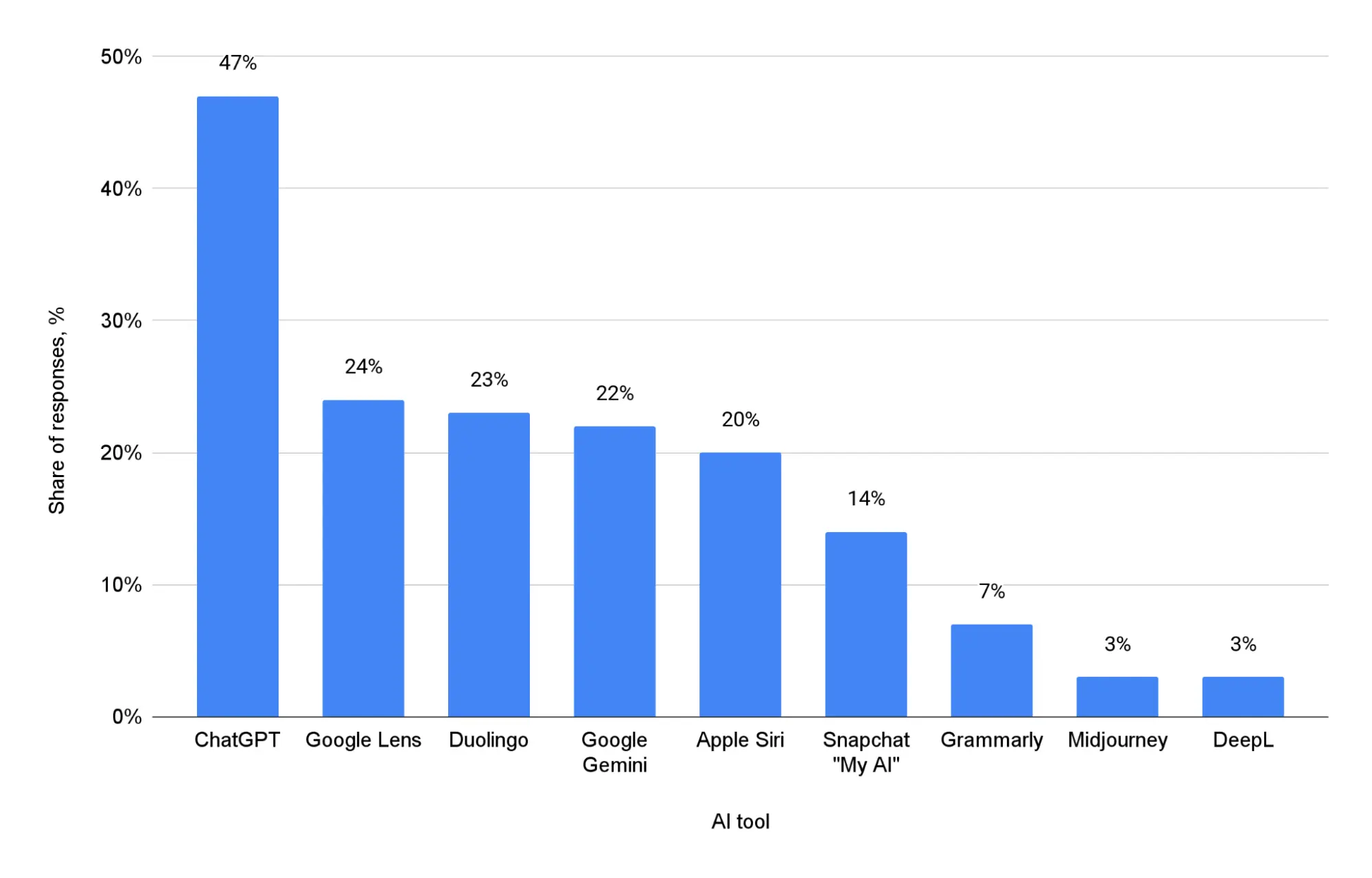
- ChatGPT is the clear leader, recommended by 47% of teachers, nearly double the next-highest tool.
- The second tier includes Google Lens (24%), Duolingo (23%), and Google Gemini (22%), separated by just 2 percentage points from top to bottom.
- Recommendations drop sharply for niche tools, with Grammarly at 7% and both Midjourney and DeepL at 3% each.
Teacher-recommended AI tools
Overall, teacher recommendations concentrate heavily on a small set of mainstream tools, led by ChatGPT. The ranking suggests that educators value AI products that are easy to access and broadly useful across lesson planning, student support, and classroom productivity.
After seeing which AI tools teachers recommend, the next step is understanding how widely students are using AI.
AI use among high school students: Adoption rates in school settings
The chart below shows the share of high school students who report using AI versus those who do not. This provides a clear baseline for students using AI statistics, helping quantify how common student AI adoption is at the school level.
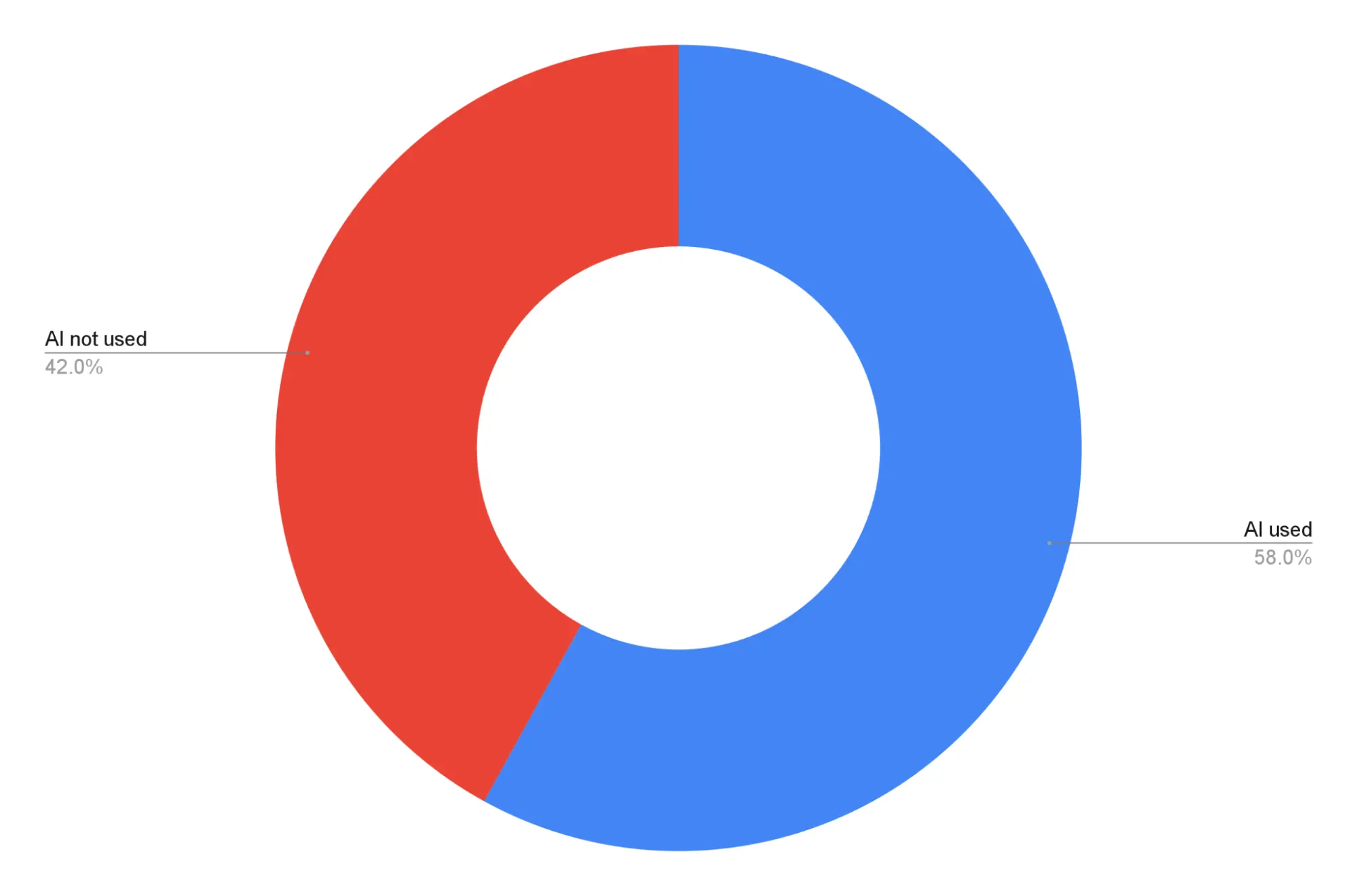
- A majority of high school students report AI adoption, with 58% reporting AI use.
- 42% of respondents report AI not used, showing a substantial segment of students still not engaging with AI tools.
- The gap between users and non-users is 16 percentage points (58% vs 42%), indicating AI use is widespread but not universal.
Students using AI in school: A snapshot of high school usage
Overall, the results suggest that students using AI is already mainstream in high school, with more than half of students reporting usage. At the same time, the size of the non-user group signals that adoption is still uneven, likely shaped by access, school policies, and classroom norms around AI in school. These student AI usage statistics support the broader conversation around why AI should be allowed in school, because AI use is happening at scale, regardless of whether schools formally encourage it.
Now that we’ve established how widespread students using AI is in high school, the next step is understanding what students actually use AI for in day-to-day learning.
For what purposes do students use AI? Top use cases in school
The chart below breaks down the most common student AI use cases, from early-stage ideation to writing support and studying. This adds detail to students using AI statistics by showing where AI fits into typical academic workflows. It also provides context for how AI is being used inside AI in school settings, whether for learning support, productivity, or task completion.
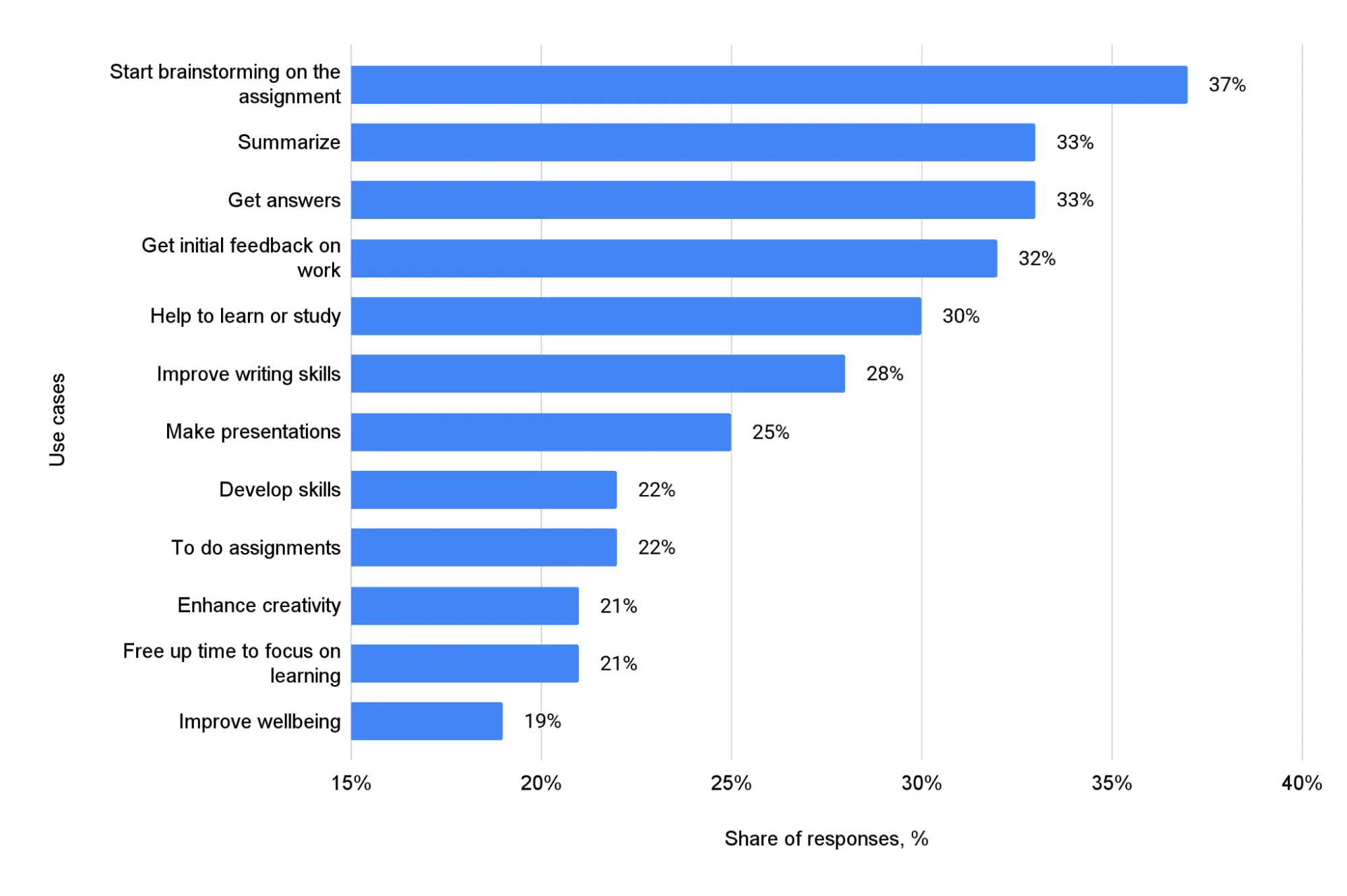
- The most common use case is starting brainstorming on the assignment (37%), making it the top reason students turn to AI.
- Information-focused tasks dominate the next tier, with summarize (33%) and get answers (33%) tied as the second-highest use cases.
- Academic support use is also substantial: getting initial feedback on work (32%) and help to learn or study (30%) together indicate that nearly one-third of students use AI as a learning assistant.
Students using AI: Most common ways learners apply AI tools
Overall, the distribution shows students use AI across multiple stages of the learning process: planning, comprehension, feedback, and production. The strongest signals point to AI being used as both a productivity accelerator and a study aid, which helps explain why students using AI continues to expand in everyday schoolwork. These students using AI statistics also highlight why schools are increasingly debating boundaries and guidelines, especially as AI supports both legitimate learning tasks and assignment completion within AI in school environments.
After looking at general student AI use cases, it’s helpful to break down how students use generative AI, including which tools they choose for specific academic tasks.
How students use generative AI: Top tools and tasks by share
The chart below connects key student activities with the AI tools most commonly used for each one, offering a practical view of real-world adoption. This supports students using AI statistics by moving beyond “what” students do with AI to “which platforms” they rely on. It also provides additional context for how AI is used in everyday AI in school workflows.
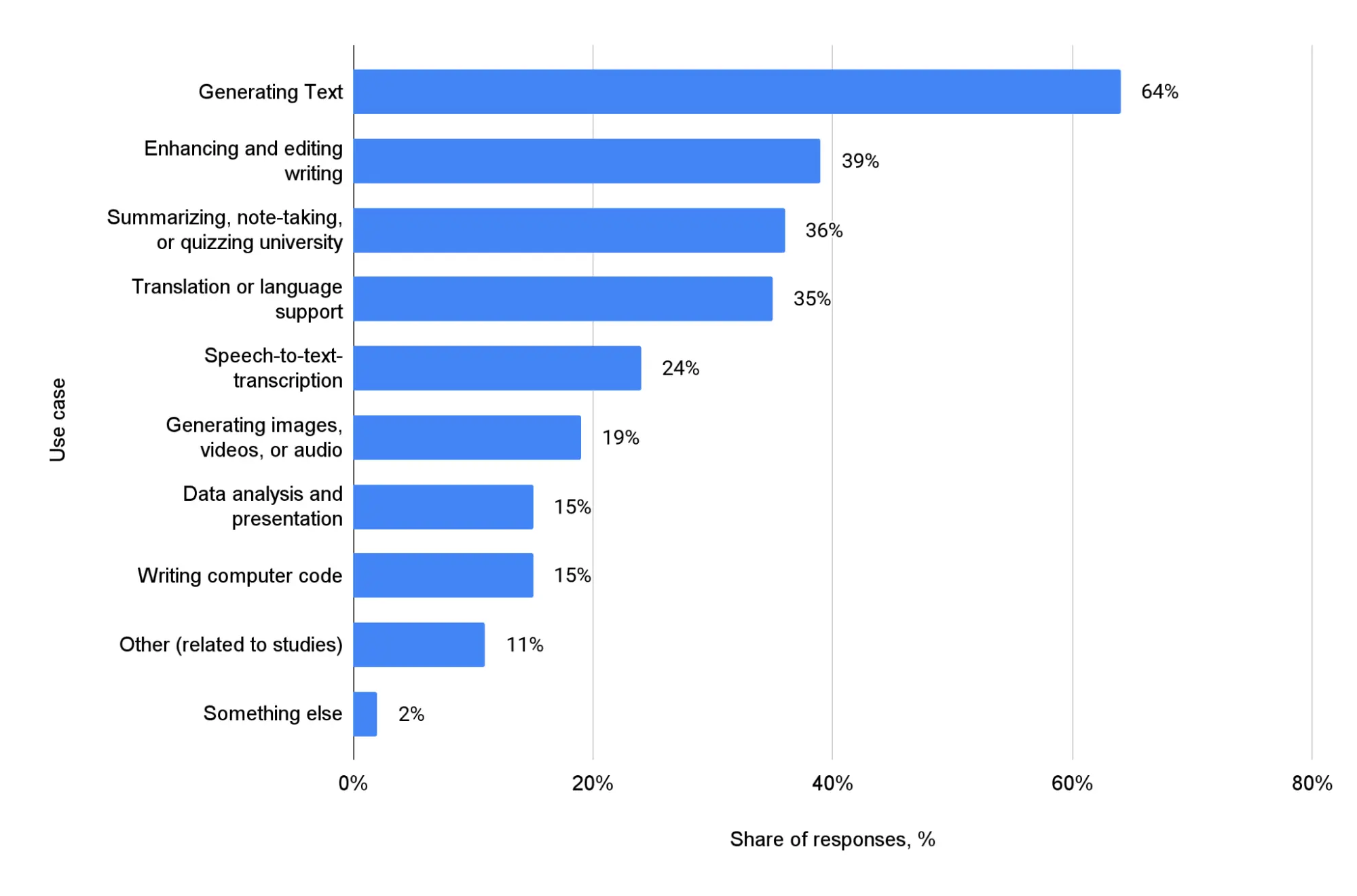
- Generating Text with ChatGPT is the top-reported use case at 64%, making it the most dominant student generative AI behavior in the dataset.
- The next tier includes enhancing and editing writing with Grammarly (39%) and summarizing, note-taking, or quizzing university textbooks with Kortext (36%), separated by just 3 percentage points.
- More specialized tasks show lower, but still meaningful, adoption, including data analysis and presentation with Julius AI (15%) and writing computer code with GitHub Copilot (15%).
Students using AI statistics: What generative AI tools do students use most
Overall, the results show that generative AI adoption among students is heavily concentrated around text-first academic workflows, with ChatGPT leading by a wide margin. At the same time, the presence of multiple tools across writing, translation, transcription, and even coding suggests student AI usage is diversifying into a broader toolkit rather than a single platform. These students using AI patterns reinforce how embedded AI has become in modern study habits, which is why questions like why should AI be allowed in school continue to gain relevance as AI in school usage expands.
After examining how students use generative AI tools, it’s important to zoom out and evaluate the broader use of AI in education, specifically, which applications are seen as most beneficial.
Impact of AI in education on student performance: Measurable gains across outcomes
The chart below summarizes performance-related impact metrics linked to using AI in education, covering academic results, engagement, efficiency, and attendance. It provides a data-driven snapshot of the impact of AI in education, showing where outcomes improve most consistently. These figures also help frame the real-world benefits of AI in the classroom, especially for students who need targeted support.
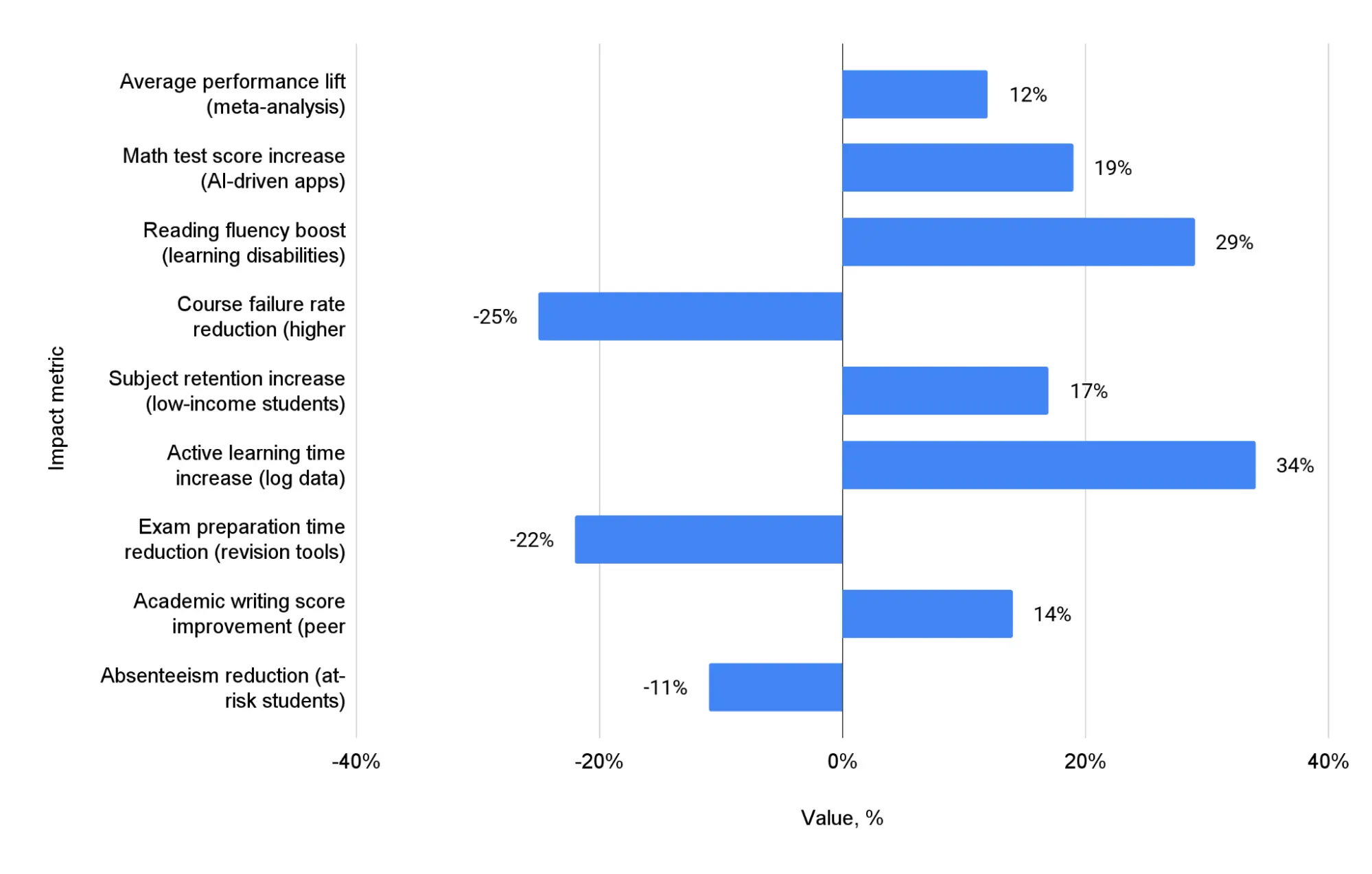
- The strongest uplift in the dataset is Active learning time increase (log data) at 34%, indicating a major engagement gain tied to the use of AI in education.
- Academic performance improvements are substantial, led by a 29% reading fluency boost (learning disabilities) and a 19% math test score increase (AI-driven apps).
- Several outcomes improve through reductions in negative indicators, including course failure rate reduction (higher education) at 25%, exam preparation time reduction (revision tools) at 22%, and absenteeism reduction (at-risk students) at 11%.
How does AI affect education? Student performance improvements backed by data
Overall, these results suggest that AI applications in education are associated with meaningful gains across multiple dimensions, not just test performance, but also engagement, workload efficiency, and persistence. The mix of increases (performance, retention, learning time) and decreases (failure rates, prep time, absenteeism) shows why the application of AI in education is often positioned as both an instructional and operational advantage. At the same time, the spread of outcomes reinforces that the uses of AI in education are not one-size-fits-all: different tools appear to deliver different benefits depending on student needs, learning context, and implementation quality.
Most beneficial AI applications in education: Top use cases by adoption
The chart below ranks the most beneficial AI use cases based on the share of responses selecting each option. It offers a practical view of AI applications in education, showing which tools and workflows users find most valuable across learning and career preparation. This helps quantify the real-world impact of AI in education, moving beyond general discussion into measurable use-case priorities.
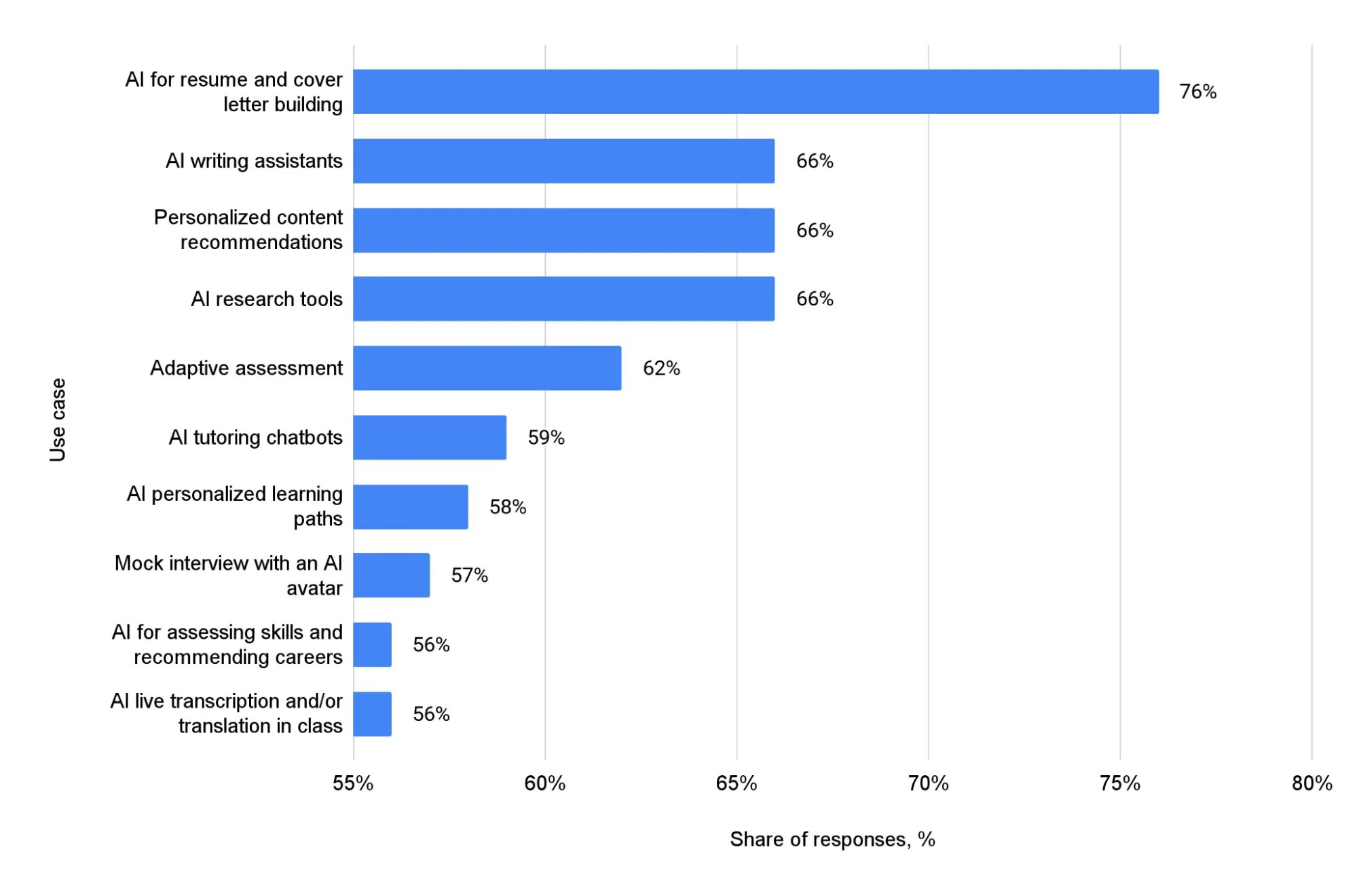
- The top-ranked use case is AI for resume and cover letter building (76%), making it the most widely cited beneficial application in the dataset.
- A strong second tier emerges at 66%, with AI writing assistants, Personalized content recommendations, and AI research tools all tied at the same level.
- Learning-focused tools remain highly represented, including Adaptive assessment (62%) and AI tutoring chatbots (59%), showing that classroom-aligned benefits are still a core part of the uses of AI in education.
Uses of AI in education: The highest-value classroom and learning use cases
Overall, these results suggest that the application of AI in education extends well beyond traditional classroom tasks and increasingly supports career readiness and productivity outcomes. At the same time, the presence of tutoring, assessment, and personalized learning pathways confirms that AI used in education is also deeply connected to improving learning delivery and student support. Taken together, the data reinforces a positive narrative around using AI in education, while also highlighting that discussions about how does ai affect education should consider both academic and real-world skill development impacts.
Together, these use cases help explain why AI is increasingly associated with measurable improvements in student outcomes.
Even with measurable performance gains, the debate around AI in schools’ pros and cons ultimately depends on how educators perceive AI’s long-term impact and day-to-day realities.
Should AI be used in schools? Teachers’ views on the pros and cons
The chart below summarizes teachers’ attitudes toward AI, focusing on perceived future impact and whether AI has changed workload. This perspective is essential when evaluating the impact of AI on education, because adoption depends not only on outcomes but also on trust, practicality, and classroom fit. It also provides context for whether AI should be used in schools, balancing optimism with concerns about the negative effects of AI in education.
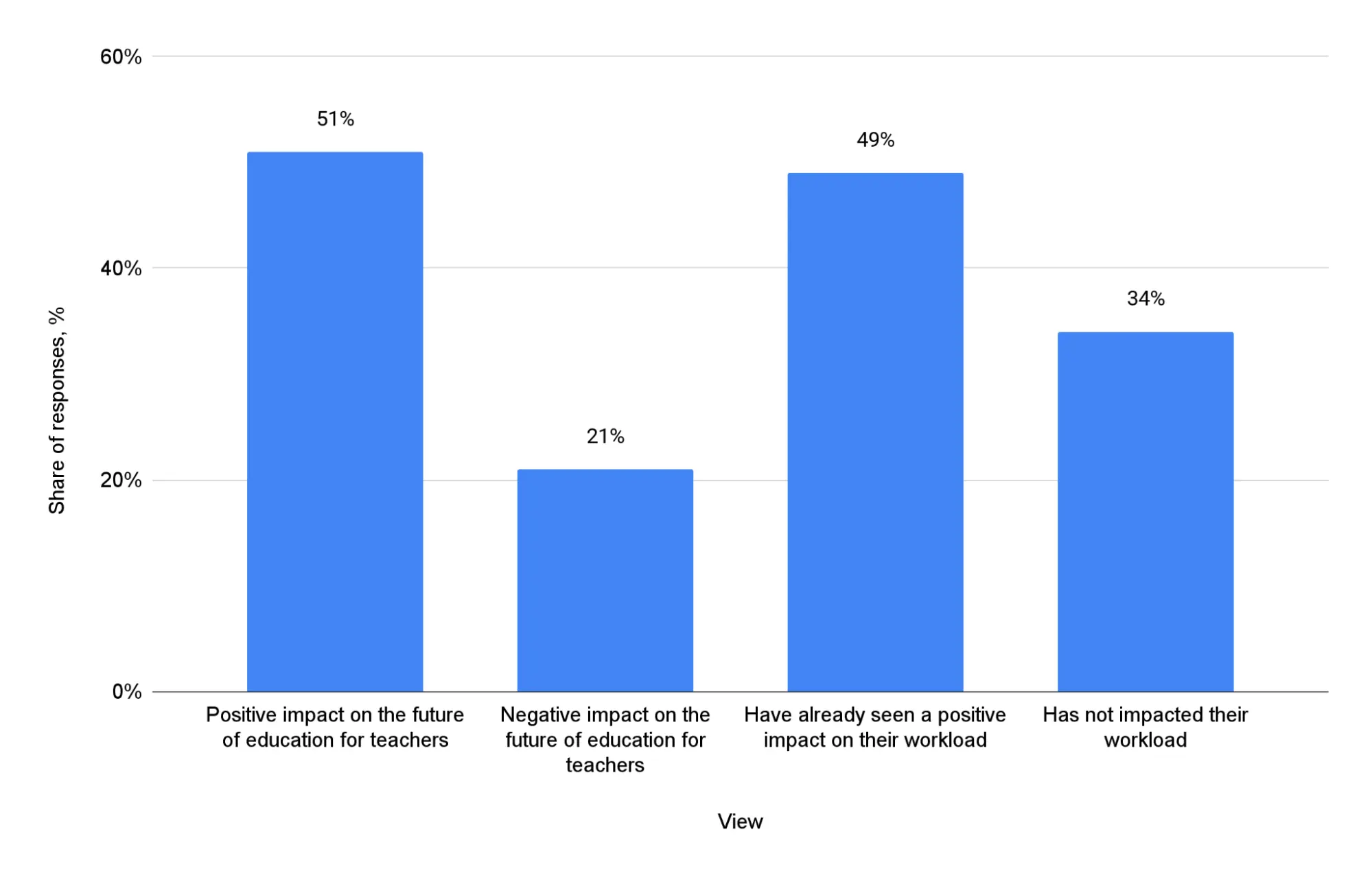
- A majority of teachers expect a positive impact on the future of education for teachers (51%), compared with 21% who expect a negative impact.
- Nearly half report they have already seen a positive impact on their workload (49%), suggesting immediate operational benefits.
- At the same time, 34% say AI has not impacted their workload, showing that results are uneven and implementation-dependent.
Pros of AI in education vs cons of AI in education: What teachers think
Overall, the results reflect a cautiously optimistic outlook: teachers are more likely to associate AI with positive future outcomes than negative ones, supporting the case for the pros of AI in education. However, the sizable shares reporting either negative expectations or no workload impact highlight why debates around the cons of AI in education remain active. In practice, these findings suggest that the AI impact on education is not universally felt, meaning school-level strategy, training, and tool selection will likely determine whether AI delivers benefits or reinforces concerns about problems with AI in education, and how AI affects education negatively.
While teacher sentiment helps explain adoption on the ground, the next step is to quantify the scale of opportunity by looking at the AI in education market size and long-term growth trajectory.
AI in education market size: Global growth forecast (2025-2035)
The chart below tracks projected global market value for artificial intelligence in education from 2025 through 2035. It provides a clear, year-by-year view of the AI in education market expansion and helps frame the future of AI in education in economic terms. These AI in education statistics also make it easier to compare near-term growth with longer-term forecasts.
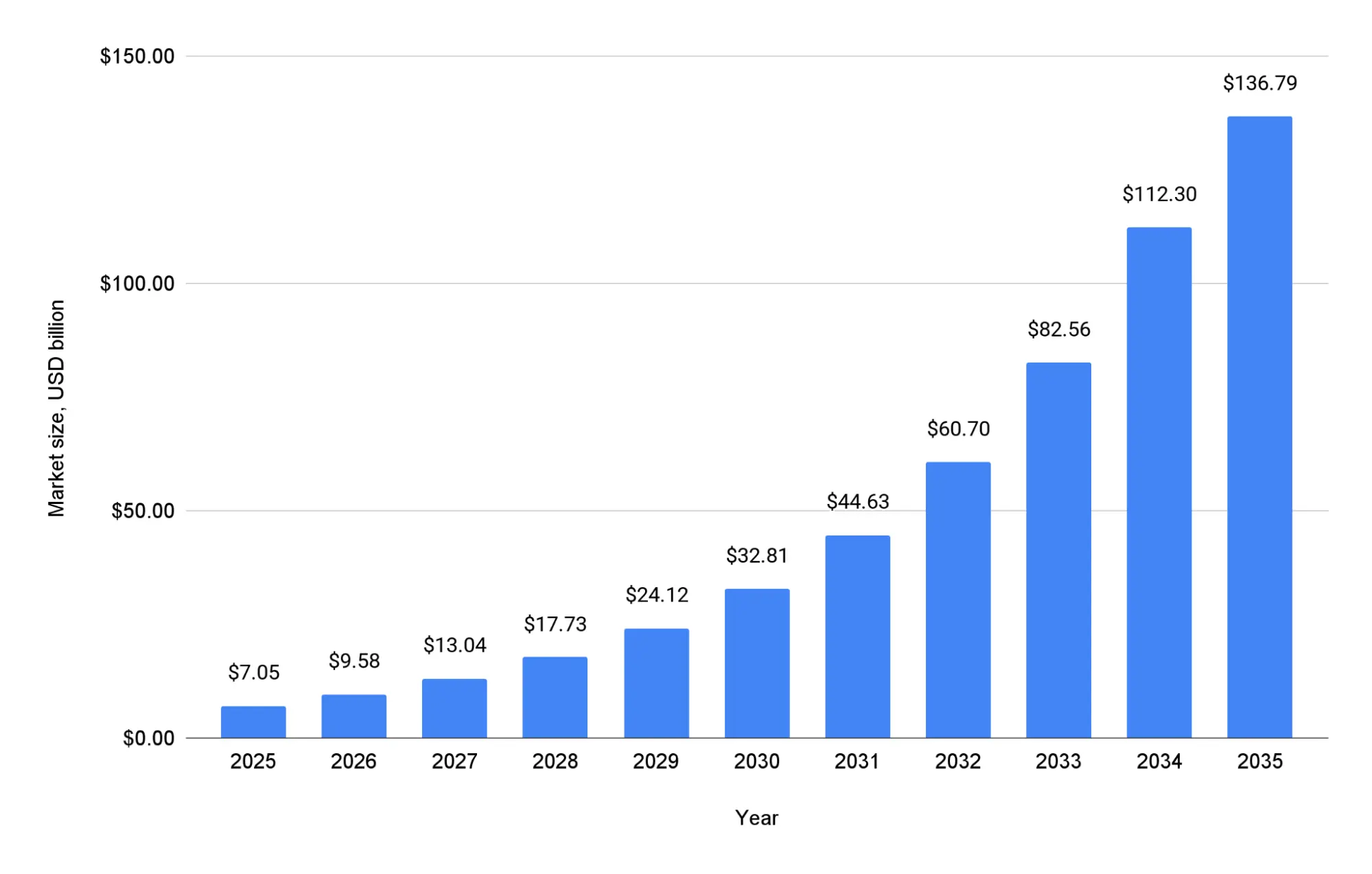
- The global AI in education market size is projected to grow from $7.05B in 2025 to $136.79B in 2035, an increase of $129.74B over the period.
- The market more than doubles between 2031 ($44.63B) and 2033 ($82.56B), rising by $37.93B in just two years.
- The single largest year-over-year jump occurs from 2033 ($82.56B) to 2034 ($112.30B), a gain of $29.74B in one year.
Artificial intelligence in education: Market expansion and future outlook
Overall, the forecast suggests the AI in the education sector is entering a rapid scaling phase, with market value accelerating sharply after 2030. This trajectory reinforces that artificial intelligence in education is moving beyond experimentation into a major global industry, with sustained growth expected across the next decade. In practical terms, these AI in education statistics position the market as one of the fastest-expanding education technology segments, supporting long-range planning tied to the future of AI in education.
After reviewing the projected AI in education market size, the next step is to quantify the pace of expansion using the AI in education market CAGR over key forecast windows.
Global AI in education market CAGR: Growth rate outlook from 2025 to 2030 and 2035
The chart below summarizes the compound annual growth rate for the global AI in education market across two time horizons: 2025-2030 and 2025-2035. This view translates long-term market expansion into a comparable annualized growth metric, helping benchmark the AI in education market growth rate against other fast-scaling technology sectors. These figures also support AI in education statistics reporting by turning market forecasts into clear growth-rate indicators.
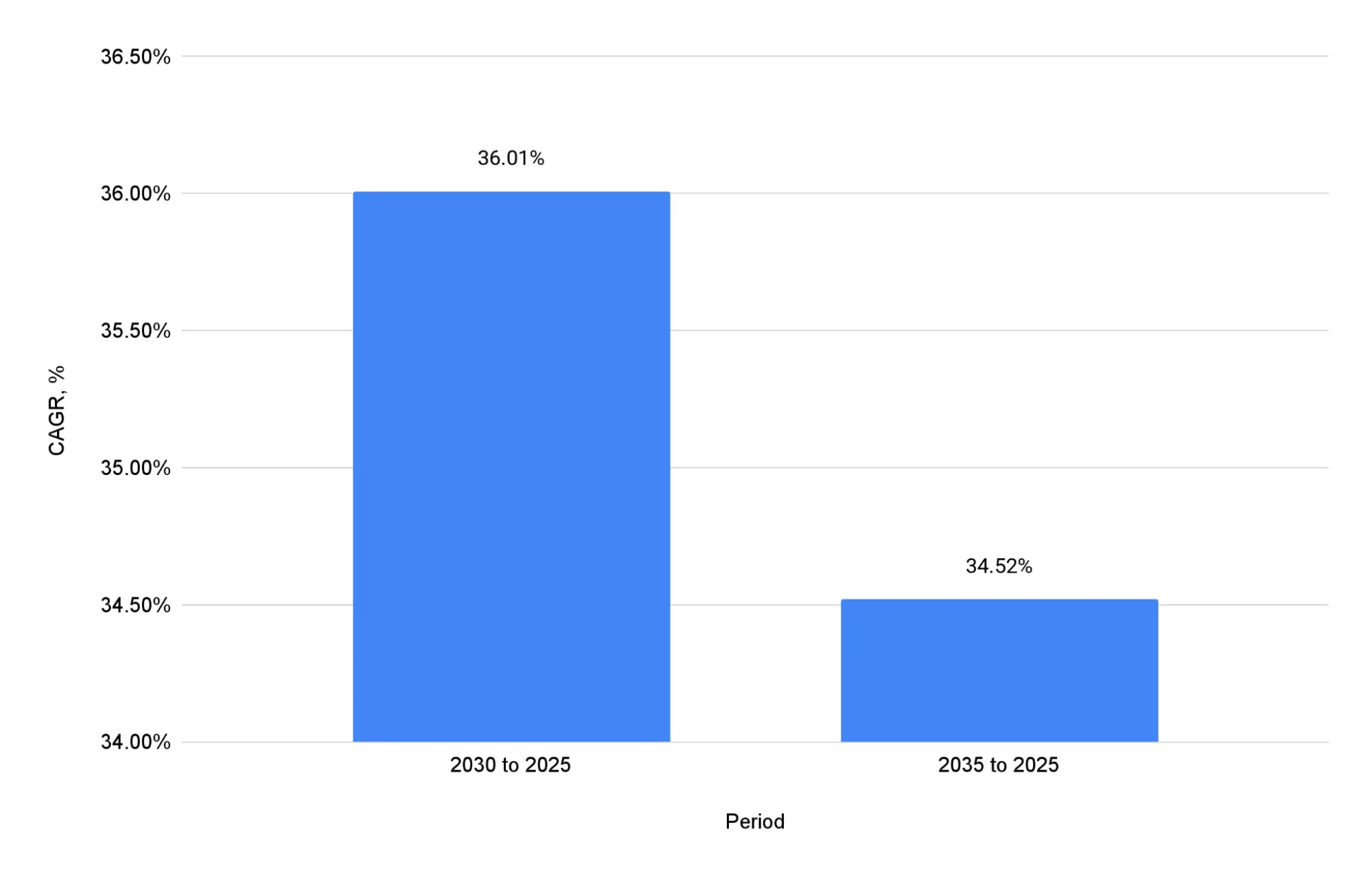
- From 2025 to 2030, the AI in education market CAGR is 36.01%, indicating a high growth rate.
- From 2025 to 2035, the CAGR is 34.52%, only 1.49 percentage points lower than the 2025-2030 growth rate.
- The close gap between 36.01% and 34.52% suggests the AI in education market maintains high growth momentum even across a full decade.
AI in global education market growth rate: CAGR benchmarks for 2030 and 2035 forecasts
Overall, these CAGR benchmarks reinforce that the AI in the education sector is forecast to grow at a sustained, high-speed rate through both 2030 and 2035. The fact that the long-horizon CAGR remains above 34% indicates the market is not expected to slow dramatically as it scales, which strengthens the investment and innovation case behind artificial intelligence in education. In practical terms, the AI in education market forecast 2030 and 2035 outlook suggests continued expansion in adoption, product development, and institutional spending aligned with the future of AI in education.
Conclusions
- By the mid-2020s, AI in education has moved past early experimentation and into a phase of rapid institutional normalization. What was once treated as a supplemental tool is now becoming a routine layer in teaching and learning workflows, reflected in the sharp rise in teacher adoption from 32% in 2024 to 61% in 2025. This shift signals that AI is no longer a fringe classroom technology; it is increasingly embedded in how education systems operate day to day.
- A defining feature of this stage is the widening gap between adoption and intensity. While overall teacher usage is rising quickly, the distribution suggests most educators remain in lighter or moderate usage modes: “little” AI use increased to 37% in 2025, and “some” reached 21%, while “a lot” remained limited at 3%. This pattern indicates that AI is spreading broadly across classrooms, but deep operational reliance is still emerging rather than fully established.
- From a functional standpoint, both teachers and students are using AI primarily as a productivity and support tool rather than a replacement for instruction. Teachers most frequently apply AI to lesson ideation and planning, 31% use it to brainstorm new lesson ideas, and 29% to create or update lesson plans, while students focus on task acceleration, such as brainstorming (37%), summarizing (33%), and getting answers (33%). These behaviors reflect AI’s current role as an assistive layer that reduces friction in core academic workflows.
- Tool concentration further highlights how quickly the ecosystem is consolidating around a small number of mainstream platforms. ChatGPT leads teacher recommendations at 47% and dominates student text generation use at 64%, reinforcing its position as the leading generative AI tool among surveyed students and teachers. Meanwhile, the adoption of secondary tools like Grammarly (39%) and Google Translate (35%) shows that student usage is diversifying into a toolkit model where different platforms support different academic needs.
- The measurable outcome metrics strengthen the case that AI can deliver real educational value when applied effectively. Reported impacts include a 34% increase in active learning time, a 29% boost in reading fluency for students with learning disabilities, and a 25% reduction in course failure rates in higher education. Together, these signals suggest that AI’s upside extends beyond convenience into performance, engagement, and persistence, particularly for students who benefit from targeted support.
- Looking ahead, the market trajectory suggests that adoption will continue accelerating at scale. With the global AI in education market projected to grow from $7.05B in 2025 to $136.79B by 2035 and CAGR remaining above 34% across both forecast windows, investment and product development are likely to intensify. The next phase will be defined less by whether AI enters education and more by how deeply it integrates into curricula, assessment, and institutional policy, as schools balance measurable benefits with governance, academic integrity, and long-term learning outcomes.
Sources
- Elad, Barry. “AI in Education Statistics 2025: Funding, Privacy, and Performance.” SQ Magazine, 29 June 2025, https://sqmagazine.co.uk/ai-in-education-statistics/. Accessed 21 January 2026.
- Langreo, Lauraine. “More Teachers Are Using AI in Their Classrooms. Here’s Why.” Education Week, 12 Jan. 2026, https://www.edweek.org/technology/more-teachers-are-using-ai-in-their-classrooms-heres-why/2026/01. Accessed 21 January 2026.
- Zoting, Learn. AI in Education Market Size to Surge to USD 136.79 Bn by 2035. https://www.precedenceresearch.com/ai-in-education-market. Accessed 21 January 2026.
- https://cdn-dynmedia-1.microsoft.com/is/content/microsoftcorp/microsoft/bade/documents/products-and-services/en-us/education/2025-Microsoft-AI-in-Education-Report.pdf. Accessed 21 January 2026.


 Built-in AI detector