



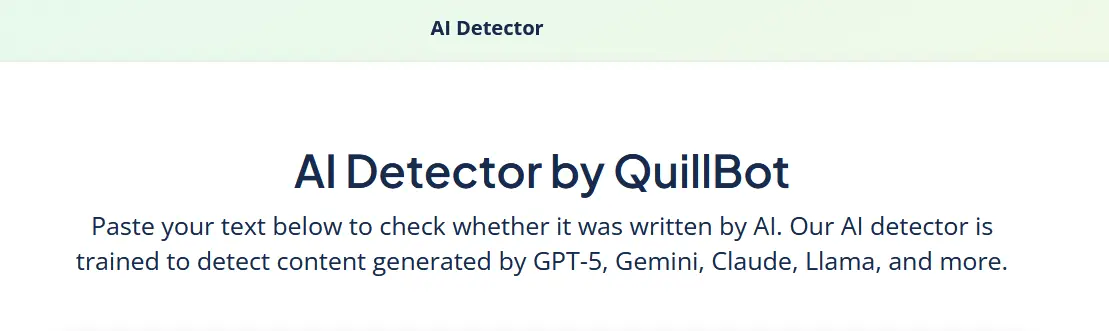
AI detectors are making students paranoid, and for good reason. You can use 10 different tools and get 10 different verdicts on whether your text is human-written or not. That’s why I ran QuillBot AI Detector through three real-world tests to determine if it’s a precision tool you can rely on or just a digital coin flip.
How Does QuillBot’s AI Detector Work?
Before I get into the numbers, let me give you a very short explanation of what QuillBot AI technology is actually measuring. Its AI detection software primarily scans for two metrics: perplexity and burstiness.
Perplexity measures the complexity and randomness of word choices, as AI tends to choose the most statistically probable next word. Human writers, by contrast, occasionally pick unusual phrasing or reach for a word that technically fits but isn’t the obvious choice.
As for burstiness, the text analyzer measures variation in sentence length and rhythm. You might have noticed that AI tends to write in uniform blocks. When you read a passage written by a person, you’ll often notice a mix: a short sentence followed by a more complex one.
Therefore, AI writes like a well-calibrated machine, and that’s exactly what QuillBot AI checker tries to detect.
We Tested QuillBot: Here Are the Results
I approached this like a structured experiment and used three different content samples to test the AI detector by QuillBot.
So, does QuillBot detect AI writing? Let’s find out.
Test 1: 100% human-written text
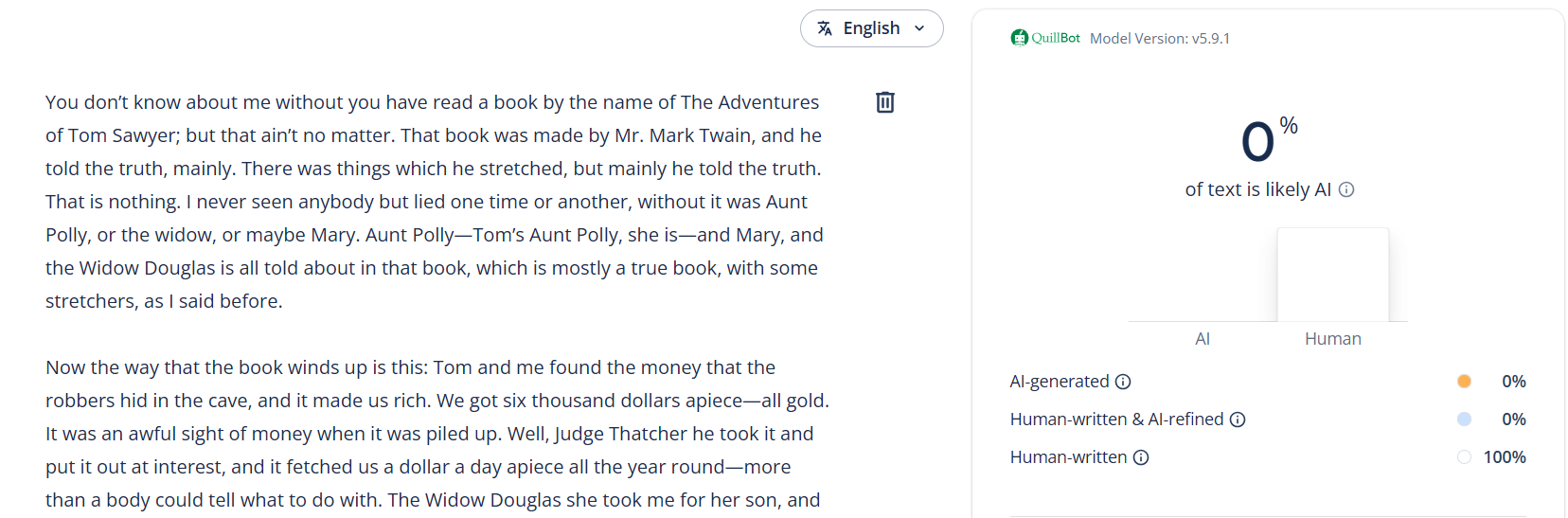
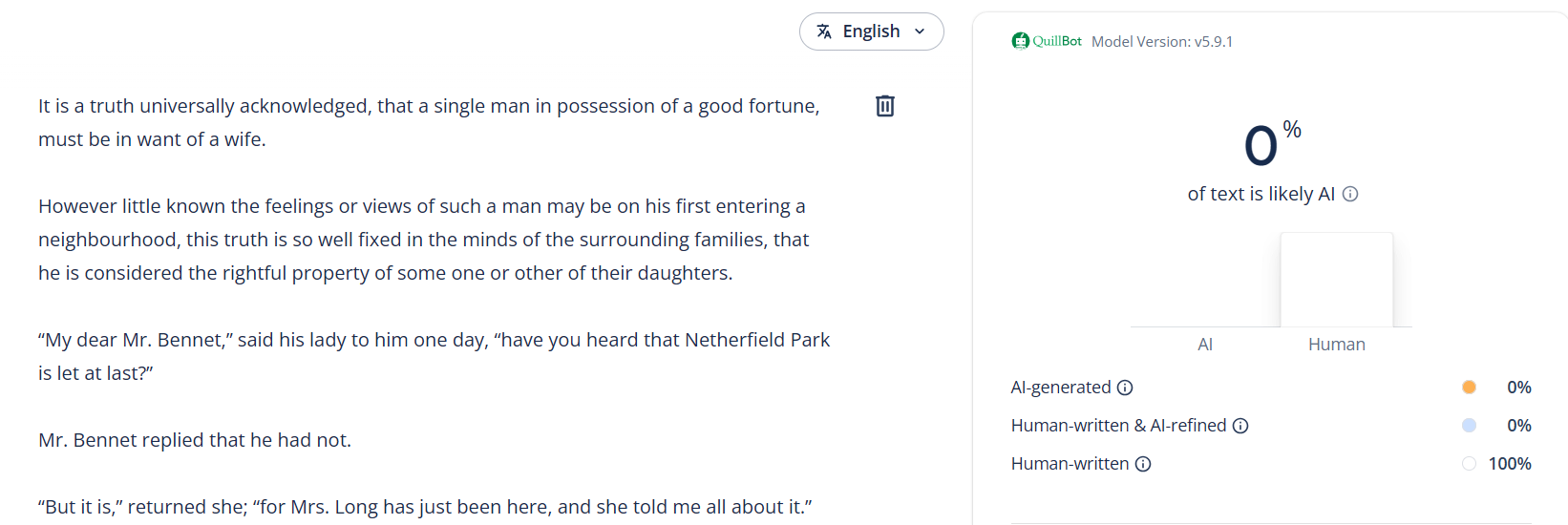
For the first test in my QuillBot AI Detector accuracy review, I used two sources that could not be mistaken for AI: excerpts from Mark Twain’s “The Adventures of Huckleberry Finn” and Jane Austen’s “Pride and Prejudice”, both published well before the digital age and both firmly in the public domain. Here are the results I got from QuillBot AI checker:
I also retrieved an old essay I wrote in 2016, years before ChatGPT existed:
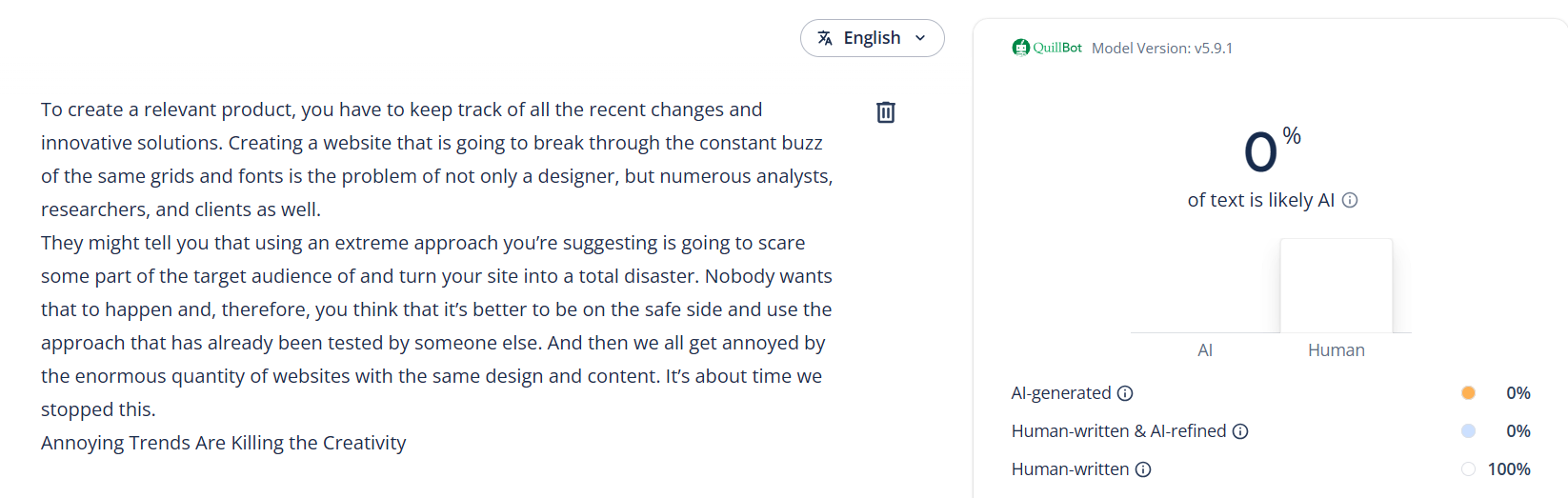
As you can see, in all three cases, QuillBot returned a result of 100% human-written content. That’s encouraging. Classic literary prose, with its idiosyncratic syntax and stylistic variation, is exactly the kind of writing that should score as human, and it did.
However, I want to flag something important here for students who may be reading this. If you’re an ESL writer or someone who naturally writes in formulaic academic structures that are a perfect fit for scientific papers, you may be at greater risk of receiving a false positive.
Test 2: Raw ChatGPT-4 output
For the second test, I generated a 500-word essay using ChatGPT-4 and copied the output directly into QuillBot’s checker without making any edits. As you can see, it does a great job when you want to detect ChatGPT content:
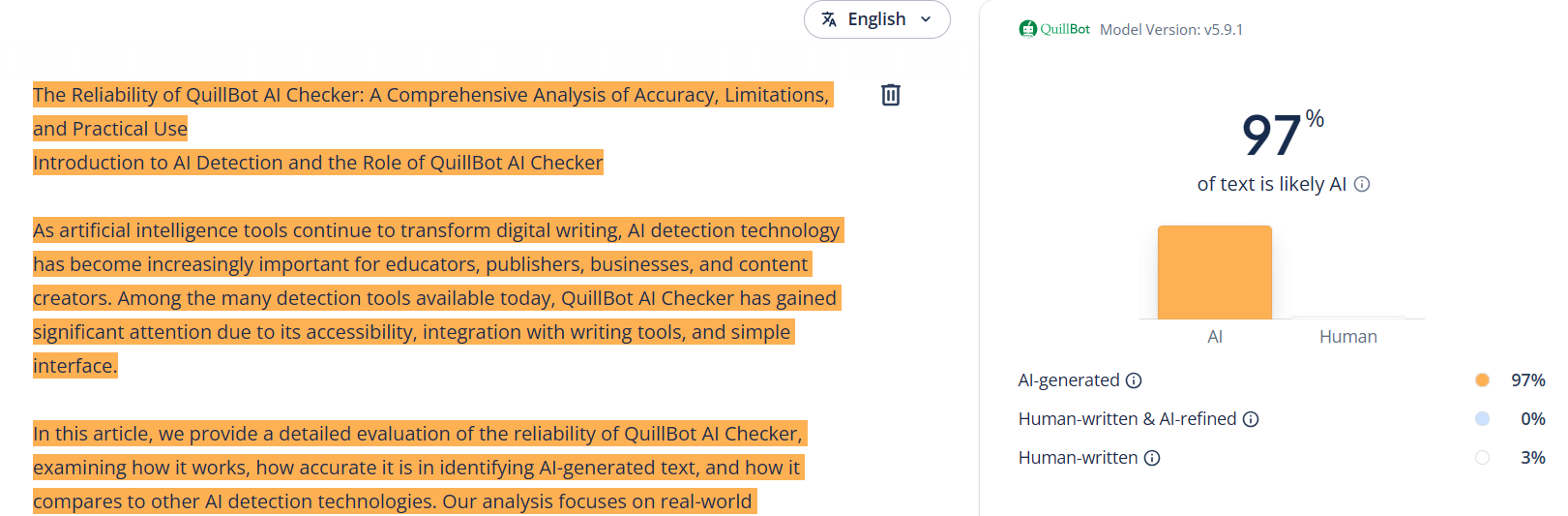
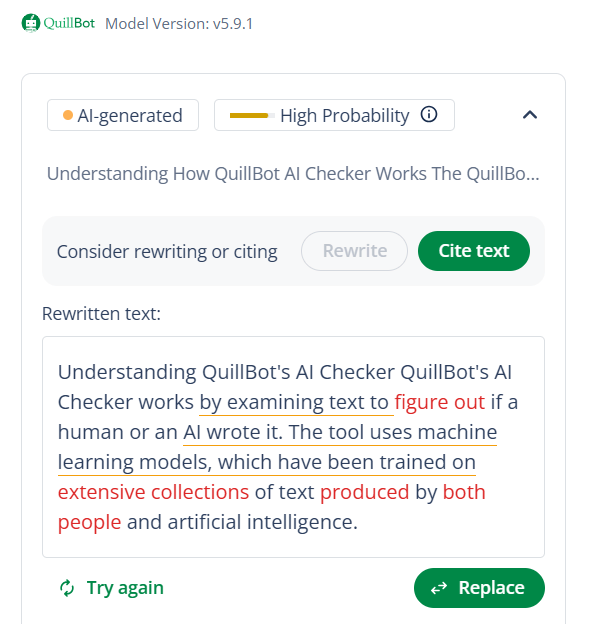
Honestly, I expected a high score, but 97% is decisive. The checker accurately highlighted the predictable transitions and the repetitive sentence structures that are hallmarks of GPT models. This feature is rather useful because it allows you to see exactly which passages triggered the algorithm. On top of that, the tool can rewrite the sections flagged as AI and paste the edited version back into the text:
So, is Quillbot reliable when it comes to unedited AI output? Yes, it is. If a student submits something that came straight from a chatbot without any further work, this tool will catch it. That’s genuinely useful both for students self-checking before submission and for educators who want a quick first-pass screen.
Test 3: AI text paraphrased by QuillBot itself
This was the test I was most curious about, and I’ll admit, I was a little cynical going in. I took the same ChatGPT-generated essay from Test 2 and ran it through QuillBot’s own paraphrasing tool. Then I copied the paraphrased output back into the AI checker:
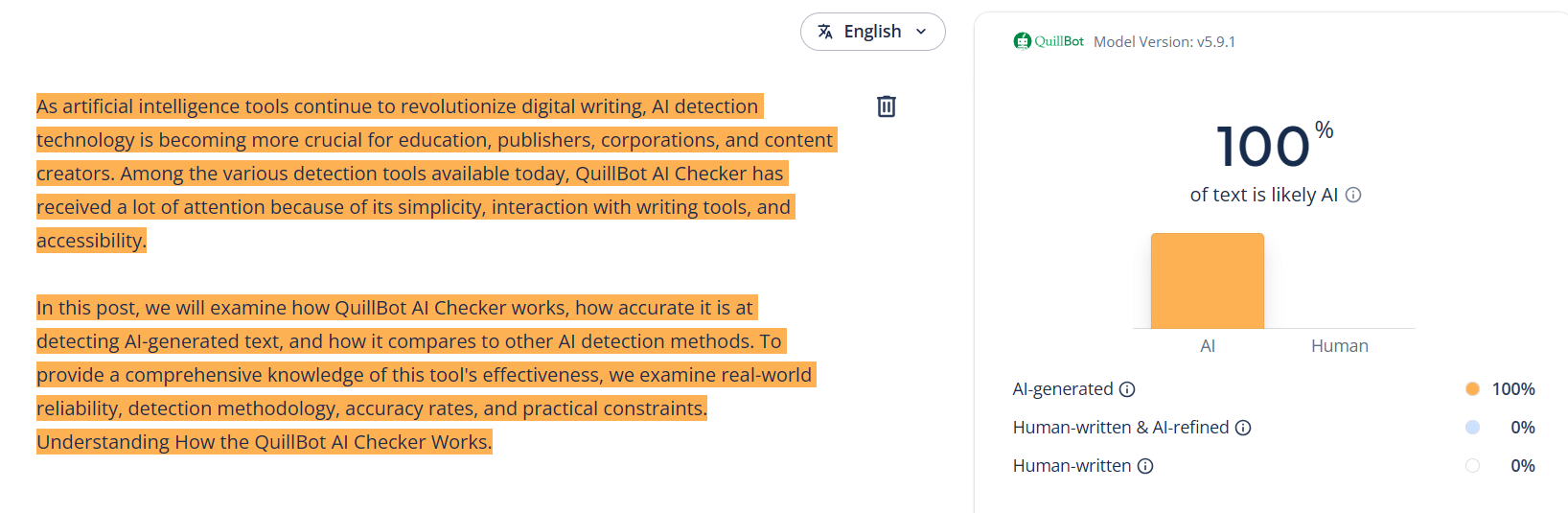
The irony is not subtle: students may use a company’s paraphrasing tool to disguise AI-generated content and then turn to the same company’s detector to catch it. When writing this QuillBot AI Detector review, I wanted to know which tool wins that battle.
The results surprised me because the probability of AI-generated content increased to 100%, meaning that it was 3% more human-like without any ‘humanization’. I also used QuillBot’s Humanizer to do the same test, and got the same result:
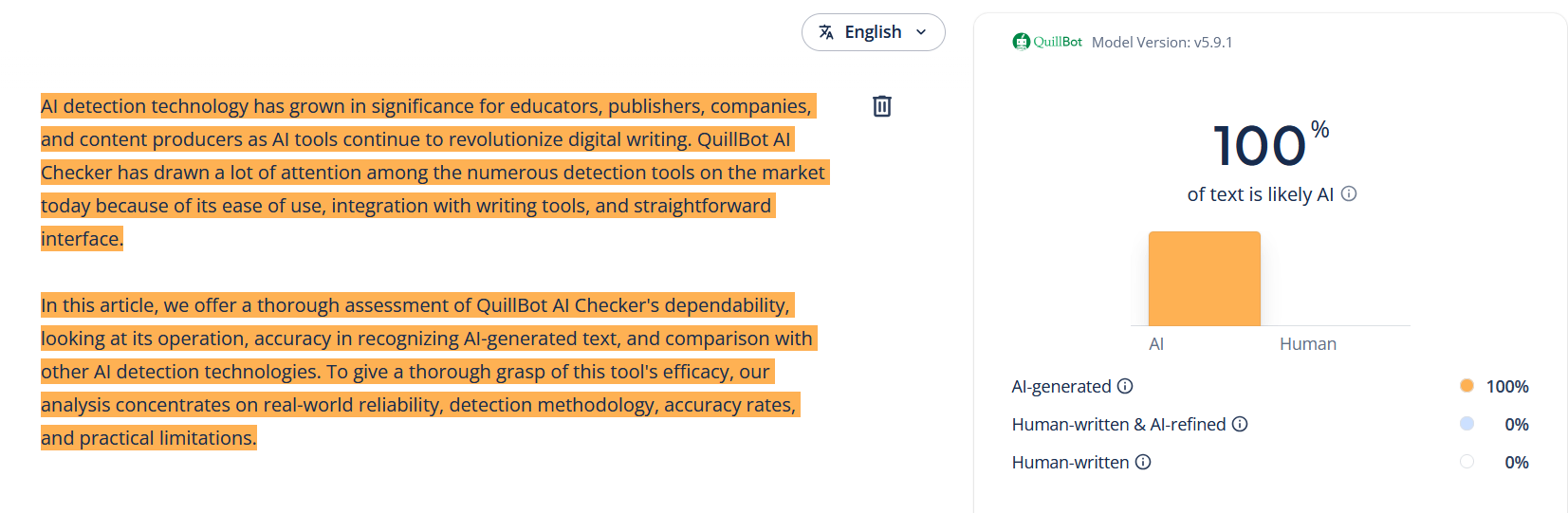
While my QuillBot AI checker review showed impressive results in terms of accuracy, I would recommend that students reading this article rely on a more effective AI detection remover when they want to rewrite some sections of their assignments.
More importantly, students should not assume that running AI output through a paraphraser or humanizer creates undetectable work. It doesn’t. Not here, and almost certainly not with Turnitin.
Pros and Cons of QuillBot’s Checker
Based on the testing stages of my QuillBot AI content detector accuracy review, here is a breakdown of the tool’s strengths and weaknesses:
Pros:
- 100% free to use with no account required for basic checks
- Highlights specific flagged sentences
- Results return in seconds
- Accurately detects unedited AI output with high confidence
- Clean interface that requires no technical knowledge
Cons:
- High risk of false positives for ESL writers and formulaic academic writing styles
- No detailed analytical report
- Not trained on academic papers specifically, and lacks institutional-grade accuracy
Is the QuillBot AI Checker Free?
Yes, the tool is currently free to use. However, there are functional limits, such as only allowing 1,200 words per scan. For a short essay, this is enough, but for a thesis chapter or a long-form literature review, you will have to scan your work in sections.
QuillBot’s premium plan offers higher limits, bundled with the paraphraser and other writing tools. But for most students using the AI checker as a quick sanity check for their academic research writing, the free tier is more than enough.
QuillBot vs. Turnitin: Which Is Stricter?
I’ll give you the honest answer right away: Turnitin is in a different category entirely, and you shouldn’t confuse these two tools.
You’ve already seen in this QuillBot AI content detector review that it’s a general-purpose language model analyzer. It has no access to a database of previously submitted academic work and no memory of papers submitted by students at your university last semester.
Turnitin is an institutional-grade tool with access to a vast database of student submissions and academic sources. It is also under significantly more scrutiny: universities pay for it, and the results carry real academic consequences.
Here’s my critical warning once again: Passing QuillBot’s AI checker does NOT guarantee that you will pass Turnitin. Do not treat a clean QuillBot result as a green light for submission. Use QuillBot as an early warning system.
Why False Positives Happen (And How to Fix Them)
False positives are the aspect of AI detection that keeps me most skeptical about overreliance on these tools. A false positive occurs when the detector flags human-written content as AI-generated. Therefore, when an instructor takes this result at face value, those students who wrote everything from scratch by themselves get frustrated.
This usually happens if you use a lot of passive voice, your sentence starters are repetitive, or every sentence is more or less the same length. In addition, if you’ve been trained to write in a tight academic register, your prose may mimic AI-like patterns.
To fix this, vary your sentence lengths and let paragraphs breathe with brief observations before returning to your argument. When it comes to research comprehension, these are good writing practices anyway, but they also signal the kind of human irregularities that AI detectors look for.
A Safer Way to Write Academic Papers
After running all these tests, one conclusion I keep returning to is this: the most reliable way to avoid AI detection flags is to write a paper that is evidently yours, with specific arguments and analytical choices that reflect your thinking.
When a paper cites peer-reviewed studies and builds an argument around real data, it reads differently to a human reader as well as to detection algorithms. This is where academic AI tools like Textero.io provide a research infrastructure that can guide you through the process. Textero helps students find academic sources quickly and build their writing around verifiable evidence that generic AI content simply cannot replicate.
Final Verdict: Should You Use It?
Is QuillBot AI Detector accurate, and should you rely on it? Yes, as it’s useful and free, and its ability to flag unedited AI output is genuinely reliable. But I suggest you don’t treat it as absolute proof of academic integrity or a definitive shield against more rigorous institutional tools like Turnitin.



 Built-in AI detector