

Earning a good reputation is not an easy thing to do, especially when you create content for others and have no right to make a mistake. I know what it feels like to share a statistic that later turns out to be completely made up.
Early in my career, when I had a little idea of what criteria for evaluating sources existed, I confidently cited an article showing that people only remember 10% of what they read. Even though we already know that it’s untrue, it still circulates in productivity blogs and marketing decks to this day.
It was embarrassing, and it taught me something I now consider a core professional skill: knowing how to check whether a source is actually trustworthy before you build anything on top of it.
This skill is crucial in the era of information overload that we live in, when Google returns millions of results in under a second and AI tools confidently present fabricated citations. It’s terrifying that anyone with a website can publish anything they want and dress it up to look authoritative.
Therefore, let me walk you through exactly how to tell if a source is credible before you trust it. I’m sure that these tools will help you cut through the noise and build on solid ground.
Why You Should Never Trust a Source at First Glance
The very first thing you should know is that a source can look credible without being credible. Professional-looking design is not a signal of quality, and neither is the fact that something appears at the top of a search engine results page. I’ll tell you later which information verification techniques I rely on in my work.
The worst part is that the consequences of getting this wrong can be dreadful. In academic writing, a weak or fabricated source can undermine your entire argument and cost you marks. Similarly, when it comes to professional work, a bad data point can influence a decision that costs a company real money.
The 5 Questions You Should Always Ask About Any Source
Whenever I’m evaluating a new tool or a research paper, I use a core framework of five questions that give me a clear picture of how to find credible sources.
#1 Who is behind this information?
Before you read a single sentence of the content, you want to know two things: who wrote this, and what makes a source credible?
For academic papers, start by assessing author authority as well as their publication history. Your goal is to find out whether they are a professor at a research university or have published on this topic before in peer-reviewed venues. For websites, look for an About page and author bios.
- Practical tip: Search the author’s name alongside their claimed credentials because you should never trust credentials that can’t be verified.
#2 Where did this data come from?
To learn how to identify credible sources, you should know that trustworthy information doesn’t exist in a vacuum, and it should point back to where it originated. It is surprisingly common for secondary sources to misrepresent the studies they claim to be referencing, either because the author was careless or because they deliberately distorted the findings.
- Practical tip: Use our AI Reference Finder Tool to cross-reference the data. If a claim is central to an argument you’re building, find the primary source in government databases, academic journals, and official organizational reports.
#3 When was it published, and does it still matter?
If you’re writing a paper on AI capabilities and relying on information from 2018, by modern standards, it’s basically ancient history. However, if you’re researching the French Revolution, a source from 1950 might still be highly relevant. When checking sources for credibility, the question isn’t just about when something was written, but whether the age of this information affects its relevance to your question.
- Practical tip: Always check the Last Updated or Published date. If you’re writing about a fast-moving field, try to keep your sources within the last 3–5 years.
#4 What’s the hidden agenda?
Everyone has a perspective, but there’s a difference between a perspective and a hidden agenda. For instance, sponsored content often disguises itself as helpful advice. So, how do you know if a source is reliable? By evaluating its objectivity.
- Practical tip: Check who owns or financially supports the publication or organization behind the content and try to notice whether a piece presents counter-evidence or only one side of a debate.
#5 Can you find the same info somewhere else?
Truth is rarely a secret held by only one person, especially when talking about trusted academic resources. Therefore, if a claim is true, other experts in the field will likely be saying similar things. If you find a striking claim that only appears in one place or whose secondary sources all trace back to the same single source, treat it with skepticism.
- Practical tip: Try to find at least three independent, reputable sources that corroborate the main claim of your primary source.
A Quick Credibility Test You Can Use in 30 Seconds
If you don’t have an hour to go down a research rabbit hole, run through these five source evaluation methods and note where you land. Three or more red flags should make you reconsider relying on the source at all.
| Question | Yes | No |
| Is the author an expert or a reputable organization? | Trustworthy | Red Flag |
| Is the site a reputable domain (e.g., .edu, .gov, .org)? | Trustworthy | Red Flag |
| Is there a clear publication or update date? | Trustworthy | Red Flag |
| Does it cite its sources? | Trustworthy | Red Flag |
| Does the tone remain objective and neutral? | Trustworthy | Red Flag |
How to Double-Check Information Without Wasting Hours
Here are my practical tips on how to get the best data without spending all day on it, because time is the most valuable resource we all have.
Compare 2–3 sources, not just one
When I’m testing a new AI writing feature for Textero, I check industry reports and competitor benchmarks. For your essays, open three tabs: one for your primary source, one for a counter-argument, and one for a neutral encyclopedia or database entry. What makes a source reliable? If all these three agree, you’re on firmer ground.
Use academic and trusted platforms
I’ve said a lot about recognizing unreliable sources in this article, so here are a few words on identifying trustworthy options. Platforms such as Google Scholar, JSTOR, and PubMed filter out the noise and prioritize peer-reviewed work.
For data and statistics, government databases (like the U.S. Census Bureau, the World Bank, or Eurostat) are usually the resources you should go to. For current events, wire services like Reuters and AP provide relatively neutral journalism. Look for the best AI for literature review tools, which can be your powerful assistants when you need to organize your sources and boost the process of verifying online sources.
Follow the reference trail
If you find a great article, scroll to the bottom and look at their bibliography to find great examples of credible sources there. Those references are a goldmine for more credible sources. You can then use a free Citation Generator to format your list of sources properly.
Real Examples: Spot the Reliable Source vs the Sketchy One
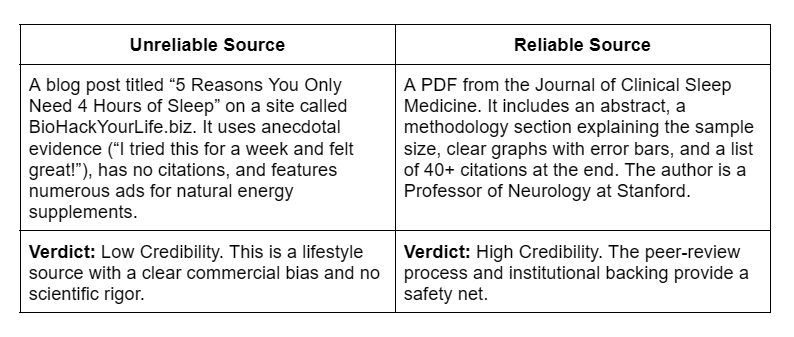
Theory is helpful, but let’s look at these hypothetical scenarios to practice determining what is a reputable source.
Can AI Help You Check a Source’s Credibility Faster?
Now that I’ve established what makes a source trustworthy, let me admit the obvious thing: manual verification is exhausting. That’s why I believe that AI provides the most value for students and researchers, as you can use it to speed up the vetting process.
If you compare AI and manual verification, you’ll see that manual research involves clicking through dozens of tabs. At the same time, AI can act as a high-speed assistant when it comes to determining the reliability of academic sources.
At Textero, we’ve built effective academic research tools to solve the information overload problem. What sets our platform apart is that it can summarize academic sources, help you find relevant literature across topics, and flag credibility signals as you’re building the foundation of your research. It’s the kind of tool that complements the five-question framework and helps you get to the moment of judgment faster.
FAQ
How can you quickly check if a source is credible?
Whenever you are unsure how to check if a source is credible, look at the author’s credentials and see if the site ends in .gov or .edu. If the author is anonymous or the site is full of clickbait ads, stay away.
What are the main signs of an unreliable source?
What is a credible source? It’s the one that doesn’t lack citations, doesn’t consist of overly emotional language, and doesn’t have outdated information.
Is Wikipedia a trustworthy source?
Wikipedia is a great starting point for source validity assessment, but you should never cite it as a final authority in an academic paper because anyone can edit it.
How do you identify bias in a source?
Whenever you are evaluating media credibility, look for one-sided presentation of evidence, politically charged language, undisclosed funding, and publication in outlets with known partisan orientations.
What tools can help verify the credibility of a source?
Hopefully, the information you’ve just read has answered the question of how to know if an article is credible. Use platforms like Google Scholar for finding the papers, FactCheck.org for news, and Textero for summarizing and organizing your academic research efficiently.

 Built-in AI detector