



You’ve definitely experienced that pleasant feeling of relief when you’ve finally outlined your arguments and poured your thoughts onto the page. Everything looks great except the fact that you are still 300 words short of the requirement.
The anxiety you feel makes you think back on how to make your essay longer by changing words or all the possible ways of stating the same idea in three different ways. You can also go for longer sentences with extra clauses or drop in a stray quote at the end of a paragraph. Even though these strategies will help you increase the word count, the quality of your piece will decrease.
We’ve all been there, trying to pad the draft with fluff, digging through a thesaurus to find the longest possible synonyms. However, padding dilutes your argument and signals to the reader that you’ve run out of things to say.
But don’t worry, as there are smarter ways to extend an essay that actually make your piece better rather than just longer. These are techniques you can apply right now, whether you are still drafting or already in the editing phase.
Why Making an Essay Longer the Wrong Way Can Hurt Your Grade
Before getting into what works, it helps to understand what doesn’t. Here are the common padding habits you should avoid when choosing how to write longer essays:
- Vague sentences: Using more words to say less.
- Empty phrases: “It is important to note that…”
- Repetition: Circling back to the same thesis without adding new evidence.
- Off-topic tangents: Bringing up details that don’t support your claim.
Here is a simple example. Compare these two versions of the same sentence:
| Padded version | Better version |
| Due to the fact that there are a wide variety of different factors that can potentially have an impact on the situation, it is not always easy to come to a clear and definitive conclusion about the matter. | Because so many factors influence the outcome, drawing a clear conclusion is difficult. |
It’s easy to see that adding filler words makes you sound like you are stretching. And to make essay longer with words the right way, you need to deepen your analysis.
The Best Way to Make an Essay Longer: Add Depth, Not Fluff
The core philosophy of a high-scoring essay is that it should feel full, not stretched. Think of your piece like a balloon. If you just blow air into it (fluff), it becomes thin and fragile, but if you fill it with substance, it becomes solid.
The goal is to take ideas that are already present and develop them more fully, add relevant examples, and explain connections the reader might not immediately see on their own.
7 Smart Ways to Make Your Essay Longer Naturally
Now, let’s explore seven concrete strategies you can use to lengthen an essay without disappointing your professors.
#1 Add further explanation after each main point
One of the most common reasons essays run short is that the writer states a point and then moves on before fully developing it. A paragraph that ends right after making a claim leaves the reader doing too much work on their own.
Here are three key questions to ask yourself after each main point:
- Why does this matter?
- How does it connect to my thesis?
- What does it actually mean in context?
Even one or two sentences answering those questions can help you develop body paragraphs without leaving your readers wondering what you really meant to say. And if you want to make this process even faster, you can use our AI Paragraph Expander that will generate numerous ideas for you in a matter of seconds.
#2 Use relevant examples to support your ideas
Whenever you’re wondering how to add more words to an essay, take a look at the examples you’ve used, as they serve a dual purpose: they add length and make your writing more convincing.
To support your main points, make sure to keep examples concise and clearly tied to your point. You can check whether you have managed to add more detail naturally to your piece by asking yourself whether the reader can now understand your argument better than they did before.
#3 Develop body paragraphs more fully
A complete body paragraph usually needs four things:
- A clear topic sentence that states what the paragraph is about
- Evidence or reasoning that supports the claim
- An explanation of why that evidence matters
- A brief closing thought that connects back to the thesis.
Many student essays skip the third and fourth steps entirely. After you strengthen topic sentences, go back to each body paragraph and check whether you need to clarify your evidence instead of simply presenting it.
#4 Expand your analysis instead of repeating yourself
When you want to expand your argument, there is an important difference between repeating an idea and analyzing it more deeply.
For instance, if you provide a quote from a primary source, break it down and analyze the tone or the historical context of the speaker instead of simply summarizing what the quote said.
Every time you catch yourself restating something you have already mentioned, treat it as a signal to push further into analysis. Our Essay Expander may come in handy when you want to go deeper into your key points.
#5 Add context where the reader needs it
Sometimes, you write as if the reader is inside your head. Therefore, make sure to provide contextual details, such as a brief definition of a key term or a sentence or two of historical or social background. You can also use stronger transitions, especially when introducing complex ideas.
You might be surprised by how even two or three sentences of background can help the reader follow your argument more easily. And, of course, it is one of the many effective essay hacks to make it longer as well.
#6 Strengthen the introduction and conclusion
In the introduction, add one or two sentences that establish why the topic matters or what the current debate around it looks like. To expand your conclusion, go beyond summary and reflect on the broader aspects of your argument or suggest what further questions your essay raises.
#7 Use better transitions between ideas
When you are looking for words to replace to make essay longer, analyze the transitions you’ve used. Strong transitions show the reader how ideas relate to each other and why the argument moves in the direction it does.
| Weak transition | Strong transition |
| Another point is… | This connects to a broader pattern in which…Building on this idea, it is worth considering… |
| Also,… | Beyond the points discussed previously… |
These transitions improve essay structure and do real work by guiding the reader through your logic. This approach is rather helpful when you want to learn how to write an analytical essay because you can explain your ideas clearly, and readers can follow your train of thought.
A Quick Checklist to Extend Your Essay Without Adding Filler
Use this checklist when you need to add words to make your essay longer:
- Did I explain the significance of every main point instead of just stating it?
- Did I add at least one relevant example wherever the argument needed support?
- Did I fully explain my evidence rather than just presenting it?
- Does each body paragraph have a topic sentence, evidence, an explanation, and a closing thought?
- Did I deepen my analysis rather than restate the same ideas?
- Did I add helpful context at the start of new sections or around complex ideas?
- Are my introduction and conclusion as complete as they could be?
- Did I use transitions that show how the ideas connect?
What to Avoid If You Need More Words Fast
No matter how tempting it is to reach for shortcuts when deadlines are too short, avoid these strategies and phrases to make your essay longer:
- Repeating the same idea
- Using overly long phrases
- Adding unrelated examples or tangents
- Rewriting obvious points the reader already understands
- Inserting long block quotes without sufficient explanation
Each of these habits adds words but don’t add context to your claims.
Before-and-After Examples: Forced Writing vs Natural Expansion
Let’s look at a specific example showing a thin paragraph transformed through natural expansion:
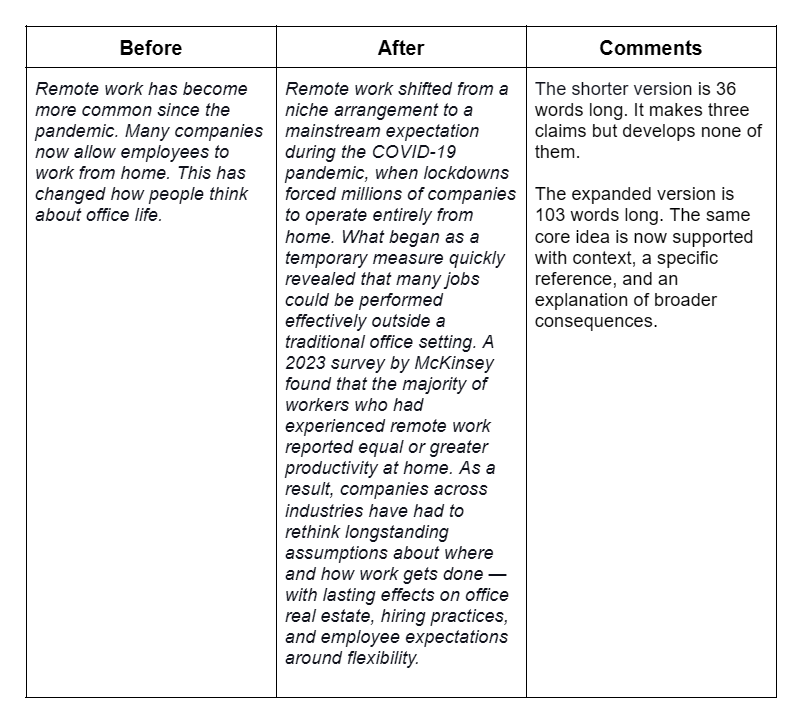
Notice that the expanded version does not repeat the opening claim. Instead, it builds on it by adding historical context, a concrete reference, and an analysis of its real-world implications. Therefore, using this approach is a great way to make your writing more detailed and engaging.
How to Make an Essay Longer During Editing
Just like many other students, you might be looking for words to use to make your essay longer during the editing phase. When you review your finished draft, pay close attention to the last third of the essay, where you usually get tired and start summarizing rather than analyzing.
- Identify short paragraphs. Any paragraph under 100 words is a candidate for expansion.
- Ask “So what?” Read your conclusion for each paragraph. If you can’t find an answer to this question, add a sentence of analysis.
- Check your roadmap. If you mention an idea in the intro that you didn’t fully explore in the body, go back and give that idea its own paragraph.
How Textero.io Can Help You Make Your Essay Longer Without Adding Fluff
Expanding an essay manually takes time and requires you to know exactly how to fill the existing gaps. That process can feel especially nerve-wracking when you are working under deadline-related pressure and need to do everything quickly.
This is where Textero can make a real difference. Rather than adding generic filler or restating your existing ideas, it helps you improve paragraph development. Our tool works with what you have already written and helps you develop it further by adding relevant supporting ideas and making your paragraphs feel more complete.
In practical terms, Textero can help you:
- Expand short paragraphs by adding more explanation or analysis
- Add supporting ideas that are relevant to your argument
- Improve the structure of your essay
- Make your writing more detailed
By using a tool designed for academic workflows, you can ensure that the 300 words you add to your essay make it a more persuasive and comprehensive piece of work.






 Built-in AI detector