


 Article fact-checked
-
AI adoption has become widespread globally, with 88% of companies using or exploring AI in 2025, up from just 20% in 2017, marking a 68-percentage-point increase over eight years.
-
Enterprise AI maturity remains limited, as only 7% of organizations have fully scaled AI, while 63% are still piloting or scaling, and 32% remain in experimentation phases.AI usage is concentrated in digitally mature functions, led by IT and Marketing & Sales (36% each), while operational and regulated areas such as Manufacturing and Strategy & Corporate Finance remain at 12%.
-
Workflow-level AI adoption prioritizes efficiency, with 53% using AI to improve production processes, 52% for SEO tasks, and 51% for process automation, compared with 29% for writing website copy.
-
Generative AI adoption is accelerating faster than overall AI, rising from 33% of companies in 2023 to 79% in 2025, a 46-percentage-point increase in two years.
-
Regional AI adoption gaps are narrowing, as the global average climbed from 55% in 2023 to 78% in 2024, with North America leading at 82% and Europe close behind at 80%.
-
Country-level maturity varies sharply, with India (59%), UAE (58%), and Singapore (53%) leading in deployed AI, while economies such as Spain and Australia show higher exploration than deployment.
-
AI market growth mirrors adoption trends, as the global AI market expanded from $93.27 billion in 2020 to $233.46 billion in 2024, and is projected to reach $826.73 billion by 2030, while the GenAI market alone is expected to hit $207.0 billion
Artificial intelligence has moved from experimental technology to a core business capability in less than a decade. Yet a simple question still dominates executive conversations and industry research: what percentage of companies use AI today, and how deeply is it actually embedded in business operations?
This article breaks down the latest AI adoption statistics using global, regional, industry, and company-level data. Rather than treating AI adoption as a binary yes-or-no metric, the analysis examines how companies progress from exploration to deployment, where AI usage is most concentrated, and which business functions and industries are leading the shift.
Using time-series data, regional comparisons, and market growth figures, the charts below show how AI adoption has evolved, how many companies use AI worldwide, and why AI has rapidly become mainstream across global businesses. Together, these insights provide a clear, data-backed picture of where AI stands today, and where enterprise adoption is heading next.
While overall interest in artificial intelligence has accelerated in recent years, the data below shows how this momentum translated into measurable company-level adoption over time.
AI adoption over time: Share of global companies using or exploring AI
The chart illustrates the share of global companies currently using or exploring AI by year, capturing how AI adoption and AI usage have evolved from early experimentation to widespread business implementation. It highlights long-term trends in AI adoption statistics and visualizes the global AI adoption curve across multiple business cycles.
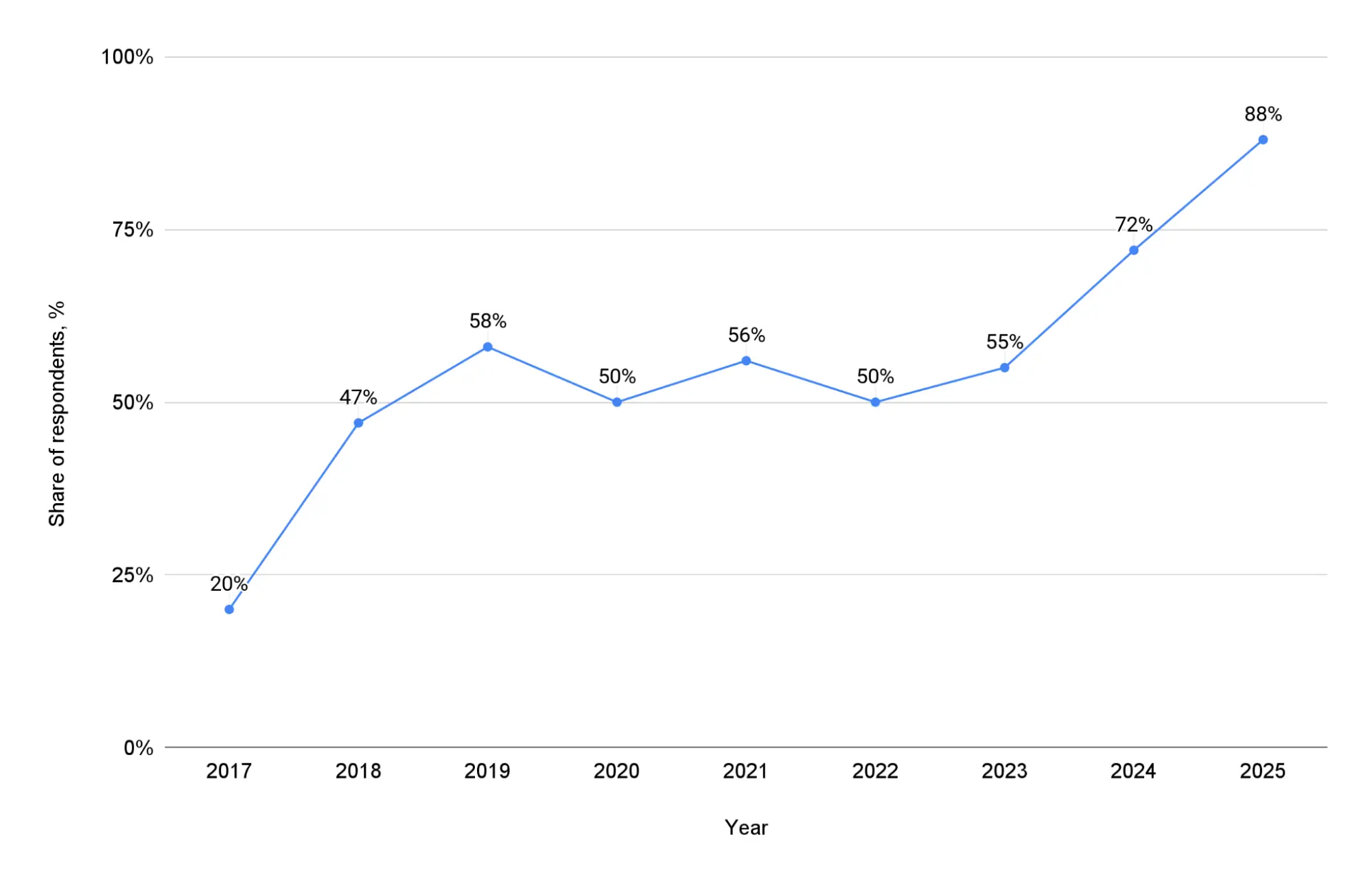
- The percentage of companies using AI increased from 20% in 2017 to 88% in 2025, marking a 68-percentage-point rise over eight years.
- After fluctuating between 50% and 58% from 2019 to 2023, AI usage accelerated sharply, jumping from 55% in 2023 to 72% in 2024.
- By 2025, nearly 9 out of 10 companies are using or exploring AI, marking the steepest phase of the global AI adoption curve.
The AI adoption curve: How many companies are using AI worldwide?
These figures show a shift from gradual experimentation to mainstream AI adoption. The data explains how many companies use AI today and why how many companies are using AI has become a central question for business strategy worldwide. As the percentage of businesses using AI continues to rise, AI is no longer an emerging technology but a core component of modern enterprise operations.
After examining how widespread AI adoption has become globally, the next step is to understand how AI is used in business once organizations decide to adopt it.
Enterprise AI adoption stages: How businesses are using AI
The chart shows the phase of AI use among organizations using AI, breaking down enterprise AI adoption by maturity level. It provides deeper context behind headline AI adoption statistics, illustrating how far companies have progressed in AI implementation in business rather than simply whether they use AI at all.
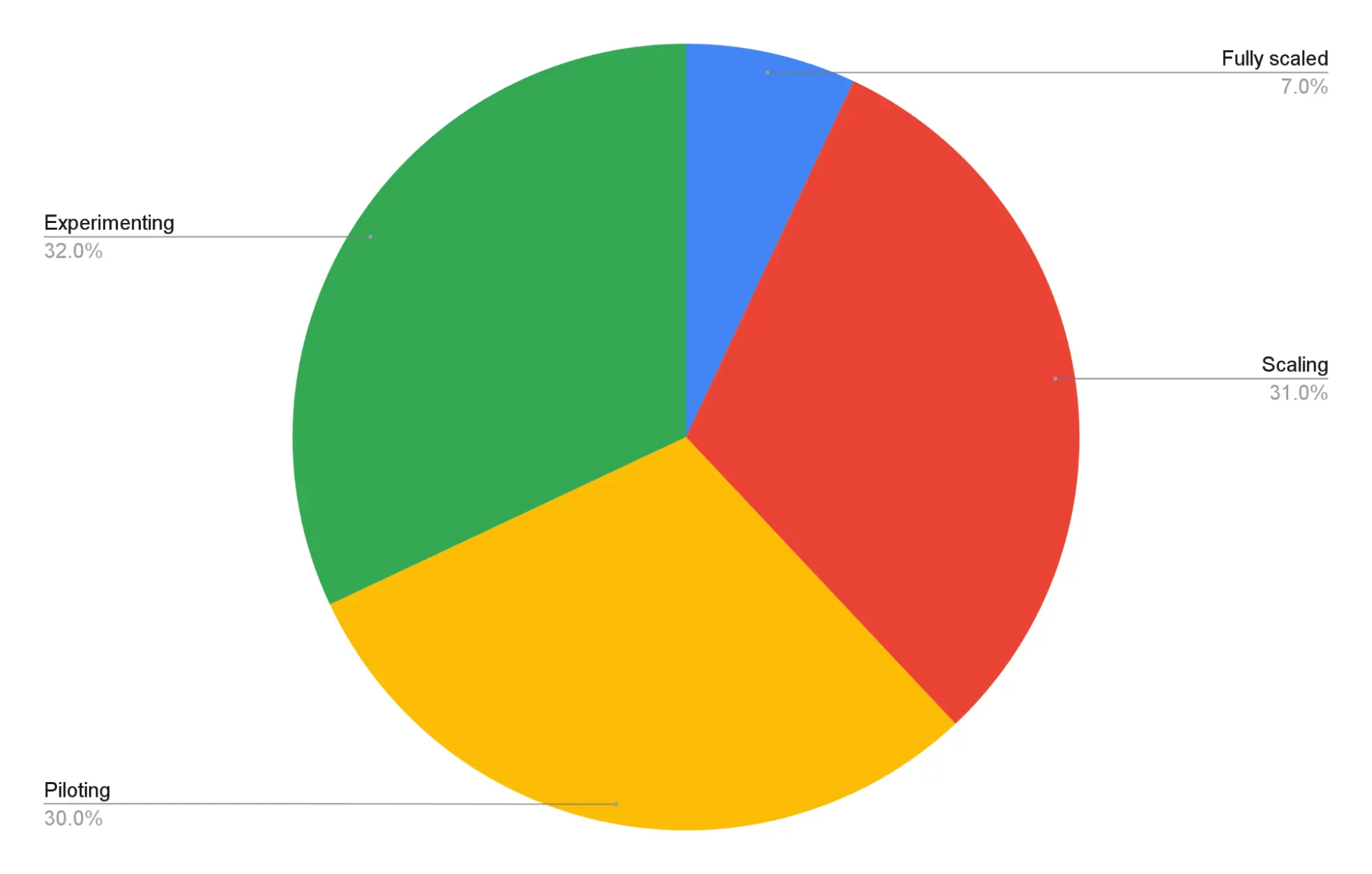
- Only 7% of organizations report AI as fully scaled, indicating that advanced AI implementation in business remains relatively limited.
- A combined 63% of companies are either scaling (31%) or piloting (30%) AI, showing that most AI adoption is still in active development phases.
- With 32% of organizations experimenting, early-stage AI usage remains the most common entry point for enterprise AI
AI implementation in business: Phases of enterprise adoption
These results highlight that enterprise AI adoption is widespread but uneven in maturity. While AI adoption is no longer experimental in principle, the data shows that most organizations are still refining how AI is used in business before reaching full-scale deployment. Overall, current AI adoption statistics suggest that AI value creation is still ahead rather than fully realized for the majority of enterprises.
After reviewing the phases of AI implementation in business, it is important to see which specific business functions are driving everyday AI usage inside organizations.
AI adoption by business function: Where companies use AI most?
The chart presents the most prominent AI adoption by business functions, showing how AI is used in business across core operational and strategic areas. It highlights differences in AI adoption statistics by function, helping explain where enterprise AI adoption is currently most concentrated.
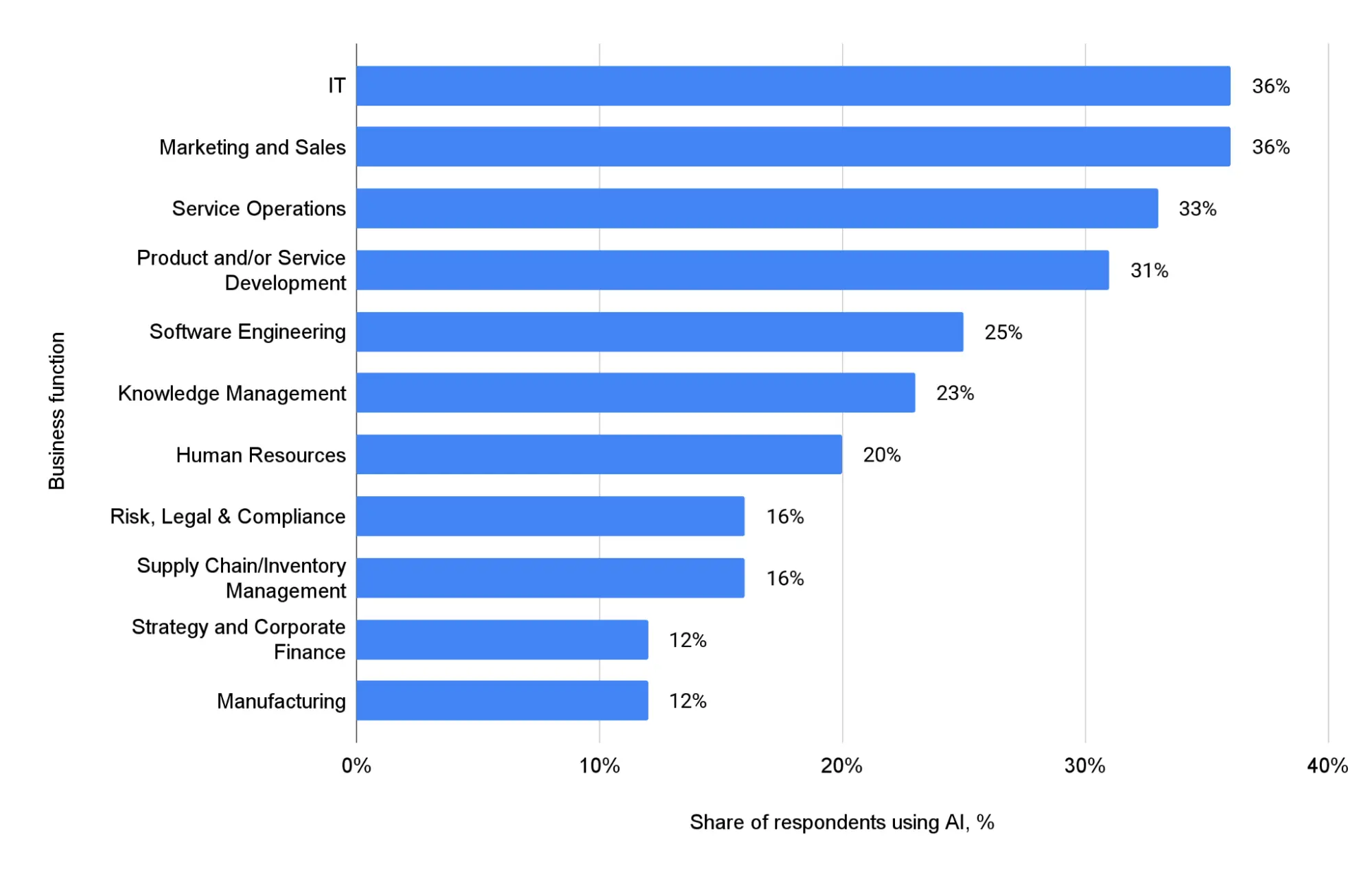
- IT, Marketing, and Sales lead AI adoption, with 36% of respondents using AI in each function.
- Service Operations (33%) and Product and/or Service Development (31%) form the second tier of AI usage, indicating strong adoption in customer-facing and innovation-focused roles.
- More regulated or complex areas, such as Risk, Legal & Compliance, and Supply Chain/Inventory Management, show lower AI adoption at 16%, while Manufacturing and Strategy and Corporate Finance remain at 12%.
How AI is used in business functions across organizations
These figures show that enterprise AI adoption is currently strongest in digitally mature and data-intensive functions. The distribution of AI usage across departments suggests that organizations are prioritizing AI where implementation barriers are lower and returns are faster. Overall, the AI adoption statistics indicate that broader functional expansion is still in progress as companies refine AI implementation in business across the enterprise.
After identifying which business functions lead to AI adoption, the next step is to examine how companies apply AI usage within specific internal processes to improve day-to-day workflows.
AI usage in internal business processes: Workflow improvement by function
The chart shows the percentage of businesses and companies that use AI in different internal processes, highlighting how AI is used in business to optimize operations and productivity. It provides practical insight into AI implementation in business by focusing on workflow-level applications rather than organizational structure.
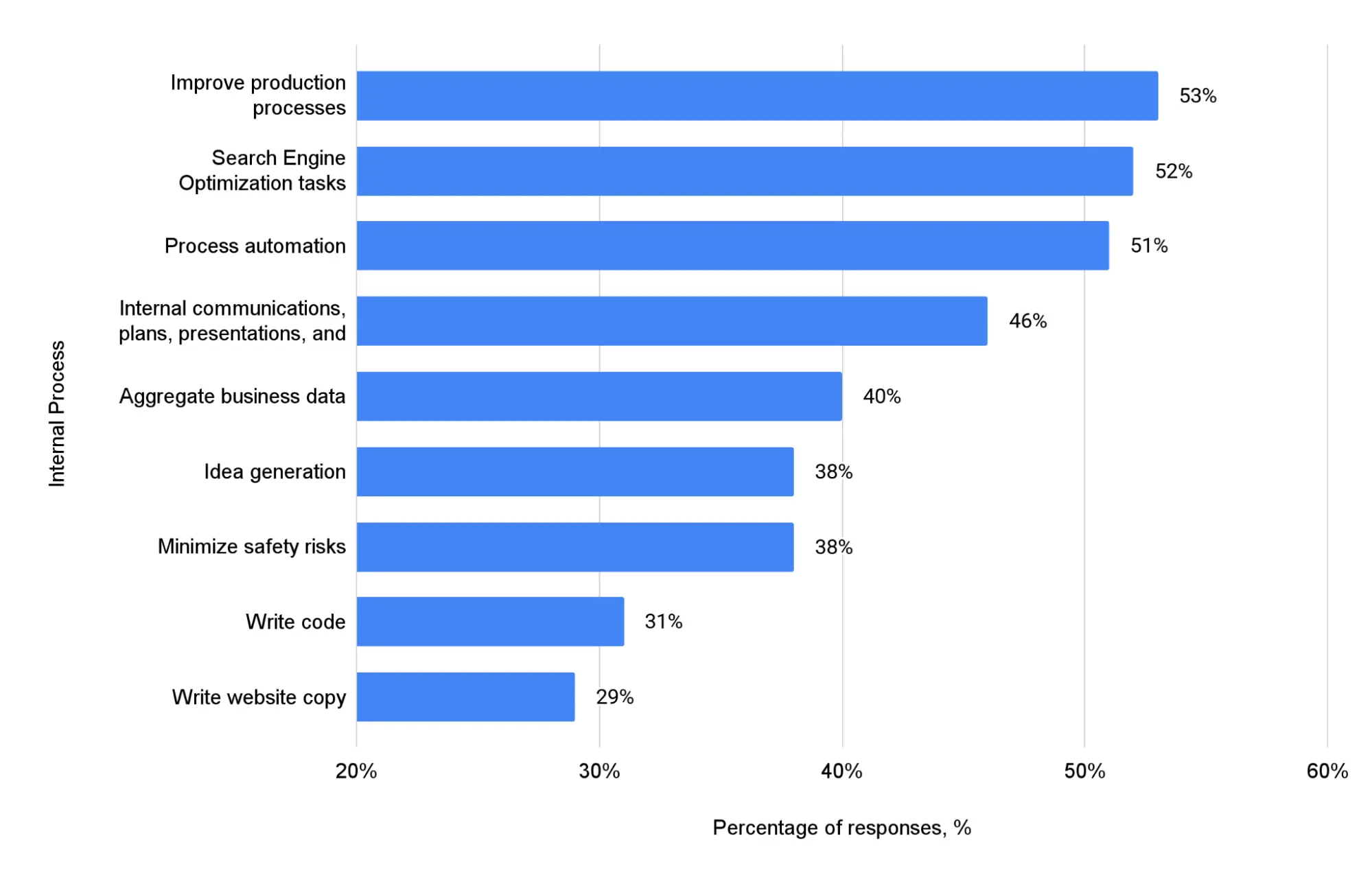
- The most common internal use of AI is to improve production processes, reported by 53% of respondents, making it the leading workflow application of AI usage.
- Search Engine Optimization tasks (52%) and process automation (51%) follow closely, indicating strong AI adoption in efficiency-driven activities.
- Content-related processes such as writing code (31%) and writing website copy (29%) show lower but still significant AI adoption, reflecting more specialized AI implementation in business.
How businesses use AI to improve internal processes
These results show that AI adoption is primarily focused on operational efficiency and workflow optimization. The data explains how AI is used in business today, with companies prioritizing internal processes that deliver immediate productivity gains. Overall, current AI adoption statistics suggest that AI is increasingly embedded in everyday operations rather than limited to experimental or strategic use cases.
After examining how AI is used across internal processes, the focus now shifts to how deeply AI agents are embedded in day-to-day company operations across different functions.
Phases of AI agent usage across company operations
The chart breaks down the phases of AI agents usage in companies’ operations by business function, showing how organizations progress from experimenting to fully scaled deployment. It highlights adoption maturity by function, rather than overall AI usage, offering a clearer view of operational readiness.
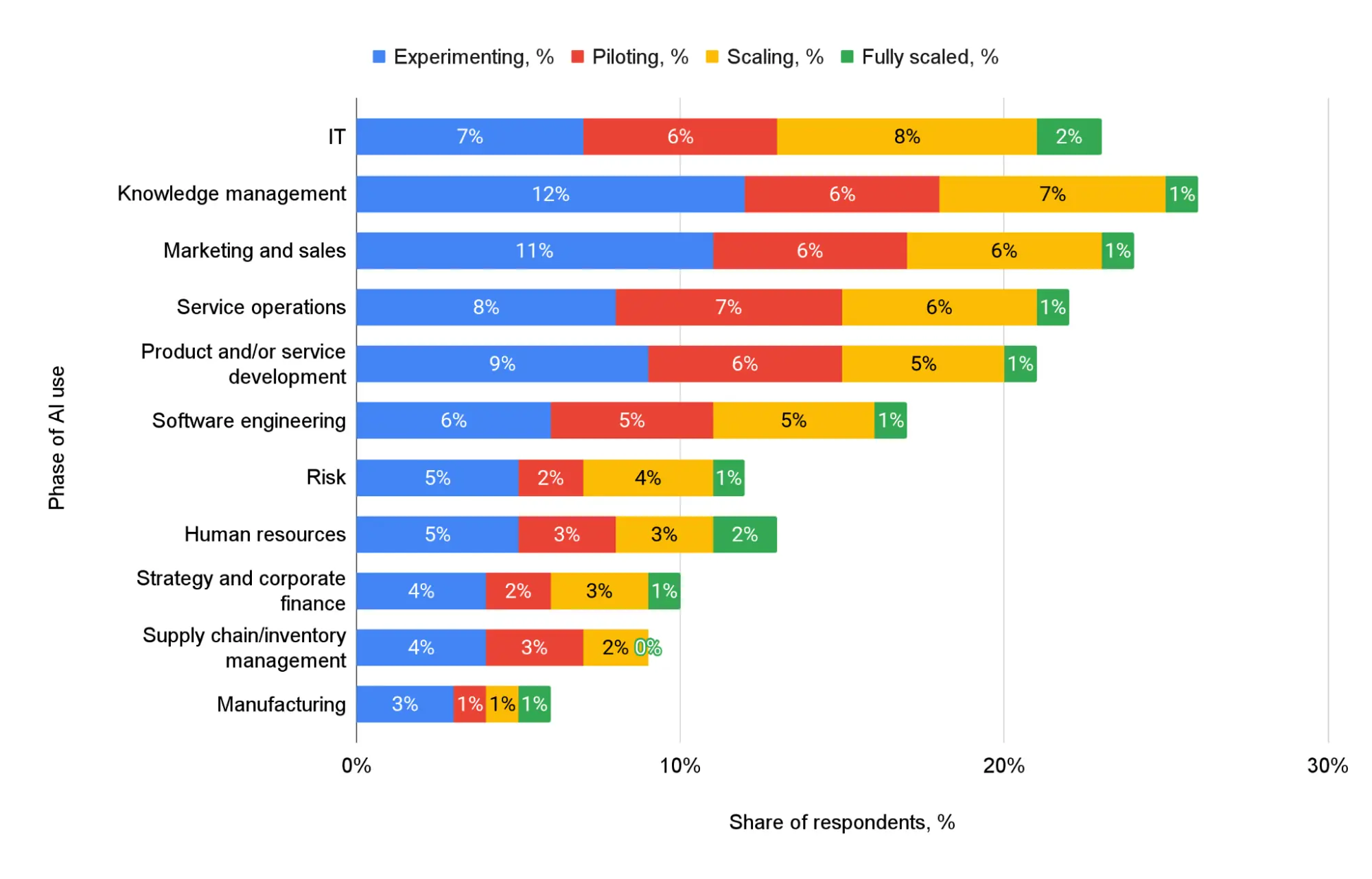
- Across all functions, experimenting is the most common phase, peaking at 12% in knowledge management and 11% in marketing and sales.
- Scaling AI agents remains limited, with the highest shares appearing in IT (8%) and knowledge management (7%).
- Fully scaled AI agent usage is rare, reaching a maximum of just 2% in IT and human resources, while several functions, including supply chain and manufacturing, remain at 0-1%.
How far are AI agents deployed in enterprise operations
The data shows that AI agent adoption is still in an early operational stage across most business functions. While experimentation is widespread, the transition to scaled and fully embedded AI agents remains slow and uneven. Overall, these patterns suggest that companies are still validating AI agent value before committing to large-scale operational deployment.
After analyzing broader AI adoption statistics, the focus now shifts specifically to generative AI adoption and how quickly it is spreading across global companies.
Generative AI adoption over time: Share of companies using or exploring GenAI
The chart shows the share of global companies currently using or exploring GenAI, highlighting recent changes in AI usage related to generative technologies. It provides a clear view of generative AI statistics within the wider context of artificial intelligence statistics.
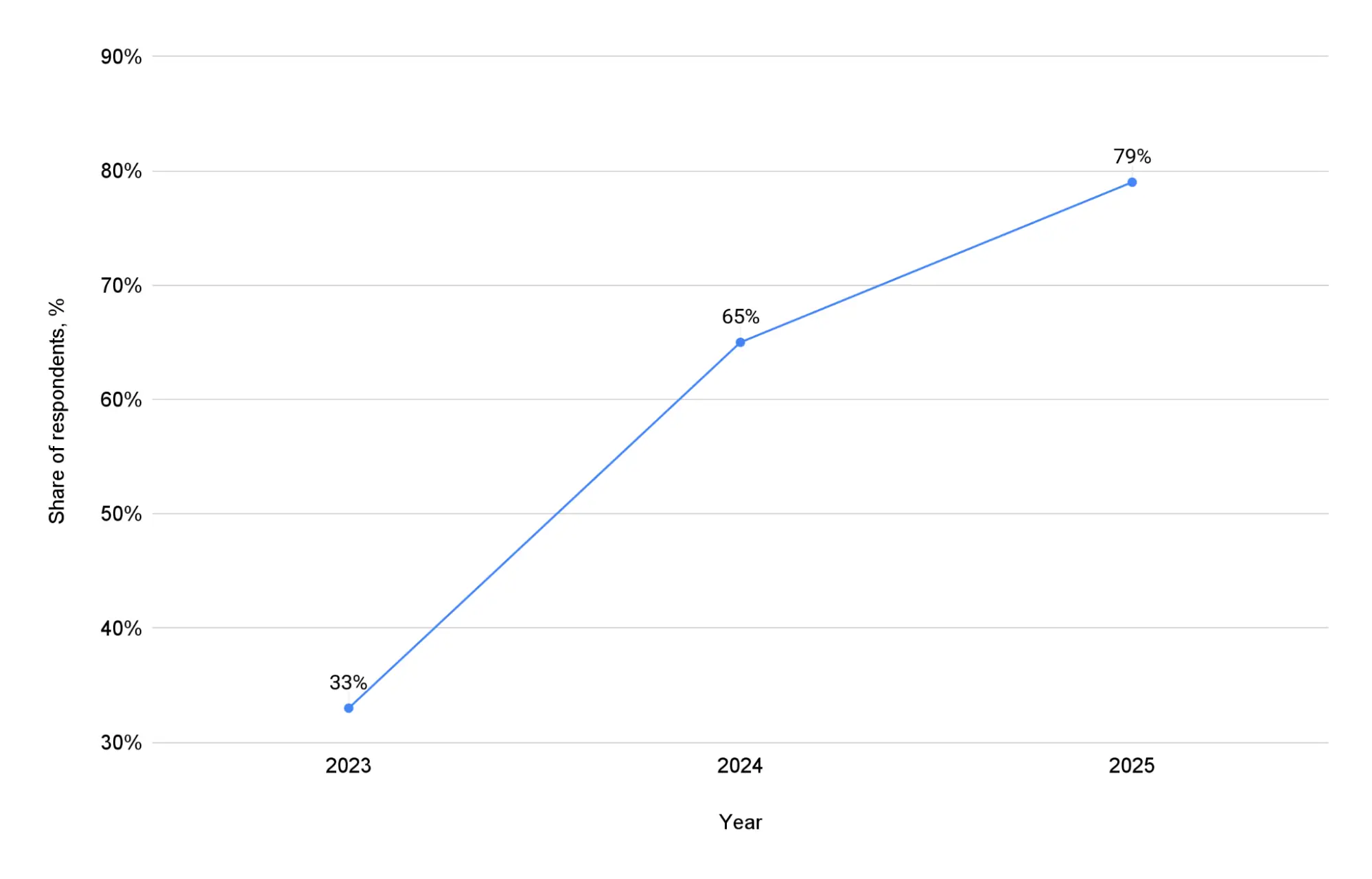
- The share of companies using or exploring GenAI increased from 33% in 2023 to 65% in 2024, representing a 32-percentage-point rise in one year.
- By 2025, 79% of global companies report some level of GenAI usage or exploration, signaling rapid generative AI adoption.
- Over the two years, GenAI adoption grew by 46 percentage points, making it one of the fastest-moving segments in current AI adoption statistics.
The rise of generative AI: Company adoption trends worldwide
These figures show that generative AI adoption is accelerating much faster than earlier waves of enterprise AI. The sharp increase in AI usage reflects how generative tools are quickly moving from experimentation to mainstream business consideration. Overall, the data positions GenAI as a central driver within current AI statistics and broader artificial intelligence statistics worldwide.
After examining how AI is applied inside companies, the next step is to compare AI adoption by industry and identify which sectors are leading overall AI usage.
AI adoption by industry: Current usage rates across sectors
The chart presents the AI adoption rate by industry, showing current AI usage levels across major economic sectors. It provides industry-level context for AI statistics, helping explain how the AI impact on business varies depending on sector characteristics and digital maturity.
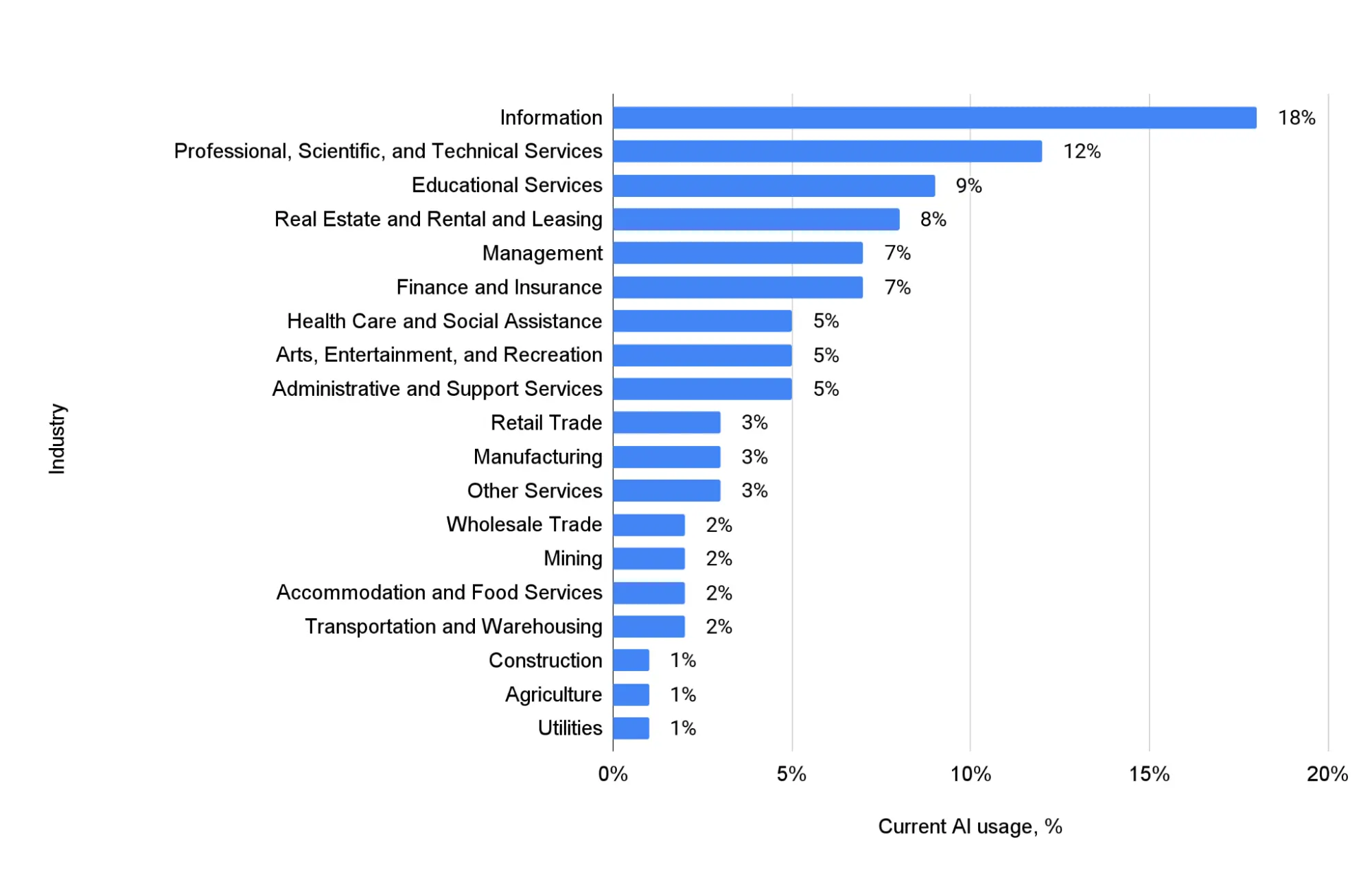
- The Information sector leads AI adoption by industry, with 18% current AI usage, the highest share among all sectors.
- Professional, Scientific, and Technical Services (12%) and Educational Services (9%) form the second tier of AI usage, reflecting stronger adoption in knowledge-intensive industries.
- Adoption remains limited in asset-heavy sectors, with Manufacturing (3%), Construction (1%), and Agriculture (1%) showing the lowest current AI usage rates.
AI use cases by industry: Where adoption is highest today?
These figures show that AI adoption by industry is uneven and closely tied to information intensity and operational flexibility. While some sectors are already integrating AI into core workflows, others remain at an early stage of adoption. Overall, the AI statistics highlight significant room for growth as the AI impact on business continues to expand across traditionally slower-moving industries.
After comparing AI adoption by industry, the analysis now turns to how AI usage differs across regions and among global businesses worldwide.
AI adoption by region: Global usage rates in 2023-2024
The chart shows the AI adoption rate by region, comparing AI usage across major global regions in 2023 and 2024. It adds geographic context to AI adoption statistics and highlights how enterprise AI adoption varies across different markets.
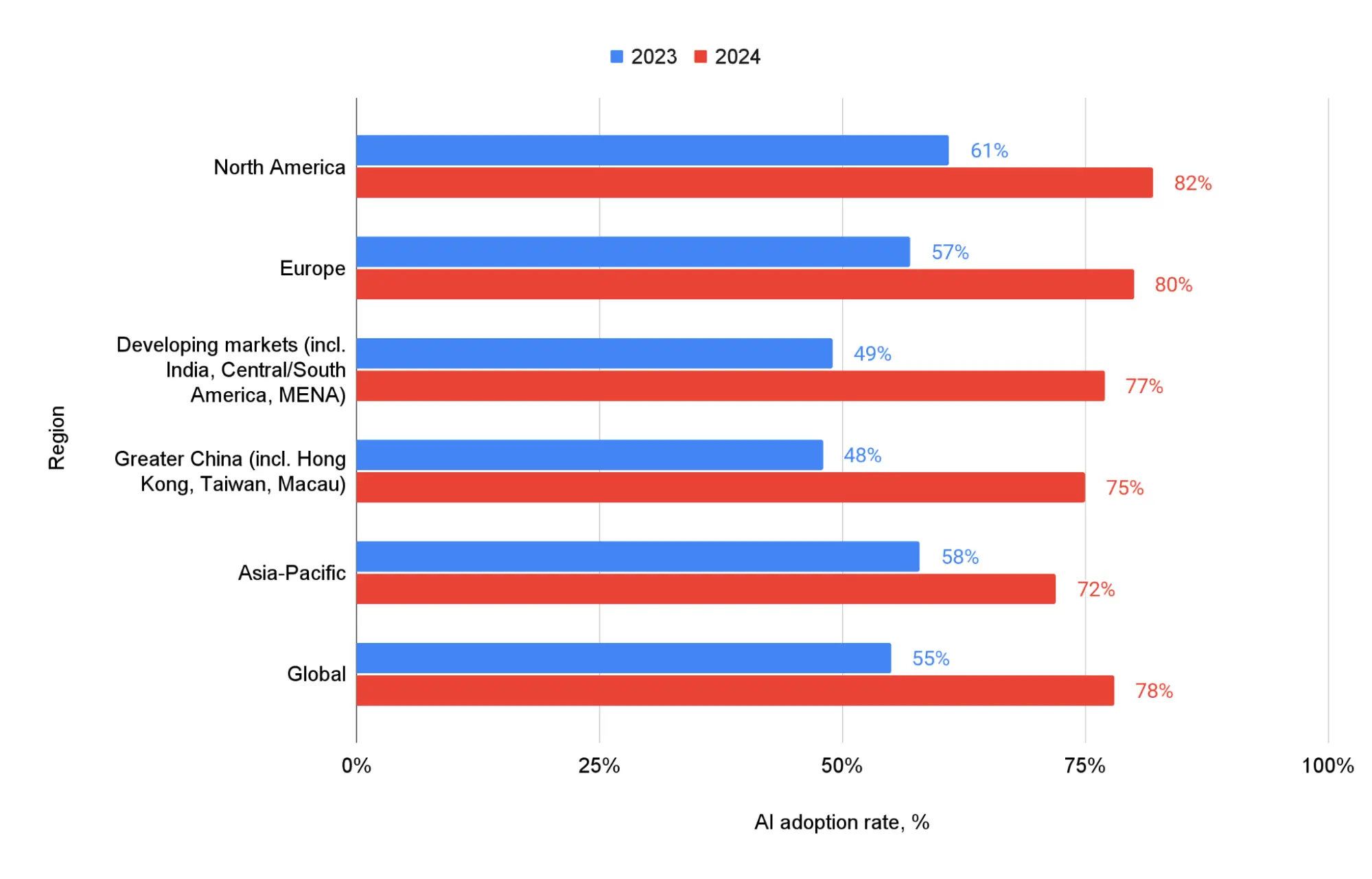
- North America leads regional AI adoption, increasing from 61% in 2023 to 82% in 2024, a 21-percentage-point gain.
- Europe and developing markets both show strong growth, with adoption rising from 57% to 80% in Europe and from 49% to 77% in developing markets.
- The global average climbed from 55% in 2023 to 78% in 2024, underscoring rapid acceleration in worldwide enterprise AI adoption.
Regional AI adoption trends across global businesses
These results show that AI adoption by industry trends is mirrored at the regional level, with strong growth across both mature and emerging markets. The rapid increase in AI usage across regions highlights how AI is becoming a standard capability for global businesses. Overall, the AI statistics indicate that regional gaps are narrowing as enterprise AI adoption expands worldwide.
After comparing regional adoption patterns, the analysis now moves to a country-level view to show how AI deployment and exploration differ across individual markets.
AI adoption and exploration by country
The chart compares AI adoption rates in different countries, separating companies that have deployed AI from those exploring AI. This distinction provides a clearer picture of adoption maturity and highlights where countries stand along the AI implementation path.
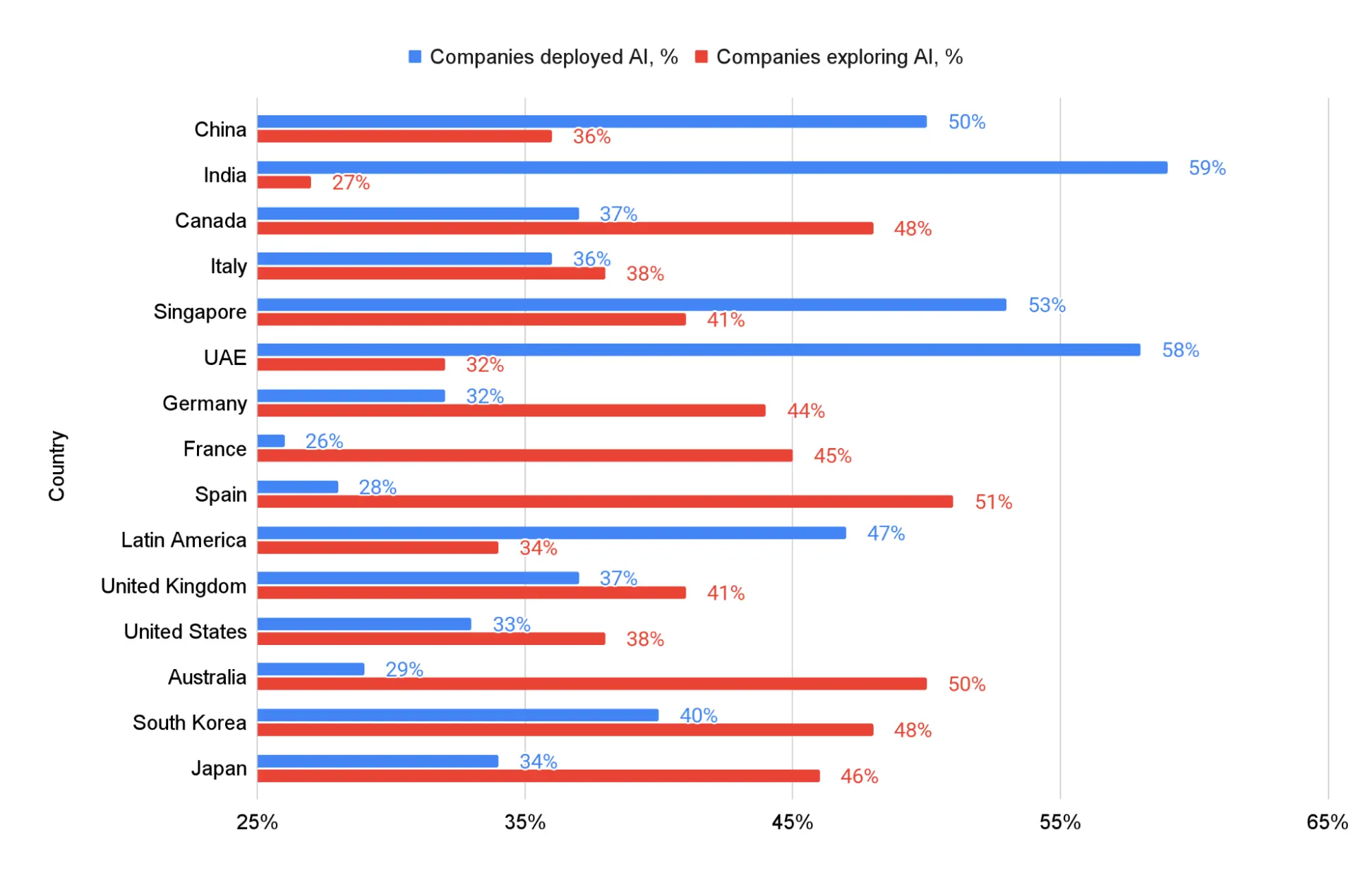
- India (59%), UAE (58%), and Singapore (53%) report the highest shares of companies that have deployed AI, indicating advanced adoption in these markets.
- Several countries show stronger AI exploration than deployment, including Spain (51% exploring vs. 28% deployed) and Australia (50% exploring vs. 29% deployed).
- Large economies such as the United States (33% deployed, 38% exploring) and Germany (32% deployed, 44% exploring) remain more weighted toward exploration than full deployment.
How AI adoption differs across countries
These figures show that AI adoption maturity varies significantly by country. Some markets are already focused on large-scale deployment, while others remain in exploratory phases despite high interest. Overall, the data suggest that national AI adoption paths depend not only on technology readiness but also on regulatory, economic, and organizational factors shaping implementation speed.
After reviewing how AI adoption varies across regions and countries, the focus now shifts to the broader economic impact of AI growth reflected in the expanding global market.
Global AI market size growth: From early adoption to 2030
The chart shows the global AI market size by year, illustrating long-term AI growth and overall market expansion. It places recent AI statistics and artificial intelligence growth statistics into context, helping explain when AI became popular and how this momentum translates into market value.
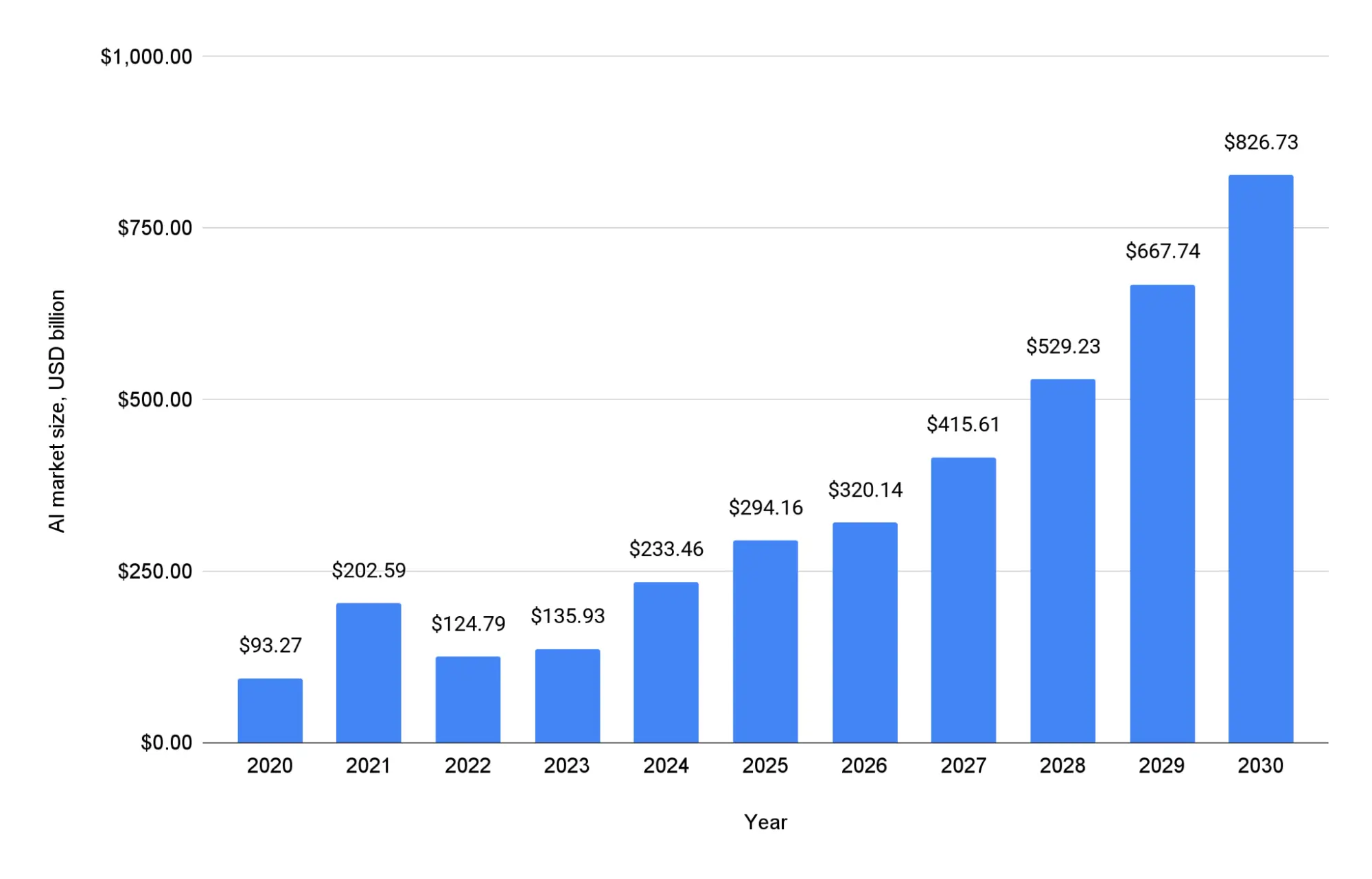
- The global AI market size increased from $93.27 billion in 2020 to $233.46 billion in 2024, more than doubling in four years.
- By 2030, the projected AI market size 2030 reaches $826.73 billion, reflecting sustained long-term AI growth.
- Between 2025 ($294.16 billion) and 2030 ($826.73 billion), the market is expected to grow by over $530 billion, reinforcing a strong AI market forecast trajectory.
AI market size over time: How the global market is expanding
These figures show that AI growth has accelerated rapidly as AI moved from early experimentation into widespread commercial use, helping explain when AI becomes mainstream. The steady rise in AI market size underscores how advances in core AI technologies, including developments reflected in generative AI statistics, are driving sustained investment. Overall, the data confirms that AI has become a major global market with long-term expansion built into current AI market forecast expectations.
After outlining the overall expansion of the AI market, the focus now narrows to the segment driving much of this momentum: the rapid growth of generative AI.
Global generative AI market size growth through 2030
The chart shows the global GenAI market size by year, highlighting how generative AI has evolved from a niche technology into a fast-growing market segment. It illustrates the pace of expansion over the past decade and the scale of projected growth toward 2030.
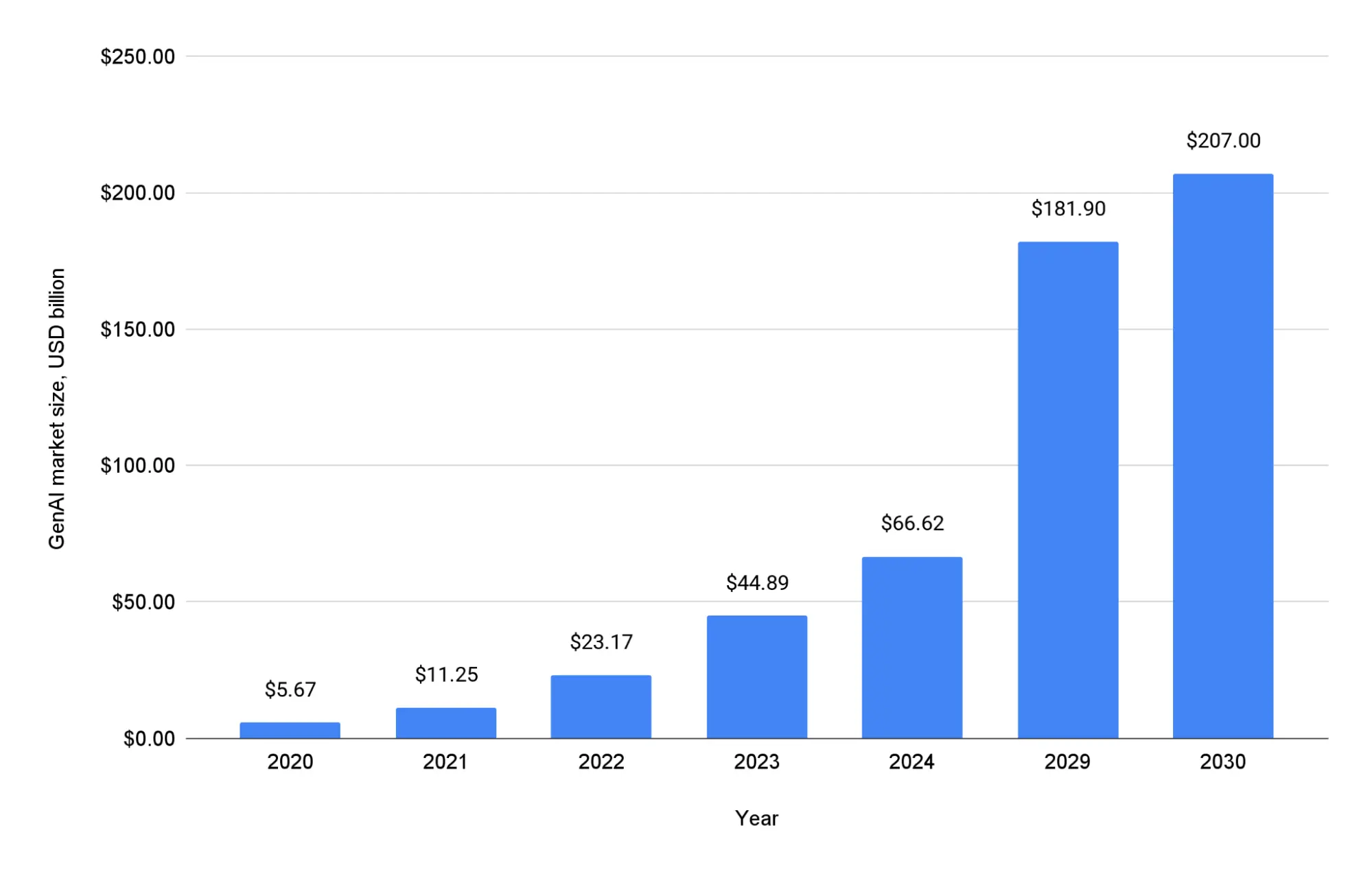
- The global GenAI market grew from $5.67 billion in 2020 to $66.62 billion in 2024, increasing by more than $60 billion in four years.
- Market size nearly doubled between 2022 ($23.17 billion) and 2023 ($44.89 billion), signaling a sharp acceleration phase.
- By 2030, the GenAI market is projected to reach $207.00 billion, more than three times its 2024 size.
How the global GenAI market is expanding over time
These figures show that generative AI is expanding at a significantly faster pace than earlier AI market segments. The steep growth curve reflects rapid commercialization and broadening use across industries. Overall, the data positions GenAI as one of the primary engines of future AI market expansion.
Conclusions
- AI adoption among companies has clearly moved beyond early experimentation and into the mainstream of global business activity. By 2025, 88% of companies are using or exploring AI, up from 20% in 2017, showing that AI is no longer a marginal technology but a standard component of enterprise strategy worldwide.
- At this stage, the defining factor is adoption depth rather than adoption breadth. While AI usage is widespread, maturity remains limited: only 7% of organizations have fully scaled AI, while the majority are still experimenting (32%), piloting (30%), or scaling (31%). This gap highlights that implementation capability, not access to tools, is now the primary constraint.
- Functionally, companies are deploying AI first where returns are fastest, and risks are lower. IT and Marketing & Sales lead adoption at 36%, while internal workflows focus heavily on efficiency gains, such as improving production processes (53%), SEO tasks (52%), and process automation (51%). This pattern shows that AI is being used primarily as a productivity and optimization layer rather than as a disruptive replacement for core business functions.
- Geographically, adoption has accelerated across all regions, but uneven maturity remains evident at the country level. While the global AI adoption rate rose from 55% in 2023 to 78% in 2024, countries such as India (59%), the UAE (58%), and Singapore (53%) lead in deployed AI, whereas several advanced economies remain more weighted toward exploration than full implementation.
- Looking ahead, market dynamics reinforce this trajectory. The global AI market is projected to reach $826.73 billion by 2030, with generative AI alone growing to $207.0 billion, signaling sustained long-term growth. However, the next phase of AI adoption will be shaped less by market size and more by execution maturity—how effectively companies move from experimentation to fully scaled, value-generating AI across operations.
Sources
- Kumar, Naveen. “How Many Companies Use AI In 2026? (Global Data).” DemandSage, 15 Dec. 2025, https://www.demandsage.com/companies-using-ai/. Accessed 28 January 2026.
- SellersCommerce. “How Many Companies Use AI? | SellersCommerce.” SellersCommerce, 16 Dec. 2025, https://www.sellerscommerce.com/blog/how-many-companies-use-ai/. Accessed 28 January 2026.
- The state of AI in 2025: Agents, innovation, and transformation. McKinsey. https://www.mckinsey.com/capabilities/quantumblack/our-insights/the-state-of-ai#/. Accessed 28 January 2026.


 Built-in AI detector