



One of the essential stages of evaluating writing tools is reading thousands of student essays, research papers, and summaries. It’s a big part of my working process, and I often notice writing patterns that students from different parts of the world use.
When it comes to writing a summary, students treat it like a retelling and include almost everything they can in it. They leave in the author’s examples and even their sequence of anecdotes. By the end, all they have is a slightly shorter version of the original, which is not exactly a result that fits the standards of academic writing.
Simply put, a good summary is a form of comprehension. My goal is to become an effective text summarizer that strips away the noise and presents only the core message. By doing so, I’m not just saving my reader time but proving to myself that I actually understood what I read.
That’s why I want to share the 5-step method on how to write a summary I’ve tested many times so that you can write summaries in your own words without losing the logical thread.
What Makes a Good Summary?
Before I walk you through the process, I want to set the target clearly. In my experience, a text summary has three non-negotiable qualities.
It is concise
As a general rule of thumb, a brief summary should be around 10–15% of the length of the original text. However, the question “How long is a summary?” has no specific answer, as it can change based on the complexity of the source, so keep that in mind.
It is strictly objective
No matter what you do, remember that your job is to report what the author said, not how you feel about it. Therefore, your story summary must not contain your personal opinions or external knowledge.
It is written entirely in your own words
Make sure there is no copy-pasting and no near-identical paraphrasing with a few synonyms swapped in. You must understand the idea well enough to explain it using your own words.
I refer back to these three criteria throughout the process every time I revise, and I suggest you do the same.
How to Write a Summary in 5 Simple Steps
Whenever you find yourself staring at a blank page, use this predictable workflow to get all the answers you need on how to write a professional summary.
Step 1: Read the entire text first
When I sit down with a new text, I read it all the way through once without stopping to highlight or take notes. After I finish, I give myself 30 seconds to describe the main idea of the text using only one sentence. If I can’t do it, I read it again. This test has saved me from using a summary writing format that misses the point entirely.
Step 2: Break the text into logical chunks
Next, I divide the material into its natural sections. After that, I write a short note (single-sentence heading) for each section in the margin or in a separate document and use them as the skeleton for my article summary.
Step 3: Identify the main idea and key points
Now comes the most important judgment call in the whole process: separating signal from noise.
Every text has a thesis, which is the central claim the author is making. You can usually find it in the introduction or sometimes the conclusion. In a book or essay, I sometimes need to infer it from the overall argument.
Once I’ve identified it, I look at my section headings and determine which of my key points directly support the central claim. Everything else is a detail that belongs in the original text, not in my summary.
To save time, I usually use an effective PDF summarizer to see the key ideas of every part of the text without spending too much effort. Why not use AI for summarizing articles if it makes me more productive, right?
Continuing through the list of summary writing tips, pay attention not only to what should be included in a summary, but also to the things you must exclude:
- Minor examples. If the author gives four examples to illustrate one point, your summary needs zero examples or, at most, one generalized reference.
- Statistics. Unless a specific number is the focal point of the argument, omit it.
- Anecdotes or background context. If it’s the background, it’s not essential for the summary.
Step 4: Draft using your own words
I know that when the source text is open in front of you, it’s so tempting to include the author’s phrasing. Understandably, it feels easier to use their words with minor tweaks in the parts of a summary, but it’s a trap.
Pro Tip: I close the original text before writing my first draft. I work only from my section headings and my understanding of the material. Therefore, I have no other choice but to reconstruct the ideas in my own language.
Write your draft summary as flowing paragraphs instead of bullet points. Start by stating the author’s main thesis, then move through the key points in the order they appeared in the original.
Step 5: Revise for length, flow, and citations
The first draft is often clunky or too long, so you need to polish it. Here are some practical summary writing recommendations I find to be quite helpful:
- Insert transition words and phrases (Furthermore, However, The author concludes, In contrast, and Consequently) to guide the reader through the argument smoothly.
- Check the length to make sure you’re at roughly 10–15% the length of the original. If it’s too long, find the points that are least connected to the central thesis and cut them.
- Include citations because the ideas you mention in a short summary belong to the original author.
Summary Examples: How to Do It Right (And Wrong)
It’s quite useful to know the theoretical concepts behind crafting a summary of a book or article, but looking at an actual literary piece can answer all of your questions. So, let’s do just that. Both summary writing examples below are based on the same source material.
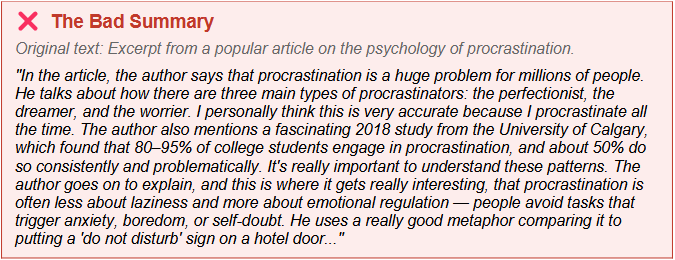
Notice what went wrong in this summarizing example:
- It’s too long and filled with the author’s exact phrases.
- It includes an explicit personal opinion.
- It has a distraction, a colorful metaphor, that isn’t crucial to the argument.
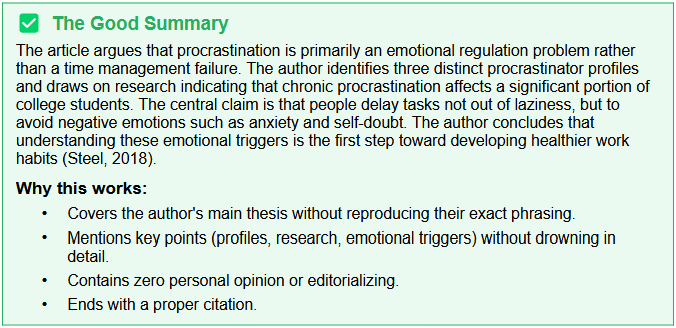
Quick Frameworks for Different Formats
One thing I’ve learned from testing these methods across different material types is that summarizing a book is not the same as summarizing a research paper. The five-step method applies in both cases, but the approach of identifying key points changes.
How to summarize a book or novel
For fiction, your framework looks like this: main conflict, character development, and core theme. Remember that when you write a summary of a novel, you’re not creating a plot walkthrough but an account of the narrative’s essential shape.
How to summarize an academic article
Academic articles follow a predictable structure, which I find actually makes it easier to summarize paragraph sections once you know what to look for. When I summarize a journal article, I make sure to hit four elements in this order:
- Research question. What specific problem or question are the researchers trying to solve?
- Methodology. Briefly describe the experiment or data collection method.
- Key findings. List the most important data points they produced.
- Conclusion. What did the results prove (or fail to prove) in relation to their initial research question?
Using AI Tools to Extract Key Points Faster
I test AI writing tools professionally and can honestly say that most of them are better at generating text than understanding it. However, that doesn’t mean you can’t use AI as part of your summarization workflow, especially when you’re dealing with dense material.
Textero, which I test regularly in real academic workflows, can come in handy when you want to accelerate Steps 1 and 2. For instance, when I have a 40-page academic PDF filled with technical terminology outside my area, I’ll run it through Textero’s AI assistant first to get a reading map.
The tool can also extract the text’s foundational arguments when you write a persuasive essay and surface the structural logic of a complex document in seconds. After all, the goal of a summary is analysis, and AI simply helps you get to that crucial analytical phase much faster.
FAQ
What is summarization?
When you summarize a text, your goal is to use your words to capture the author’s main idea and key points in a shorter form. However, it’s not about simply shortening a text mechanically, but about understanding what a piece is trying to say and expressing that core message clearly.
How to start a summary?
The best way I’ve found to start a summary is with a clear attribution statement that introduces the source and its central claim. Therefore, you should include the author’s name, the title of the work, and a statement of the main argument. It can be helpful to look through a well-written example of a summary before you start working on yours.
How many sentences are in a summary?
There’s no specific answer to this question because the length of your summary depends on the length of the source. The best way to approach the wordcount of your piece is to follow the 10–15% rule. Then, you will have no doubts about how to summarize a paragraph or how long it should be.
How to write a good summary?
If you want to know how to make a summary that can impress any scholar out there, make sure you understand the source and can express its key ideas using your own words. My practical answer would be to follow the five-step method and close the original before you start drafting.



 Built-in AI detector