



I’ve spent a lot of time with citation generators due to the specifics of my work. What I’ve found is that most of these tools are quite useful, but almost all of them make mistakes often enough that you cannot submit their output without checking it first.
While the rise of automated tools has made life easier, it has also created a false sense of security, so I’ve decided to write this review and help you find the best citation generator available at the moment.
I believe it will be useful for students and researchers who want a practical overview of how citation generators work and how to verify what they produce.
Why Citation Errors Are So Common in Academic Writing
Citation errors are not usually a sign that students don’t care about their references. In my experience, it’s easy to get confused because the rules governing citation styles change depending on the type of source, the number of authors, the edition of a work, and sometimes even the discipline.
Manual formatting vs citation style rules
When you format citations manually, you are essentially memorizing and applying a set of formatting rules that can run to hundreds of pages in their official guides. APA alone publishes a manual that exceeds 400 pages.
The worst part is that small details carry real consequences. A misplaced period or an author’s name listed in the wrong format in the bibliography are the kinds of errors that are easy to make when you are formatting references yourself.
Why small citation mistakes cost academic points
The reason citation accuracy matters in academic assessment is not the testing of your patience or your ability to follow the requirements of a citation style guide. Accurate citations allow readers to verify the sources you have used and play a crucial role in plagiarism prevention.
At many institutions, citation errors contribute to a deduction in marks even on otherwise strong essays. The stakes are real, and they explain why searching for the best citation generators is a popular activity among modern students.
What Citation Generators Actually Do
Understanding what happens when you paste a URL into a free citation generator helps you interpret the output more critically.
How citation generators format references
When you use websites that cite for you and manually enter a title or paste a web address, digital object identifier, or ISBN, the reference finder tool retrieves the available metadata. The formatting itself is rule-based: the tool applies a template that reflects the conventions of APA, MLA, Chicago, or whichever style you choose.
What data citation generators rely on
They depend entirely on the quality of the source’s metadata. Most citation generators pull from databases like CrossRef, Google Scholar, WorldCat, or publisher APIs. When these databases contain accurate, complete records, you get a properly formatted reference list.
The problems arise when the metadata is incomplete, outdated, or inconsistent. This happens more often than you might expect, particularly with older books, government publications, and non-English sources.
What citation generators do not check
These tools do not:
- Verify that the source you have cited actually supports the claim you are making.
- Check whether the URL you have provided is still live.
- Confirm that the edition or volume number matches what you consulted.
- Know whether a work has been retracted since it was published.
Most importantly, citation generators do not check whether the source exists at all. If you enter incorrect metadata, even the best citation maker will generate a citation based on that incorrect information.
Common Citation Styles Students Use
Before looking at the best websites for citations, let’s consider what the major citation styles require because knowing which style your institution expects will help you use online tools more effectively.
APA
Educational institutions usually require APA style when it comes to social sciences, psychology, education, and nursing. It uses author-date in-text citations and a reference list at the end of the document.
Key features:
- The use of hanging indents in the reference list
- The inclusion of a DOI or URL for online sources
- Specific rules around how to handle multiple authors
- Consistent use of sentence case for article and book titles
MLA
MLA is standard in the humanities, including literature, languages, film, cultural studies, and related disciplines. It uses parenthetical author-page citations in the text and a Works Cited list at the end. This style has an interesting container model, which describes how sources exist within larger structures (a journal article within a journal, a chapter within a book, etc). Citation generators often handle standard MLA sources well but can struggle with nested containers or unusual source types.
Chicago
The Chicago style is used in history, the arts, and some social sciences. Unlike APA and MLA, Chicago has two distinct citation systems: the notes-bibliography system, which uses footnotes or endnotes paired with a bibliography, and the author-date system, which is more similar to APA.
The best citation websites handle Chicago formatting with varying degrees of reliability, and the distinction between the first and subsequent citations in footnotes is something many tools do not get right.
Harvard
This is a family of author-date referencing systems rather than a single standardized format. There is no official Harvard style guide in the way there is an APA manual, as different universities have developed their own Harvard variants, which means the specific punctuation and conventions can differ.
It’s no wonder that this creates a particular challenge for citation generators. If your university uses Harvard referencing, I strongly recommend downloading your institution’s own Harvard guide and comparing it against what citation generators produce.
The Best Citation Generators by Use Case
To make the decision process easier for you, I’ve grouped the best citing websites by the kinds of tasks they are best suited to. Each tool has its strengths and limitations, and what determines the right choice depends on what you are working on.
Citation generators for quick assignments
When you are working on a shorter assignment with a tight turnaround, you need the best free citation generator that is fast and easy to use.
Citation Machine
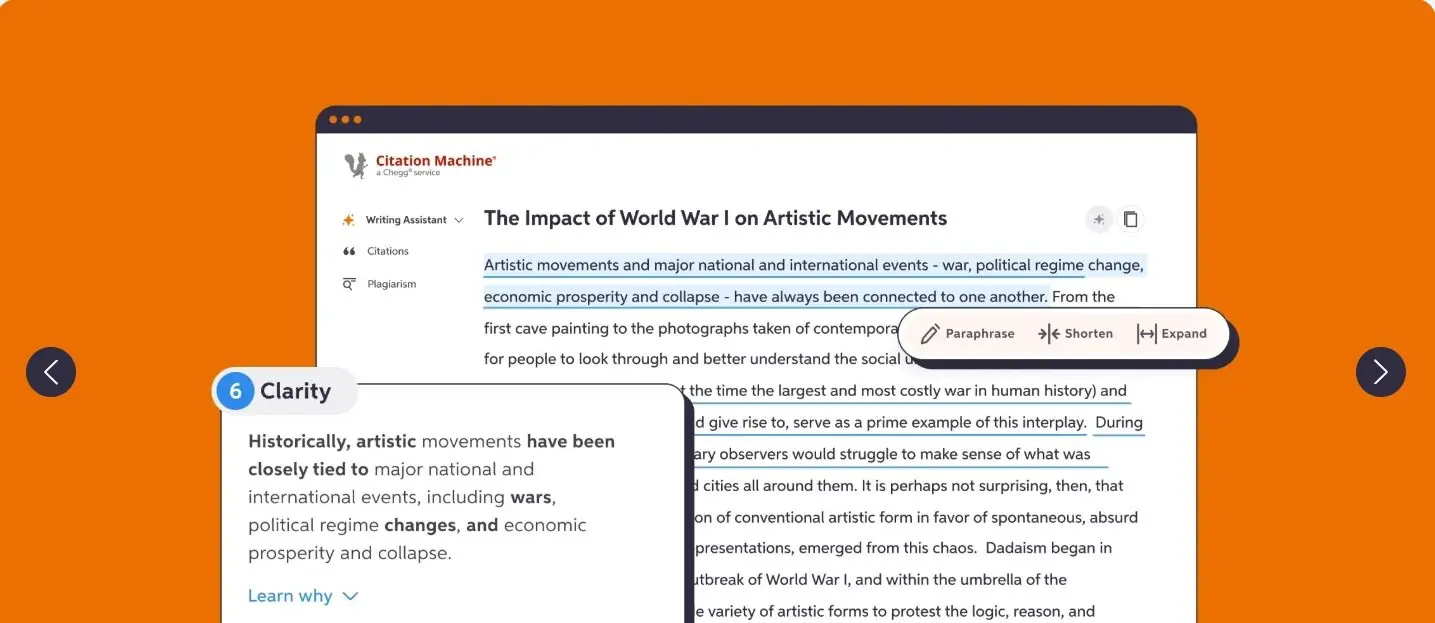
It’s one of the most widely used tools that allows you to search by title, author, or URL and receive formatted citations. Be aware that the free version includes advertising and prompts to upgrade for additional features, but you can always look for other sites like Citation Machine with fewer ads.
Textero
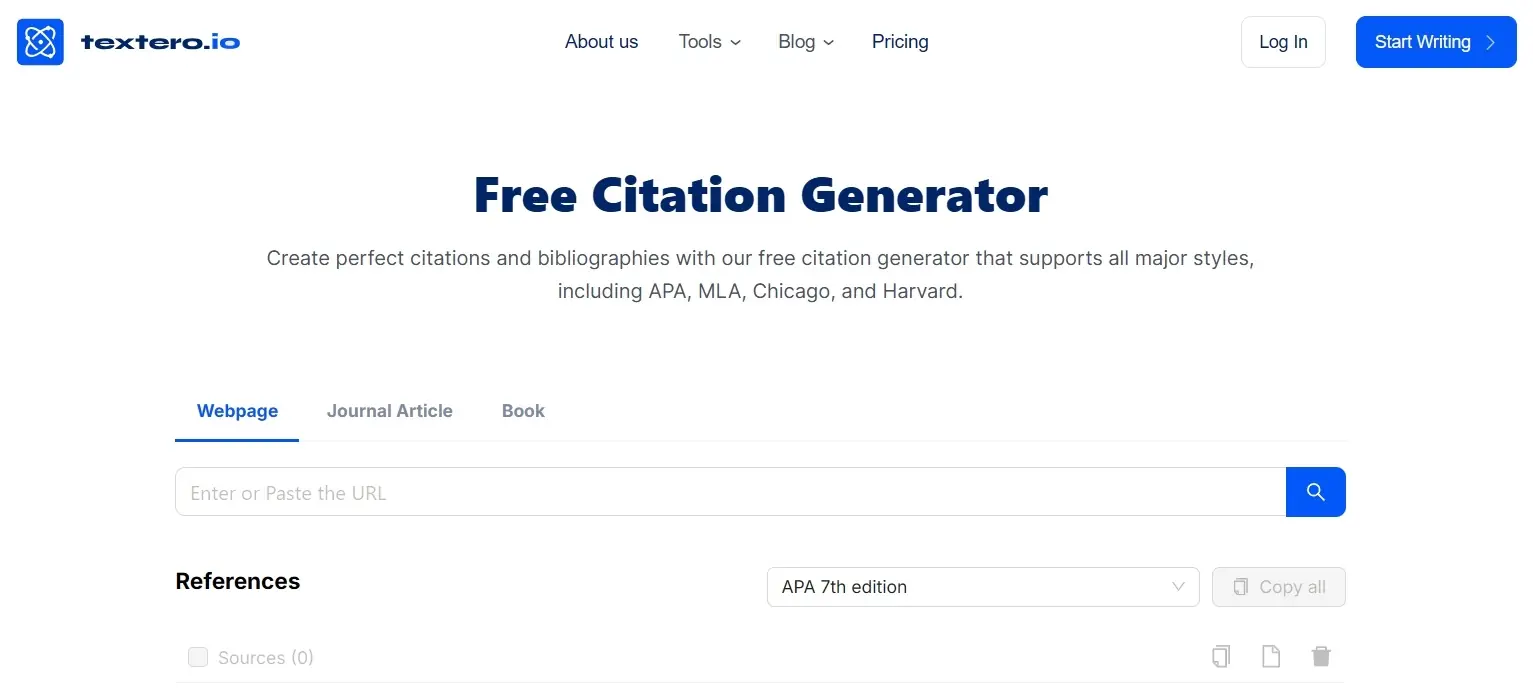
Conveniently enough, the Textero AI Citation Generator is a part of the platform’s broader academic writing toolkit:
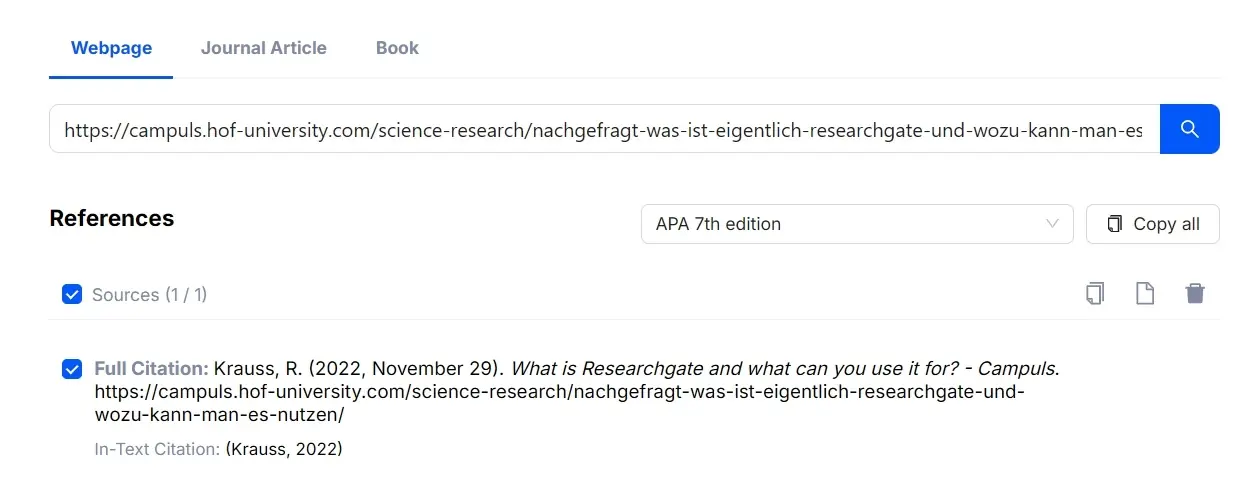
For students already using the platform for essay drafting and feedback, having a tool for academic referencing at hand means that there’s no need to switch between tools.
Citation generators for research papers
Research papers typically involve a larger volume of sources and stricter expectations around citation accuracy. Here are the tools that can help you meet these requirements.
Zotero
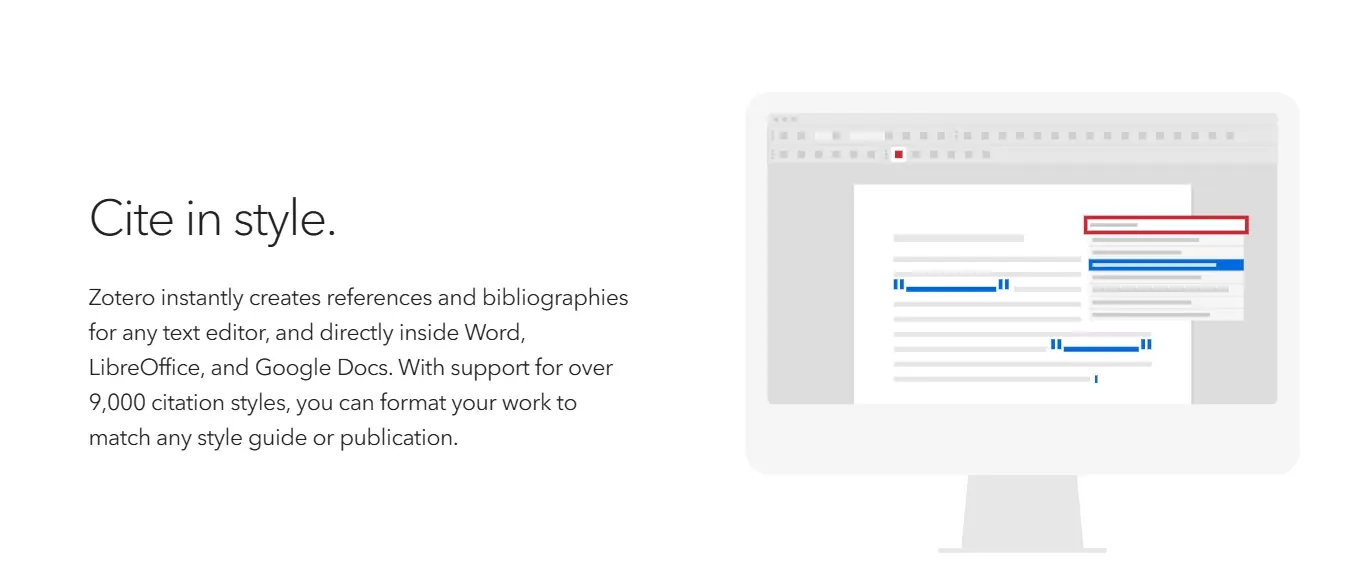
It might be the best bibliography generator for you because, unlike web-based citation generators, Zotero has a desktop application and browser extension. It captures source metadata automatically when you visit a journal article, book page, or database record in your browser, and it stores your references in an organized library.
For research papers and longer academic projects, Zotero’s ability to manage a large library of sources and integrate directly with Word and Google Docs is a significant practical advantage. The learning curve is steeper than it would be for a simple web-based generator, but for sustained research work, the investment is worth the trouble.
Scribbr Citation Generator
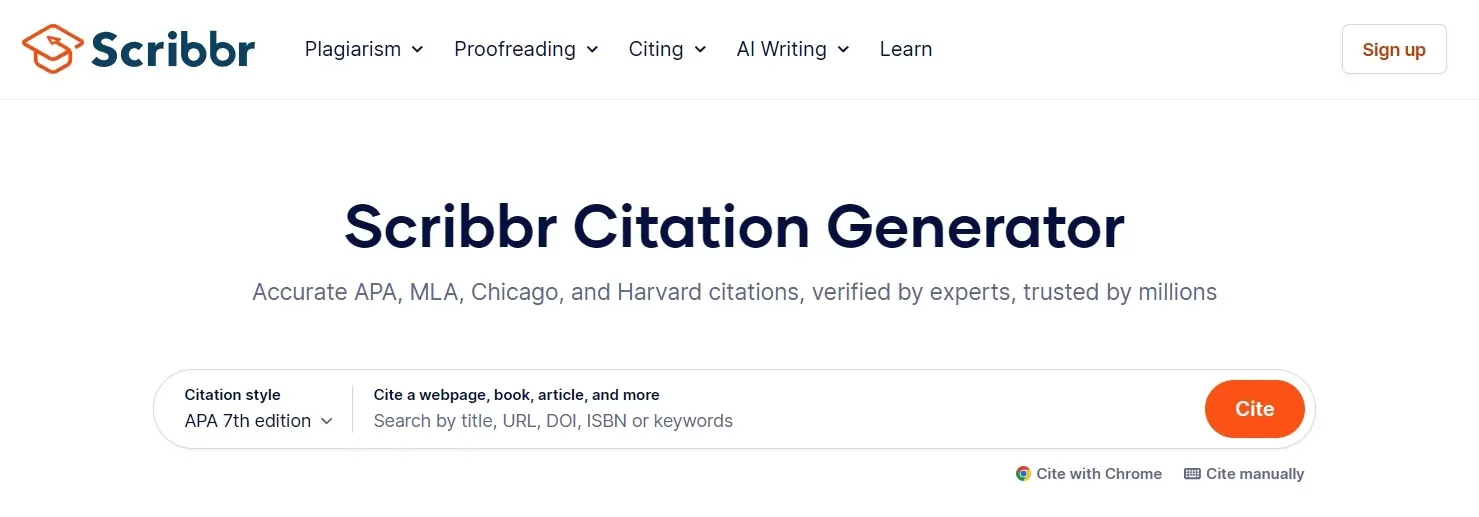
Scribbr’s citation generator is notable for its impressive accuracy. The tool is particularly strong on APA and MLA and provides detailed guides alongside the generator. For students who want to understand citation rules rather than just generate outputs, the accompanying documentation makes the platform a valuable resource.
Scribbr also supports a wide range of source types and handles some of the trickier cases, including edited volumes and translated works. It is a free tool with no enforced paywall for basic citation generation.
Citation generators for mixed source types
Some projects involve various sources: academic journals alongside government reports, archival documents, social media posts, podcasts, or datasets. Consider using these websites for citing sources when you work on such assignments.
EasyBib
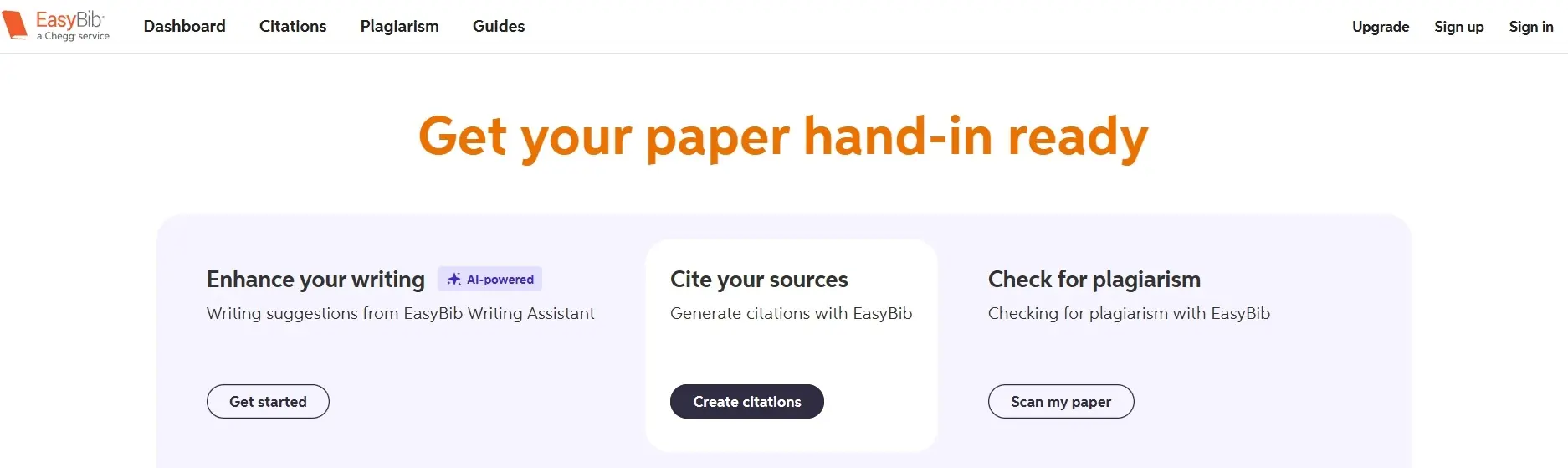
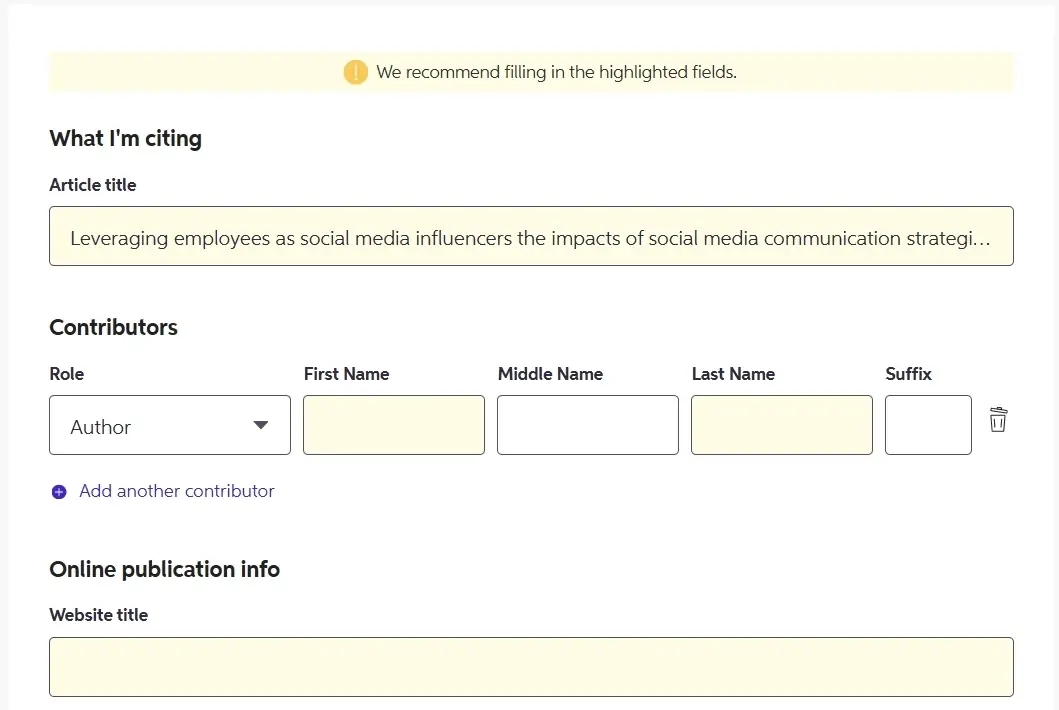
For web-based sources, social media, videos, and the other kinds of digital content that students increasingly cite, EasyBib might be the best citation website out there. The quality of the output depends on the available metadata, so keep in mind that YouTube videos and social media posts often have incomplete information that you will need to add manually:
BibMe
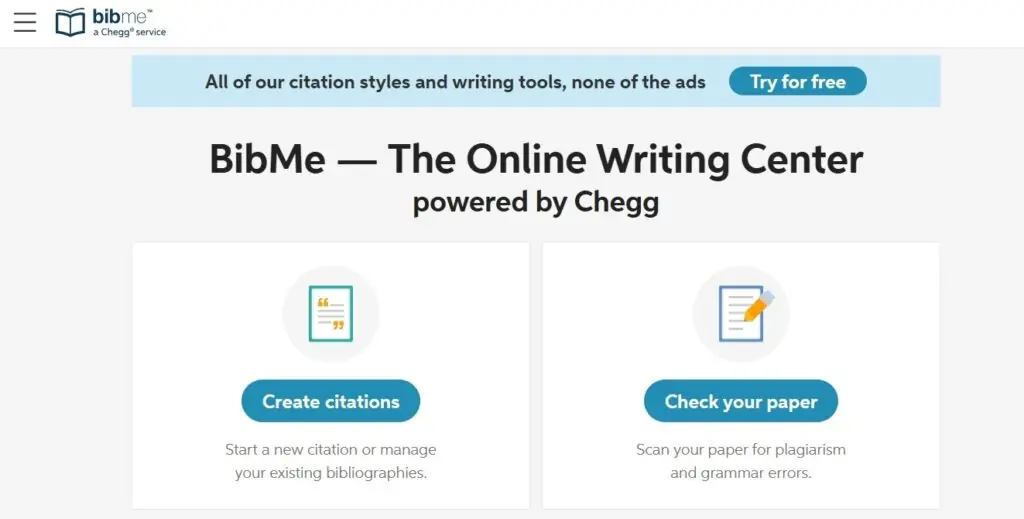
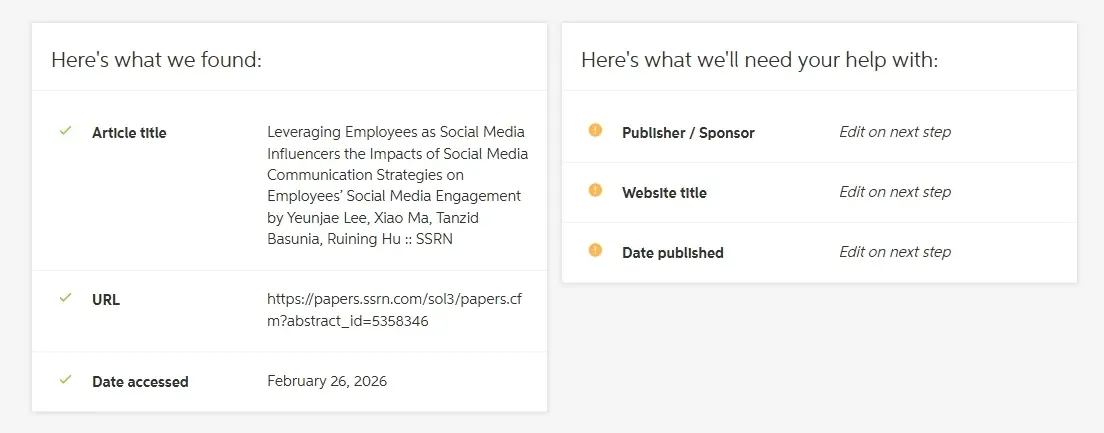
It’s one of the websites for citations that offer a comprehensive search feature for non-traditional sources. It helps prompt you for missing information that standard tools might skip, such as the timestamp of a video or the handle of a social media user:
How to Check a Generated Citation Before Submission
I want to highlight this idea once again: never copy-paste directly from the best cite generator you use to your final draft without this 30-second audit:
- Step 1: Check your citation style requirements
Confirm which citation style and which edition your assignment requires because even APA 6th and APA 7th have meaningful differences.
- Step 2: Review author names and titles
Ensure the capitalization is correct. Sentence case is required for APA titles, while title case is standard for MLA.
- Step 3: Verify publication details
Open the original source and compare the publication details against the generated citation. For journal articles, check the publication year, volume, and issue numbers, and for books, confirm the page ranges, publisher, and place of publication, as well as the edition, if applicable.
- Step 4: Match in-text citations with the reference list
Every name mentioned in your essay must appear in the bibliography, and vice versa. Check that the author names and years used in your in-text citations exactly match the corresponding entries in your reference list.






 Built-in AI detector