




 Article fact-checked
-
24% of U.S. companies are cutting costs by an estimated $50,000 to $70,000 annually through ChatGPT-driven automation and workflow efficiencies.
-
Nearly half of U.S. companies (49%) already use ChatGPT, while adoption among Fortune 500 firms reaches 92%, indicating near-universal enterprise penetration.
-
Businesses report strong cost efficiency, with 47% saving over $50,000 annually, and the most common savings bracket ranging from $50,001 to $75,000.
-
Customer service automation delivers the highest operational savings at $15,000 per month, while content creation and social media reduce costs by $90-$300 and $200 per post, respectively.
-
ChatGPT is used daily across key workflows, with 66% of companies relying on it for coding, 58% for content, and 57% for customer support, underscoring broad functional integration.
-
Global usage is led by the United States and India, each contributing 16% of all traffic, followed by Brazil (5.8%) and Canada (5.4%), reflecting a highly concentrated adoption landscape.
-
Adoption varies significantly by industry, peaking in marketing (77%), consulting (71%), and advertising (67%), while government and media show minimal uptake at just 2%.
As artificial intelligence moves from experimentation to everyday operations, one question has become central for companies of all sizes: Is ChatGPT profitable for businesses? Over the past two years, organisations have steadily integrated AI tools into marketing, customer service, data analysis, and internal workflows, and many report substantial cost reductions as a result. From saving money on routine content creation to automating previously labour-intensive tasks, ChatGPT is reshaping how businesses allocate time, budgets, and talent.
But financial efficiency is only part of the story. The global adoption of ChatGPT is accelerating steadily across industries, with millions of professionals using it daily, and entire industries shifting their workflows to leverage AI. Companies across marketing, consulting, advertising, and technology now rely on ChatGPT to improve productivity, while adoption rates continue to grow in sectors like healthcare, insurance, education, and government.
This article explores how many companies use ChatGPT, which countries lead in usage, the most effective business use cases, and, most importantly, how much money companies actually save using ChatGPT. It also includes industry-specific adoption data and real examples of how businesses reduce operational costs through AI. Whether you’re assessing ROI, evaluating adoption trends, or considering how ChatGPT can fit into your workflow, this guide provides a clear, data-driven overview of the AI’s impact on modern business.
After exploring how businesses integrate AI into their workflows, the next step is understanding how much money companies save using ChatGPT and whether these savings justify the investment.
How much money would U.S. companies save using ChatGPT?
The chart below illustrates how much money companies save using ChatGPT based on survey responses across multiple industries. These data points reveal clear financial patterns, showing that ChatGPT saves money across both small and large-scale operations. By examining reported savings ranges, we can determine how businesses save money using ChatGPT and assess whether ChatGPT is profitable for different types of organisations.
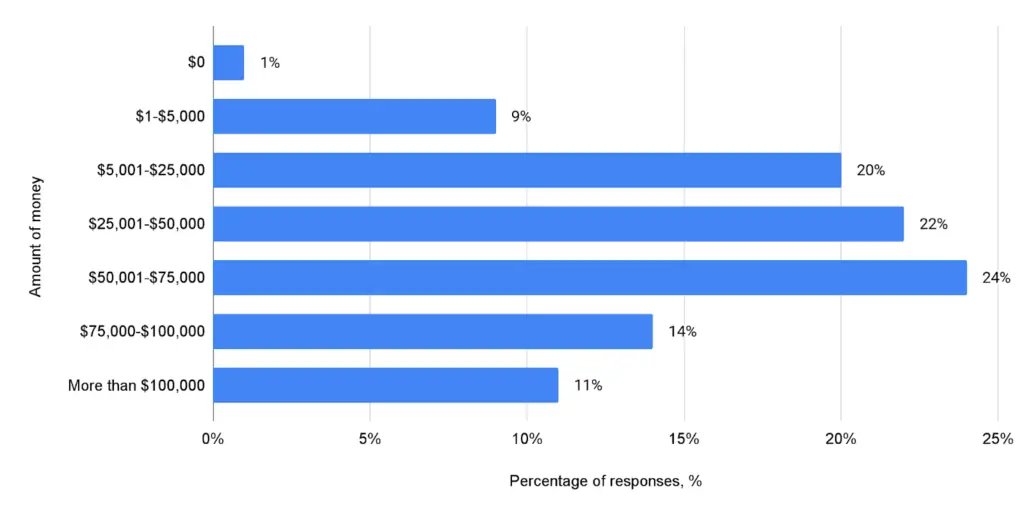
- The largest share of U.S. companies (24%) save between $50,001 and $75,000 using ChatGPT, making it the most common savings bracket.
- Only 1% of organisations reported saving $0, showing that nearly all companies achieve measurable financial benefits.
- A combined 47% of respondents save more than $50,000 annually, indicating that ChatGPT delivers measurable savings at scale.
How much money do companies save using ChatGPT
Overall, the data demonstrates that ChatGPT is delivering substantial financial value, with the majority of companies reporting meaningful cost reductions. Mid-tier savings between $25,000 and $75,000 dominate the distribution, while more than one in ten companies achieve savings exceeding $100,000. These results clearly support the view that ChatGPT saves money across diverse industries and help answer the question: Is ChatGPT profitable? For many businesses, the cost-efficiency gains are not only significant but materially impactful.
Having examined how much money companies save using ChatGPT, it is equally important to understand how many companies use ChatGPT today and how rapidly adoption is accelerating.
How many companies use ChatGPT? Key adoption statistics in 2025
The following chart highlights the latest companies’ use of ChatGPT statistics, illustrating adoption levels across the U.S., Fortune 500 firms, and organisations implementing AI in at least one business function. These metrics help clarify how many businesses use ChatGPT. By comparing adoption levels across different groups, we can better understand the scale of ChatGPT usage for companies.
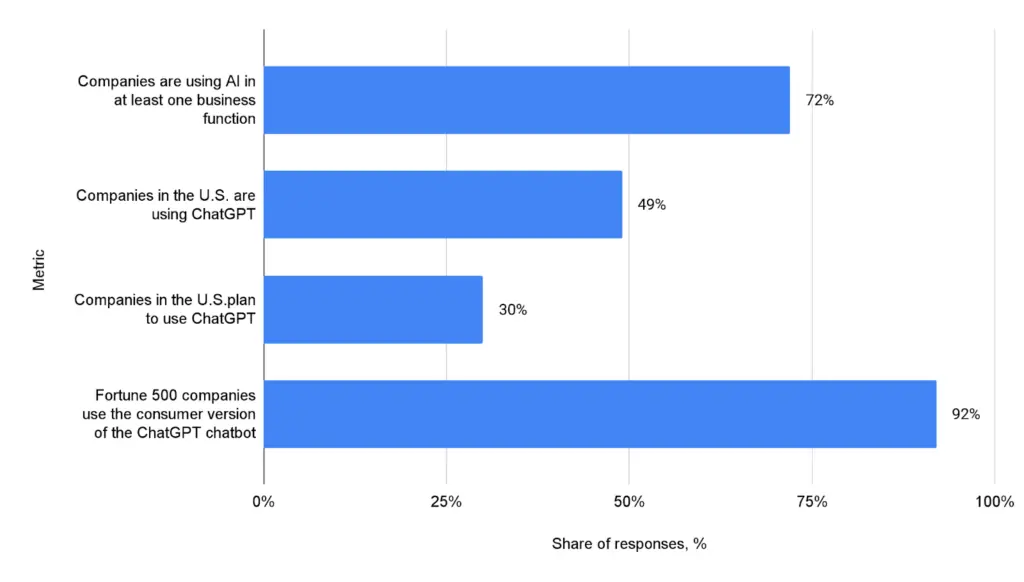
- 72% of companies report using AI in at least one business function, showing widespread readiness for tools like ChatGPT.
- Among U.S. organisations, 49% already use ChatGPT, while another 30% plan to adopt it soon.
- An impressive 92% of Fortune 500 companies use the consumer version of ChatGPT, underscoring strong enterprise-level adoption.
Companies using ChatGPT
Overall, the data confirms that companies using ChatGPT represent a rapidly expanding segment of the global business landscape. Adoption is particularly strong among large enterprises, with Fortune 500 usage reaching near-universal levels. At the same time, nearly half of U.S. companies have already integrated ChatGPT, and many more intend to follow, indicating that the number of companies using ChatGPT worldwide will continue to rise. These trends highlight ChatGPT’s growing importance as a strategic tool for operational efficiency and innovation.
After looking at how many businesses use ChatGPT, the next step is understanding exactly how companies can use ChatGPT across different tasks and workflows.
Best ChatGPT use cases for business: How companies apply AI in daily tasks
The chart below highlights the most common ChatGPT use cases for business, based on the share of companies applying the tool in specific tasks. These data points provide a clear business use case example of how businesses can use ChatGPT to streamline code writing, content production, customer support, and internal operations. By analysing these adoption patterns, we can see which processes benefit the most from ChatGPT used by businesses.
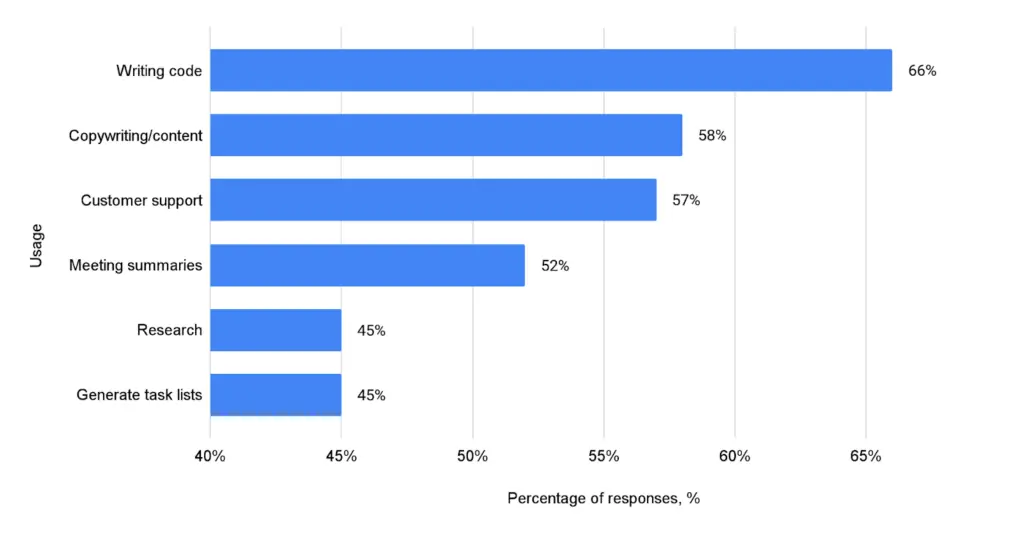
- Writing code is the top ChatGPT use case for business, with 66% of companies relying on it for development tasks.
- Content creation and customer support follow closely, used by 58% and 57% of companies, respectively.
- Meeting summaries, research, and task list generation are also widely adopted, each used by 45-52% of organisations.
How companies can use ChatGPT: most common business use cases in 2025
Overall, the data shows that how businesses can use ChatGPT extends far beyond simple text generation. The most popular workflows include writing code, producing content, and supporting customers, all core functions that directly impact productivity and cost efficiency. These insights reinforce the growing role of ChatGPT use cases for business and demonstrate why companies increasingly view AI as an essential operational tool rather than an optional experiment.
After exploring how companies apply ChatGPT across their everyday tasks, it’s important to understand how businesses can use ChatGPT not only for productivity but also for measurable financial savings.
How much money companies save using ChatGPT: cost savings by use case
The following chart breaks down how much money companies save using ChatGPT across various operational functions. These data points showcase concrete examples of how businesses save money using ChatGPT by automating routine work, reducing labour costs, and increasing output efficiency. Each use case demonstrates that ChatGPT saves money in both high-volume workflows and specialised roles.
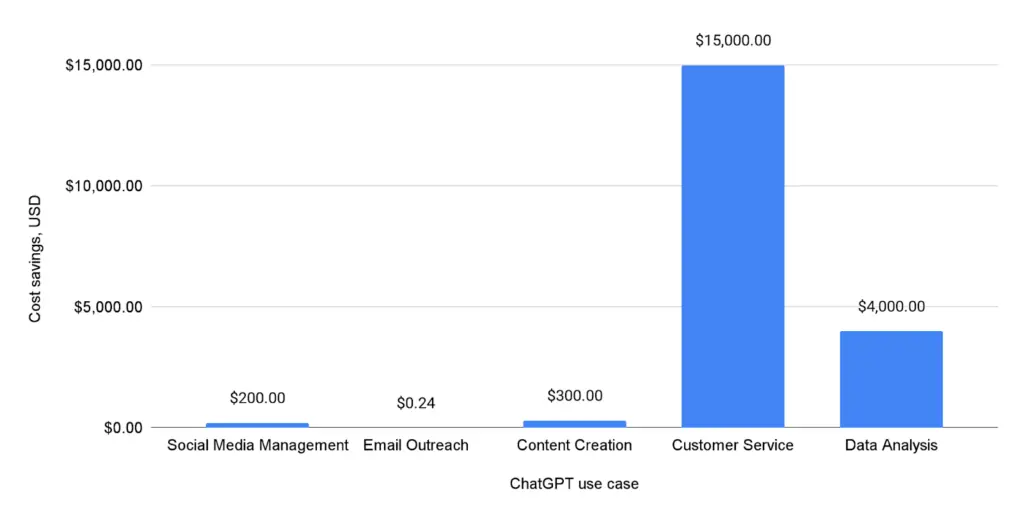
- Customer service automation delivers the largest savings, with companies reducing costs by $15,000 per month.
- Content creation offers savings between $90 and $300 per post, making it one of the most cost-efficient creative workflows.
- Social media teams save $200 per post, while automated email outreach cuts an additional $0.24 per e-mail, highlighting consistent savings across communication tasks.
How businesses save money using ChatGPT
Overall, the data clearly shows how much money companies save using ChatGPT across both creative and analytical workflows. From substantial monthly reductions in customer service and data analysis costs to per-task efficiencies in content and social media, ChatGPT saves money at every level of business operations. These examples demonstrate how businesses can use ChatGPT not only to accelerate work but also to achieve meaningful and repeatable financial benefits.
Building on the previous insights into how businesses leverage AI tools, it’s equally important to understand where ChatGPT is used the most worldwide.
Global breakdown of ChatGPT usage by country
The chart below highlights ChatGPT usage by country, showing which regions contribute the highest share of global traffic. These numbers reveal clear geographic patterns in user engagement and point to where demand for AI tools like ChatGPT is most concentrated. Understanding ChatGPT’s most used country helps contextualise global adoption trends.
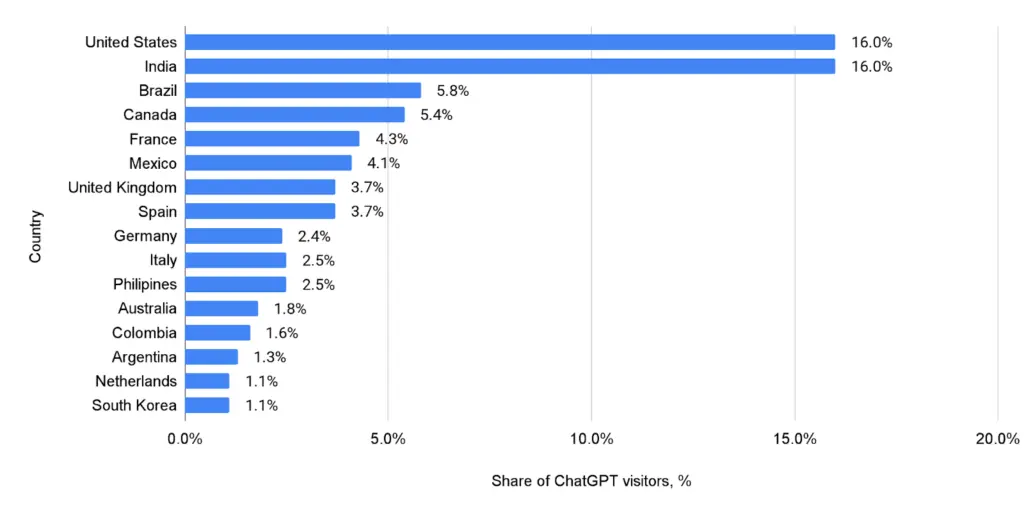
- The United States and India jointly lead global activity, each contributing 16% of all ChatGPT visits.
- The next largest group of users comes from Brazil (5.8%), Canada (5.4%), and France (4.3%), forming the second tier of usage.
- European countries, including the United Kingdom (3.7%), Spain (3.7%), and Germany (2.4%), show steady but moderate engagement levels.
Which countries drive the most ChatGPT traffic?
The data shows that ChatGPT’s global footprint is heavily concentrated in a few major markets, with the United States and India together accounting for nearly one-third of all traffic. A diverse mix of countries across North America, Europe, Asia, and Latin America contribute meaningful usage, reflecting broad global interest in AI tools. While leading markets dominate the numbers, the long tail of countries emphasises that adoption is widespread and not limited to any single region. This distribution highlights ChatGPT’s position as a globally relevant technology with strong international engagement.
After exploring how ChatGPT usage varies by country, it’s essential to see how quickly different industries are embracing the technology.
ChatGPT adoption by the industry
The following chart illustrates ChatGPT adoption levels across key industries, highlighting how quickly different sectors are integrating AI tools into their workflows.
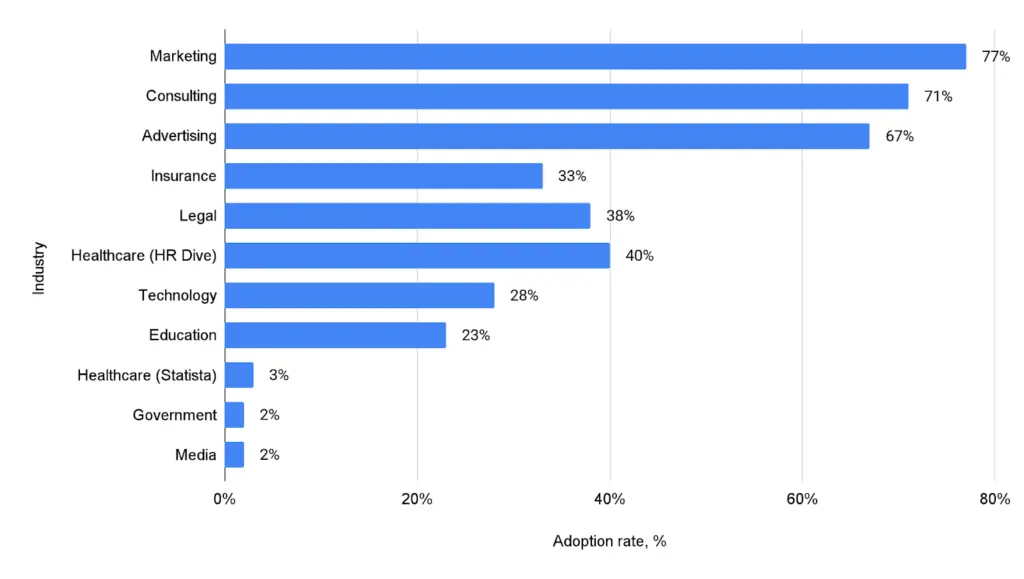
- Marketing leads all sectors with a 77% adoption rate, followed closely by consulting at 71% and advertising at 67%.
- Professional and regulated sectors show moderate adoption, including legal at 38%, healthcare (HR Dive) at 40%, and insurance at 33%.
- The slowest movement along the ChatGPT speed of adoption curve appears in government, media, and healthcare (Statista), with rates of just 2%, 2%, and 3% respectively.
ChatGPT adoption rates across major industries
The data reveals a wide disparity in ChatGPT adoption rates across industries, with marketing-driven fields emerging as the clear front-runners. Professional and compliance-heavy sectors are showing a gradual but steady uptake, reflecting a more cautious approach toward AI tools. Meanwhile, public sector and media organisations remain at the earliest stages of the adoption curve, indicating significant untapped potential. Overall, the ChatGPT speed of adoption varies dramatically by industry, highlighting both maturity gaps and opportunities for future growth.
Conclusions
- By late 2025, the business adoption of ChatGPT has entered a phase of clear structural maturity, with usage patterns, cost savings, and operational applications stabilising after an initial period of rapid experimentation. What began as exploratory testing across marketing and tech teams has evolved into large-scale, measurable integration across diverse industries, supported by consistent financial results and increasingly predictable adoption trends.
- A defining shift is visible in how organisations now approach AI-driven efficiency. Early adoption was dominated by isolated pilots and opportunistic use cases, but recent data shows a transition toward sustained, workflow-embedded utilisation, particularly in coding, content production, and customer support. This evolution reflects a broader recalibration in business processes, where AI is becoming a foundational productivity layer rather than a supplementary tool.
- Despite strong overall stability, variability remains across key indicators such as industry adoption rates, per-task savings, and geographic usage distribution. Some sectors, most notably marketing, consulting, and advertising, have accelerated far ahead of others, while regulated fields and public institutions continue to adopt AI at a slower, more cautious pace. Yet compared with the early adoption phase, businesses now absorb technological shifts more effectively, indicating a growing level of internal readiness and AI literacy across teams.
- Long-term trends highlight a decisive movement from experimental value to repeatable operational gains. Companies increasingly report consistent annual savings in the $50,000-$70,000 range, with a significant subset surpassing $100,000, demonstrating that ChatGPT’s financial impact extends well beyond short-term optimisations. The data underscores a broader transformation in how enterprises allocate labour, streamline communication, and scale output.
- Looking ahead, the trajectory of ChatGPT in business will depend on its ability to sustain efficiency gains as organisations expand usage across more complex and regulated workflows. If current adoption patterns continue, ChatGPT is well-positioned to remain an important driver of business productivity, strengthen its role in enterprise operations, and support a new cycle of AI-enabled growth across global industries.
Sources:
- “1 in 4 Companies Have Already Replaced Workers with ChatGPT – ResumeBuilder.Com.” ResumeBuilder.Com, 20 Feb. 2023, https://www.resumebuilder.com/1-in-4-companies-have-already-replaced-workers-with-chatgpt/. Accessed 03 December 2025.
- Albert. “Number Of ChatGPT Users In 2025: Stats, Usage & Impact.” Digital Silk, 30 May 2025, https://www.digitalsilk.com/digital-trends/number-of-chatgpt-users/. Accessed 03 December 2025.
- Bailyn, Evan. “ChatGPT Usage Statistics: November 2025 – First Page Sage.” First Page Sage, 7 Nov. 2025, https://firstpagesage.com/seo-blog/chatgpt-usage-statistics/. Accessed 03 December 2025.
- Hay, Tara. “The Cost-Saving Revolution: How ChatGPT 3.5 and GPT-4 Are Impacting Businesses and Professions The Cost-Saving Revolution: How ChatGPT 3.5 and GPT-4 Are Impacting Businesses and Professions.” Workyard, 16 Mar. 2023, https://www.workyard.com/research/chatgpt-3-5-and-gpt-4. Accessed 03 December 2025.
- Zherebetska, Olena. “100 ChatGPT Statistics to Know in 2025 & Its Future Trends.” Intelliarts, 7 Jan. 2025, https://intelliarts.com/blog/chatgpt-statistics/. Accessed 03 December 2025.


 Built-in AI detector