


 Article fact-checked
-
By 2030, AI-driven transformation is projected to displace 92 million jobs globally, while creating 170 million new roles, resulting in a net employment gain of 78 million jobs, indicating large-scale reallocation rather than net job loss.
-
Structural churn will affect 22% of all global jobs by 2030, with 14% of roles newly created and 8% displaced, showing that AI’s impact reaches more than one in five positions worldwide.
-
Technology-driven macrotrends affect employment unevenly: broadening digital access creates 19 million jobs while displacing 9 million, whereas AI & information processing create 11 million and displaces 9 million, producing a much narrower employment margin.
-
Employer responses emphasize adaptation over layoffs, with 85% planning workforce upskilling and 70% expecting to hire new skilled talent, compared with 40% anticipating workforce reductions, underscoring skills mismatch as a central driver of displacement.
-
Job losses are highly concentrated in routine roles: Data Entry Clerks (-40%), Bank Tellers (-35%), and Cashiers (-30%) experience the steepest declines, while data- and AI-intensive roles lead growth, including Big Data Specialists (+117%) and AI Specialists (+82%).
-
In the United States, estimated AI-related job losses in 2025 range from 200,000 to 300,000 positions, far exceeding the 54,836 jobs officially attributed to AI, suggesting that most displacement occurs indirectly or goes unreported.
Artificial intelligence is no longer a future technology; it is already reshaping how work gets done. Companies across industries are adopting AI tools at scale, boosting productivity and cutting costs, while workers increasingly wonder whether their roles will still exist in a few years. The question is no longer whether AI will change jobs, but which jobs are most at risk from AI, and how large the impact really is.
Predictions about automation often swing between extremes: some warn of mass unemployment, while others argue that AI will create more jobs than it destroys. The reality is more complex. AI is simultaneously eliminating certain roles, transforming others, and generating entirely new forms of work. Understanding this shift requires moving beyond anecdotes and looking closely at the data.
This article breaks down what the numbers actually show. Using global employment forecasts, sector-level risk estimates, and U.S.-specific job loss data, it examines how many jobs AI could replace, where job displacement is already happening, and which roles are growing fastest as automation accelerates. The goal is not to speculate, but to clarify what the current evidence says about how AI is reshaping the global job market.
After outlining the broader concerns around job displacement due to artificial intelligence, it is essential to quantify how these shifts translate into concrete changes in global employment levels.
Global job displacement and creation under AI by 2030
The chart below illustrates global job transformation by 2030, breaking employment changes into jobs created, jobs displaced, and net job growth. It provides a data-driven view of how many jobs will AI replace by 2030 while also capturing the scale of new roles emerging alongside automation.
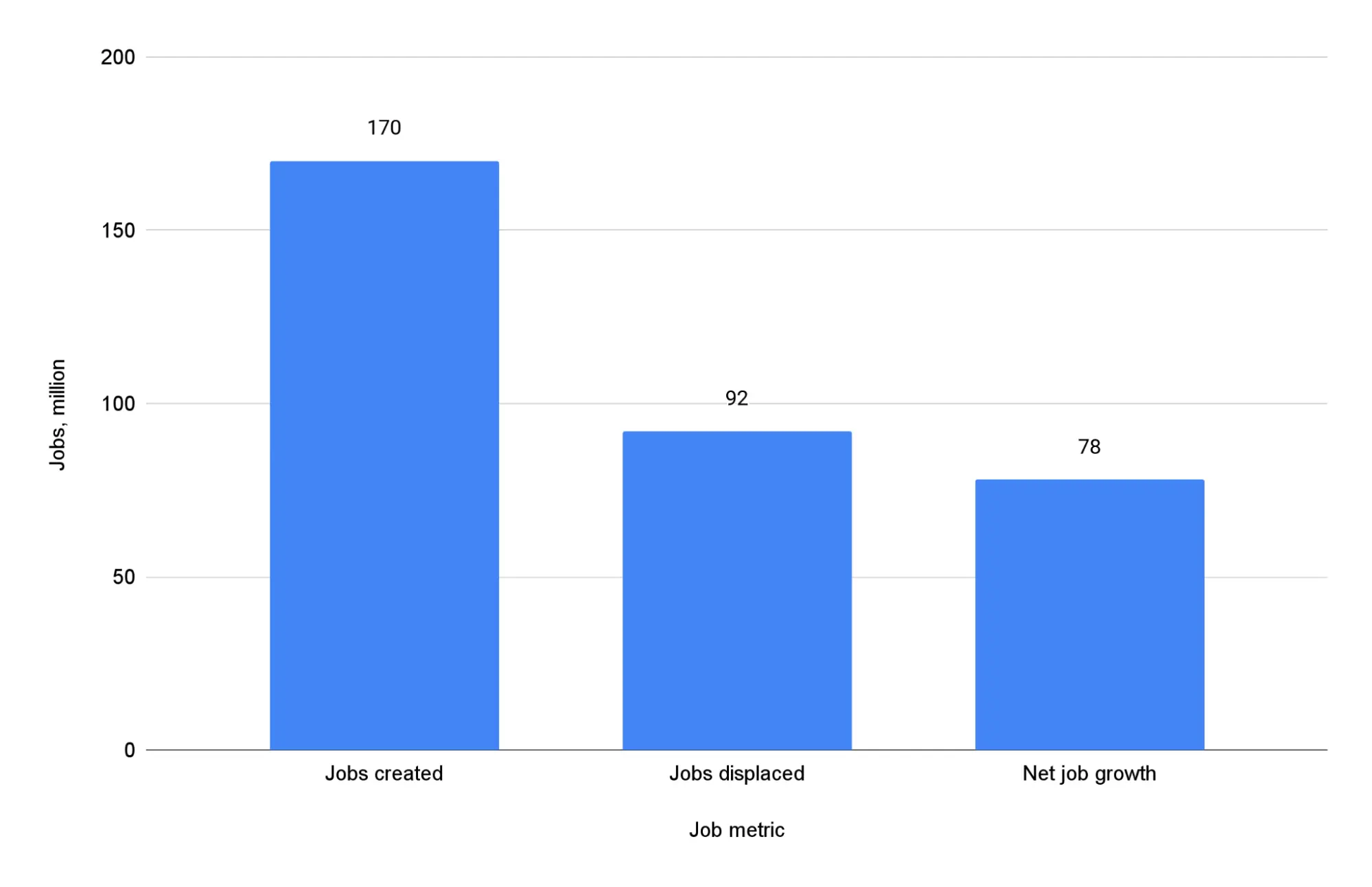
- By 2030, AI-driven transformation is expected to displace 92 million jobs globally, highlighting the scale of job displacement associated with automation.
- Over the same period, 170 million new jobs are projected to be created worldwide, significantly exceeding the number of jobs displaced.
- The net effect is a global employment increase of 78 million jobs, indicating that job displacement due to AI does not translate into net job loss at the global level.
How many jobs will AI replace: Global employment shifts by 2030
These figures show that while job displacement will affect tens of millions of workers, AI-driven transformation is also associated with substantial job creation. The global labor market is therefore undergoing reallocation rather than collapse, with employment shifting across roles and sectors. Understanding how many jobs will AI replace requires viewing displacement and creation together, rather than focusing on losses in isolation.
While absolute job numbers show the scale of AI-driven change, percentage-based metrics reveal how deeply automation reshapes the global labor market relative to total employment.
Global job transformation as a share of total employment by 2030
The chart presents global job transformation by 2030 as a share of total employment, highlighting structural churn alongside the proportions of jobs created and displaced. This perspective helps contextualize job displacement within the overall size of the global workforce.
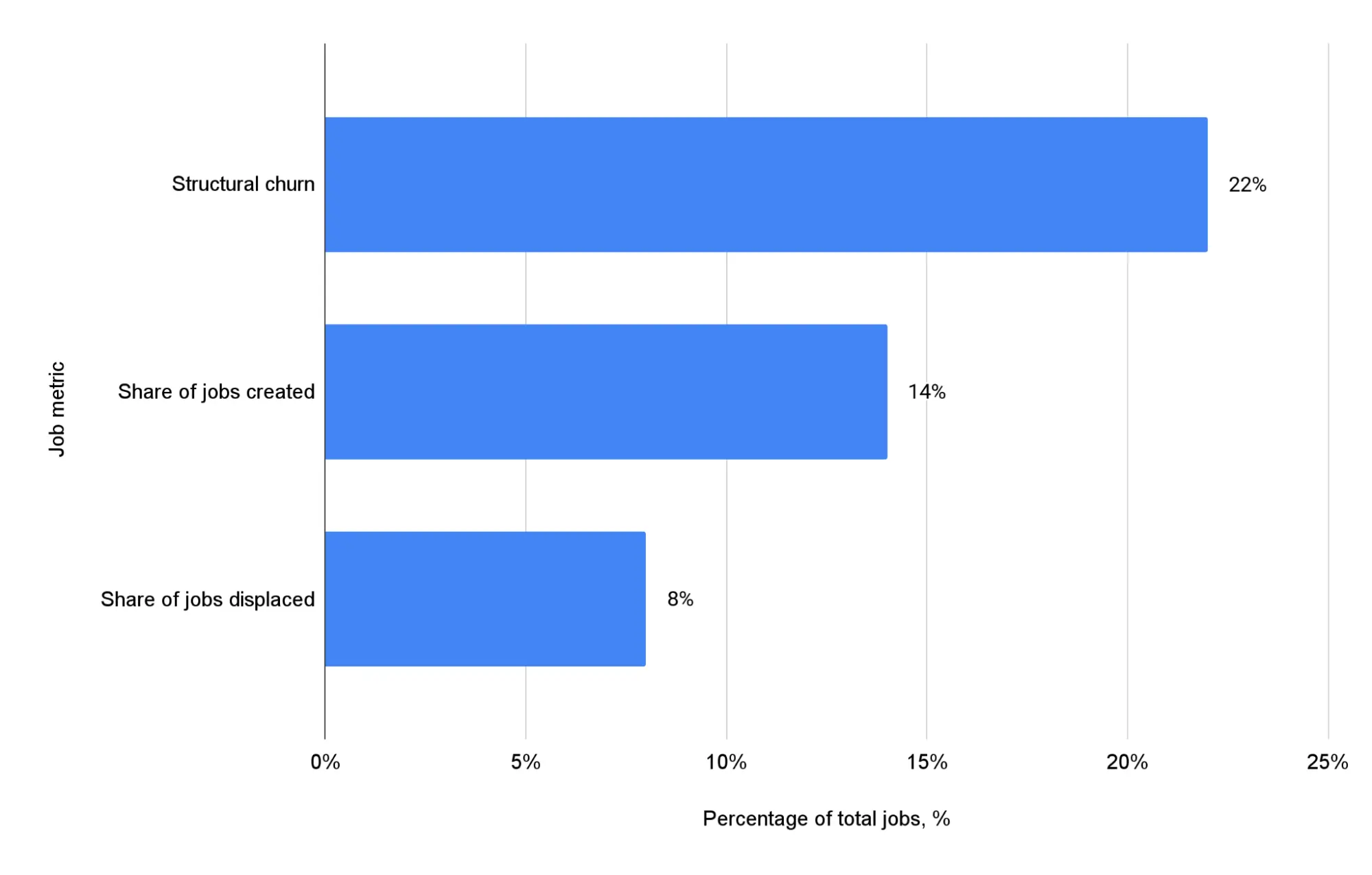
- By 2030, structural churn is projected to affect 22% of total global jobs, indicating that more than one in five roles will experience creation or displacement.
- Jobs created through AI-driven transformation account for 14% of total employment, exceeding the share of roles lost to automation.
- Jobs displaced represent 8% of total global jobs, underscoring the measurable impact of job displacement due to AI within the broader labor market.
What share of jobs AI will replace: Global employment churn by 2030
Expressed as shares of total employment, these figures show that AI-driven change is widespread but not overwhelmingly destructive. A larger portion of job movement comes from new roles being created rather than existing ones being eliminated. This reinforces the idea that understanding how many jobs will AI replace requires looking at proportional churn, not just absolute job losses.
Beyond overall employment churn, examining individual macrotrends helps clarify which forces are driving job creation and which are contributing most to job displacement.
AI and digital access as drivers of global job creation and displacement
The chart compares two major macrotrends, broadening digital access and AI & information processing, by showing the number of jobs each creates and displaces globally. This breakdown highlights how different technology-driven forces contribute unevenly to job displacement due to AI and broader labor market transformation.
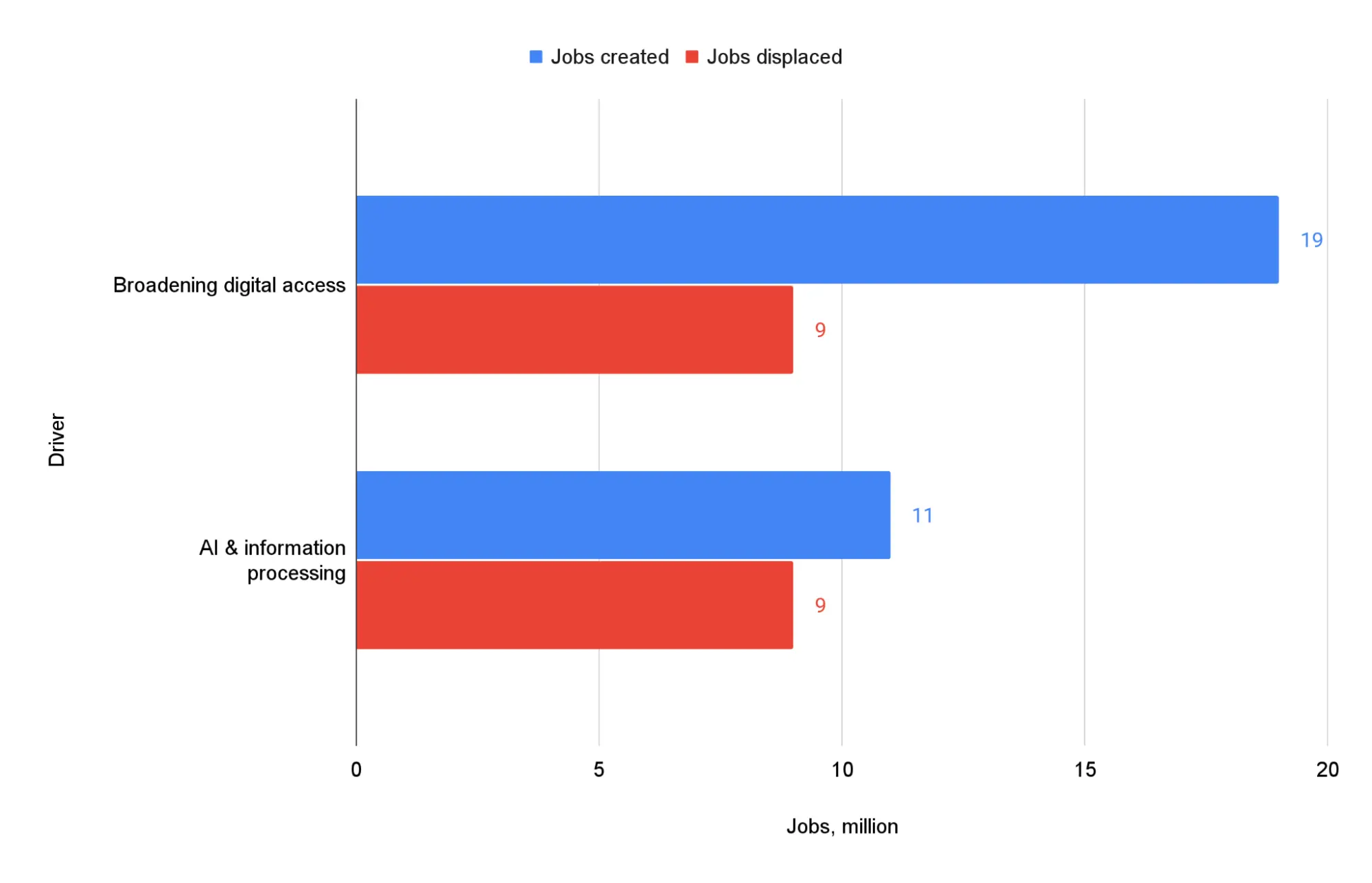
- Broadening digital access is associated with 19 million jobs created and 9 million jobs displaced, resulting in a strong positive employment balance.
- AI & information processing drives the creation of 11 million jobs, while also displacing 9 million, indicating a much narrower gap between gains and losses.
- Across both macrotrends combined, 18 million jobs are displaced, underscoring the scale of job displacement linked to technology-driven change.
How AI and digital technologies are reshaping jobs at the macro level
At the macrotrend level, not all technology impacts employment in the same way. Broadening digital access generates substantially more jobs than it displaces, while AI & information processing produce a more balanced mix of job creation and loss. These differences matter when assessing how many jobs will AI replace by 2030, as they show that displacement outcomes depend heavily on the specific technology driving change rather than automation alone.
After examining how AI-driven change reshapes global employment in aggregate, the next step is to understand how workers and employers perceive these shifts and how they are preparing to respond.
Will AI replace jobs? What workers and employers expect next
The chart summarizes employer workforce strategies in response to AI adoption, highlighting how organizations plan to adjust hiring, training, and staffing levels. These figures provide context for ongoing debates around whether AI will replace jobs and how quickly job displacement may materialize.
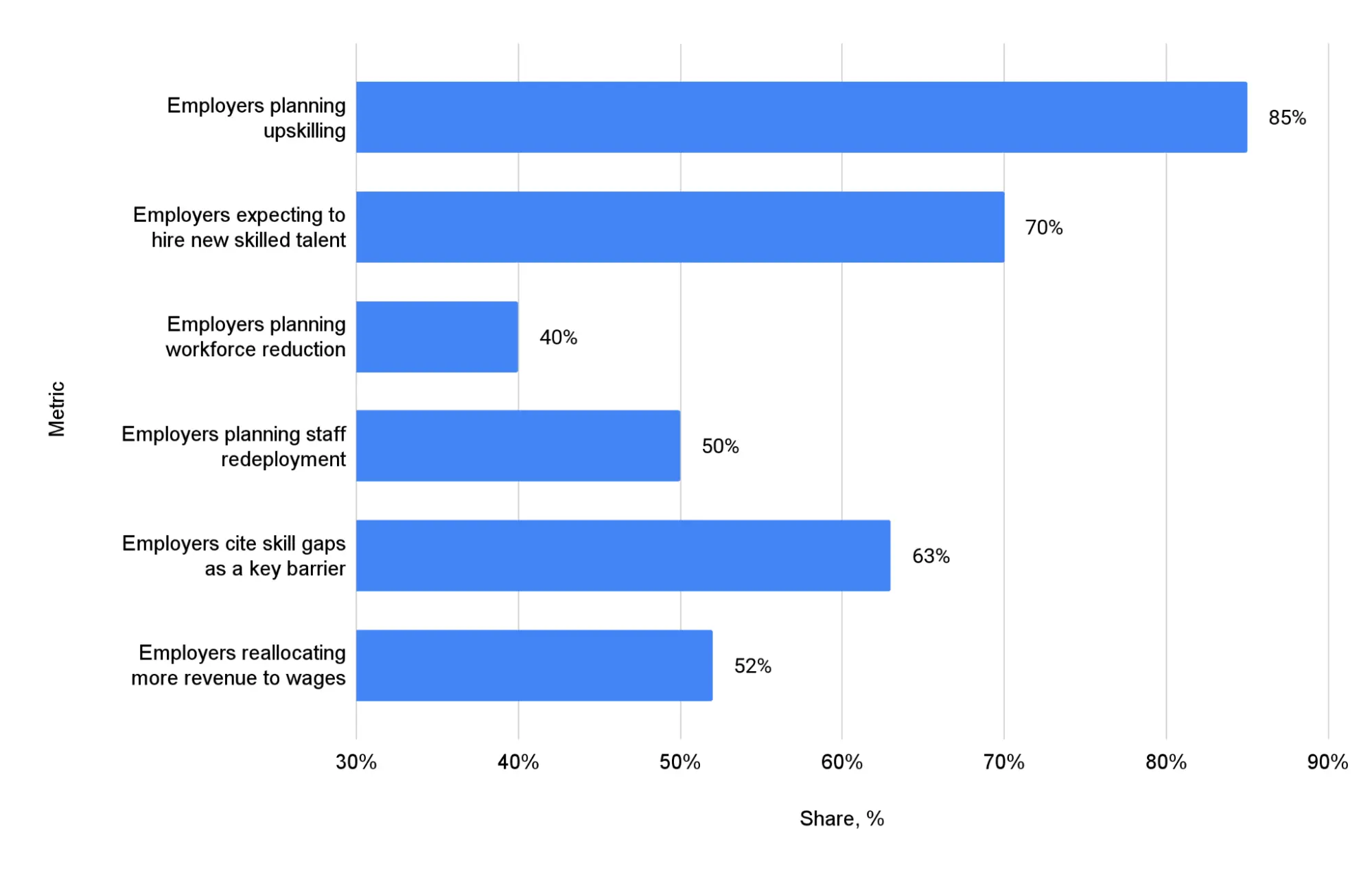
- 85% of employers plan to prioritize upskilling their workforce, signaling that adaptation is the dominant response to AI-driven change rather than immediate job cuts.
- While concerns about job losses are widespread, only 40% of employers expect to reduce their workforce, compared with 70% planning to hire new skilled talent.
- 63% of employers cite skill gaps as a key barrier, reinforcing that job displacement pressures are closely tied to skills mismatches rather than automation alone.
Job loss expectations among workers and employers
These expectations suggest that uncertainty about whether AI will take over jobs coexists with active investment in workforce transformation. Employers appear more focused on reskilling and redeployment than on large-scale layoffs, even as AI job displacement statistics continue to draw attention. Overall, the data point to a labor market adjusting through skills and role changes rather than immediate, widespread job losses.
After outlining how automation affects tasks and occupations overall, the focus now shifts to the specific roles that are expanding fastest as AI reshapes job demand.
Which jobs will AI replace, and which will grow the fastest
The chart highlights the fastest-growing job roles by percentage growth, showing where employment demand is increasing most rapidly amid AI-driven transformation. This perspective helps contextualize what jobs will AI replace by 2030 by contrasting displacement risks with areas of strong job growth.
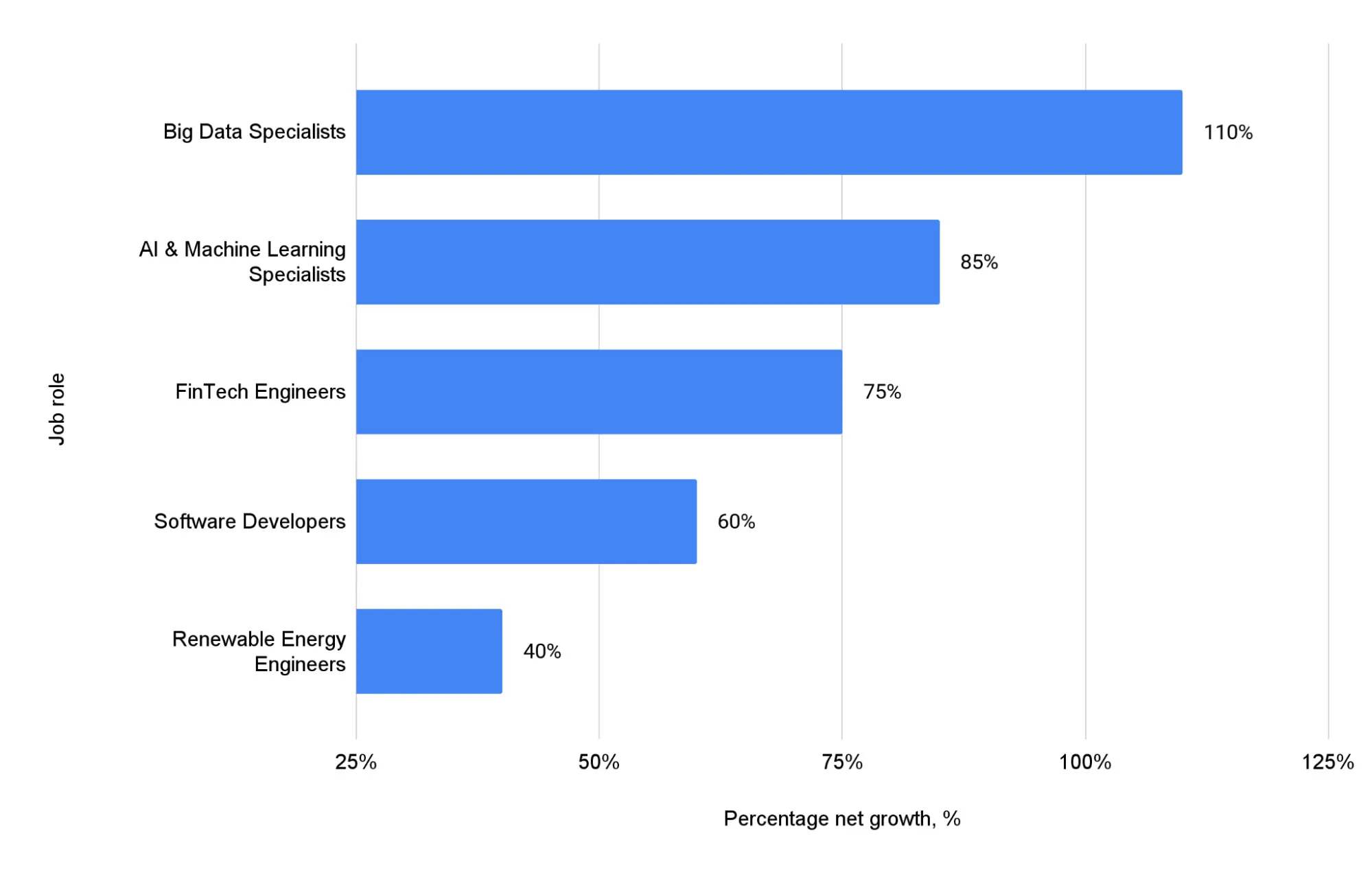
- Big Data Specialists lead all roles with 110% net job growth, making them the fastest expanding occupation in the chart.
- AI & Machine Learning Specialists show 85% growth, underscoring rising demand for advanced AI-related skills.
- Software Developers continue to see strong expansion, with 60% net growth, alongside 40% growth for Renewable Energy Engineers.
Jobs most affected by AI: Growth leaders in the automation era
The fastest-growing roles are concentrated in data, AI, and digital infrastructure, indicating where new employment opportunities are emerging most clearly. While discussions about jobs most likely to be replaced by AI often focus on automation risk, this data shows that AI simultaneously drives substantial job growth in specialized technical fields. Understanding which jobs will AI replace requires pairing task automation data with evidence of where demand is accelerating most strongly.
While some roles are expanding rapidly alongside AI adoption, others are experiencing sustained decline as automation reshapes routine and clerical work.
Jobs most likely to be replaced by AI and automation
The chart shows the job roles with the fastest percentage decline, highlighting occupations where automation and AI are reducing employment most sharply. These figures provide concrete insight into which jobs are at risk from AI as task automation accelerates.
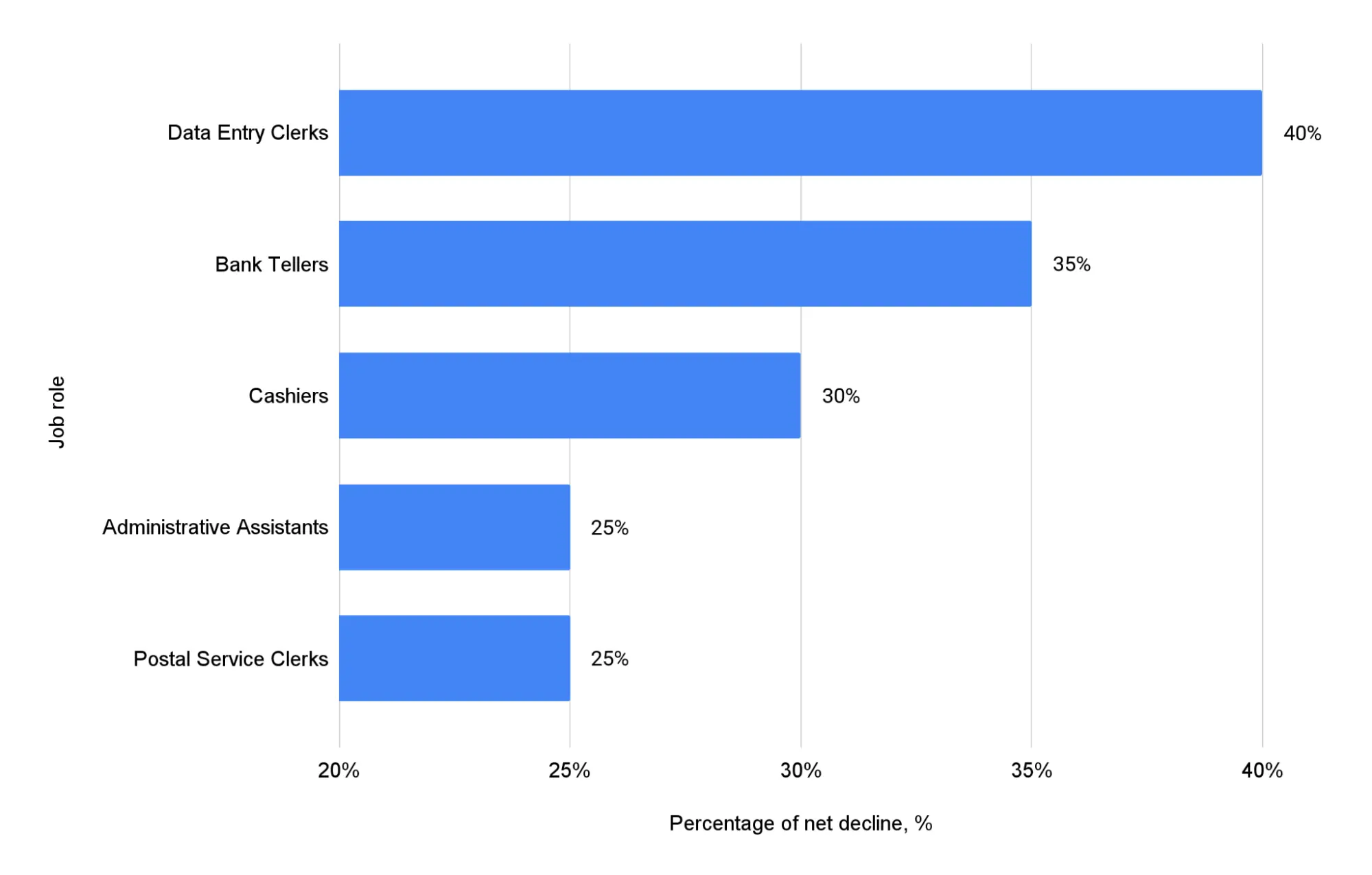
- Data Entry Clerks face the steepest decline, with employment falling by 40%, making them the job most affected by AI in the chart.
- Bank Tellers experience a 35% decline, reflecting the impact of automation on transaction-based roles.
- Cashiers see a 30% reduction, while Administrative Assistants and Postal Service Clerks each decline by 25%.
Which jobs are at risk from AI: Fastest declining roles
The fastest-declining roles are primarily found in clerical, transactional, and routine occupations, where tasks are easier to automate. This pattern clarifies which jobs AI will replace first, as automation targets predictable and repeatable work. Overall, the data underscores how task-level automation translates directly into employment declines for specific job categories.
After identifying which roles are most exposed to automation-related decline, it is equally important to examine whether AI-driven transformation generates enough new employment to offset these losses.
Will AI create more jobs? Global job creation through 2030
The chart presents an AI job creation forecast from 2025 to 2030, showing how the number of jobs created by AI evolves. It illustrates the pace at which new jobs created by AI accumulate as automation and digital technologies scale globally.
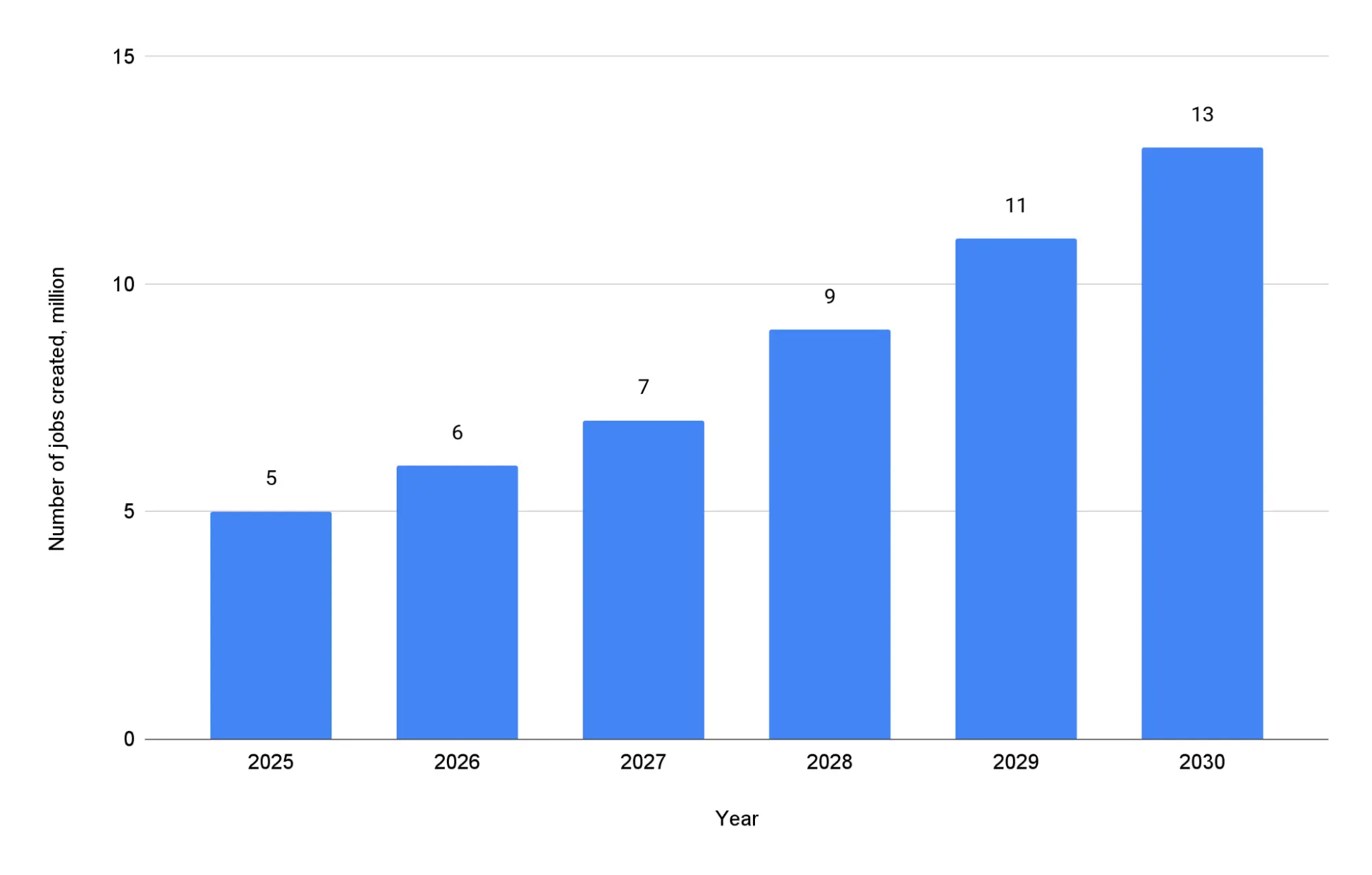
- Global job creation linked to AI rises from 5 million jobs in 2025 to 13 million jobs in 2030, indicating accelerating employment growth over the period.
- Annual job creation increases steadily each year, moving from 6 million in 2026 to 11 million by 2029, before reaching its peak in 2030.
- Across the full period shown, the upward trend supports a net global gain of 78 million jobs by 2030, reinforcing expectations that AI-driven transformation contributes positively to employment.
New jobs created by AI: Global employment growth outlook
These projections suggest that AI is not only reshaping existing roles but also generating a growing pipeline of new employment opportunities. The data aligns with broader expectations about jobs that will be in demand in the next 5 years, particularly in technology-driven and digitally enabled sectors. Overall, the trajectory indicates that understanding what jobs AI will create is central to evaluating whether AI ultimately expands or contracts the global labor market.
After reviewing global patterns of job creation and displacement, the focus now narrows to the United States, where estimates aim to quantify the scale of AI job loss more precisely.
AI job loss in the United States: Estimated employment impact in 2025
The chart compares different estimates of AI-driven job losses in the United States in 2025, ranging from employer-reported figures to broader analytical estimates. This approach highlights the gap between officially reported jobs lost to AI and higher estimates that account for indirect and unreported displacement.
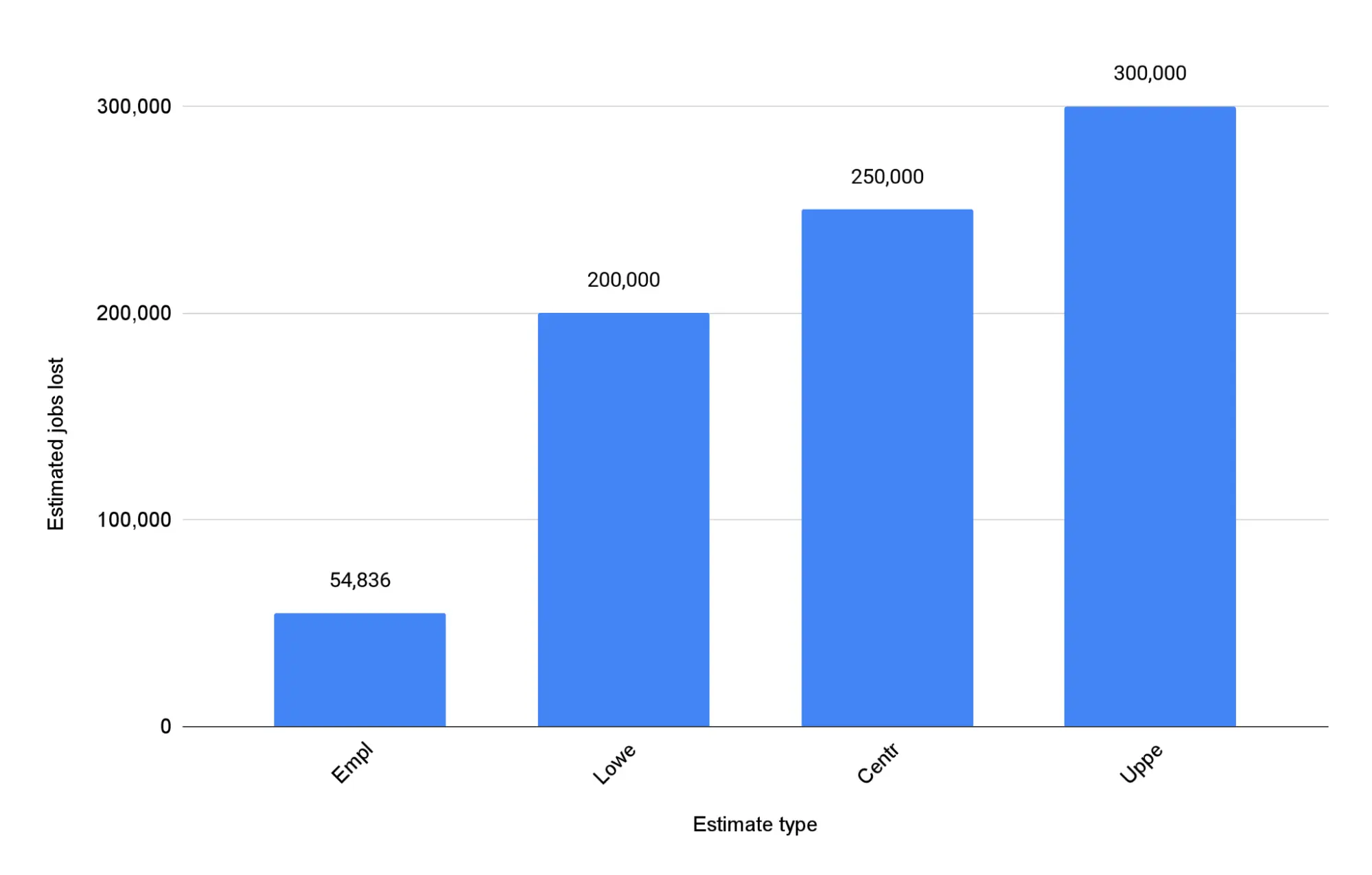
- Employer-reported data attributes 54,836 U.S. job losses to AI in 2025, representing the lowest bound in the chart.
- Broader analytical methods place AI job displacement between 200,000 and 300,000 jobs, suggesting substantially higher losses than employer disclosures indicate.
- The central estimate of 250,000 jobs lost implies that reported figures capture only a fraction of total job loss due to AI in the United States.
How many jobs were lost to AI in the US? 2025 estimates
These estimates suggest that official counts significantly understate the true scale of AI job loss in the U.S. labor market. A large share of people losing jobs to AI may not appear in employer-reported data, as displacement often occurs indirectly or through unfilled vacancies.
To understand why job losses linked to automation continue to emerge, it is necessary to examine the broader forces shaping how companies transform their operations.
Why companies automate: Macrotrends behind job loss and transformation
The chart outlines the macrotrends that employers identify as driving business transformation, highlighting the role of AI, robotics, and economic pressures. These trends provide essential context for discussions around robots taking over jobs and the wider impact of automation on employment.
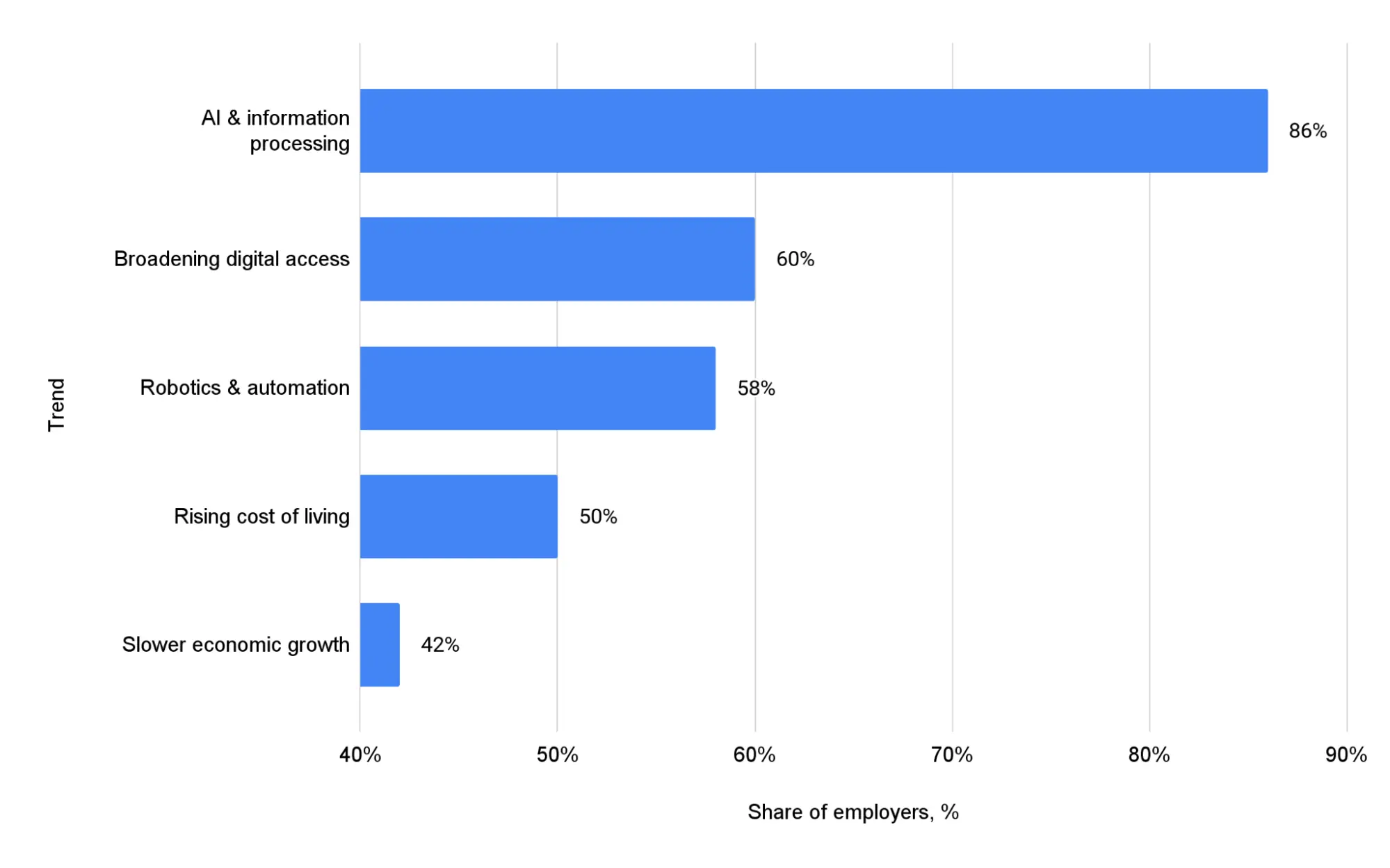
- AI & information processing is cited by 86% of employers, making it the most influential driver of business transformation in the chart.
- Robotics & automation are identified by 58% of employers, reinforcing the link between automation taking jobs and operational change.
- Beyond technology, 50% of employers point to rising cost of living and 42% to slower economic growth, showing that automation-driven job loss occurs alongside broader economic pressures.
Automation killing jobs? What drives business transformation today
These macrotrends suggest that automation is rarely adopted in isolation and is instead part of a wider transformation strategy. While concerns about automation killing jobs remain prominent, the data show that technology adoption is intertwined with cost pressures and growth dynamics. Interpreting jobs lost to automation statistics, therefore, requires accounting for both technological and economic drivers shaping employer decisions.
After examining the macro forces driving automation, the analysis now turns to where these pressures translate most directly into employment risk across specific job sectors.
Which jobs are being replaced by AI: Sectors most at risk
The chart shows the sectors with the highest share of jobs at risk from automation, highlighting where AI-driven change is most likely to reshape employment. This breakdown helps clarify what jobs are being replaced by AI by focusing on sector-level exposure rather than individual roles.
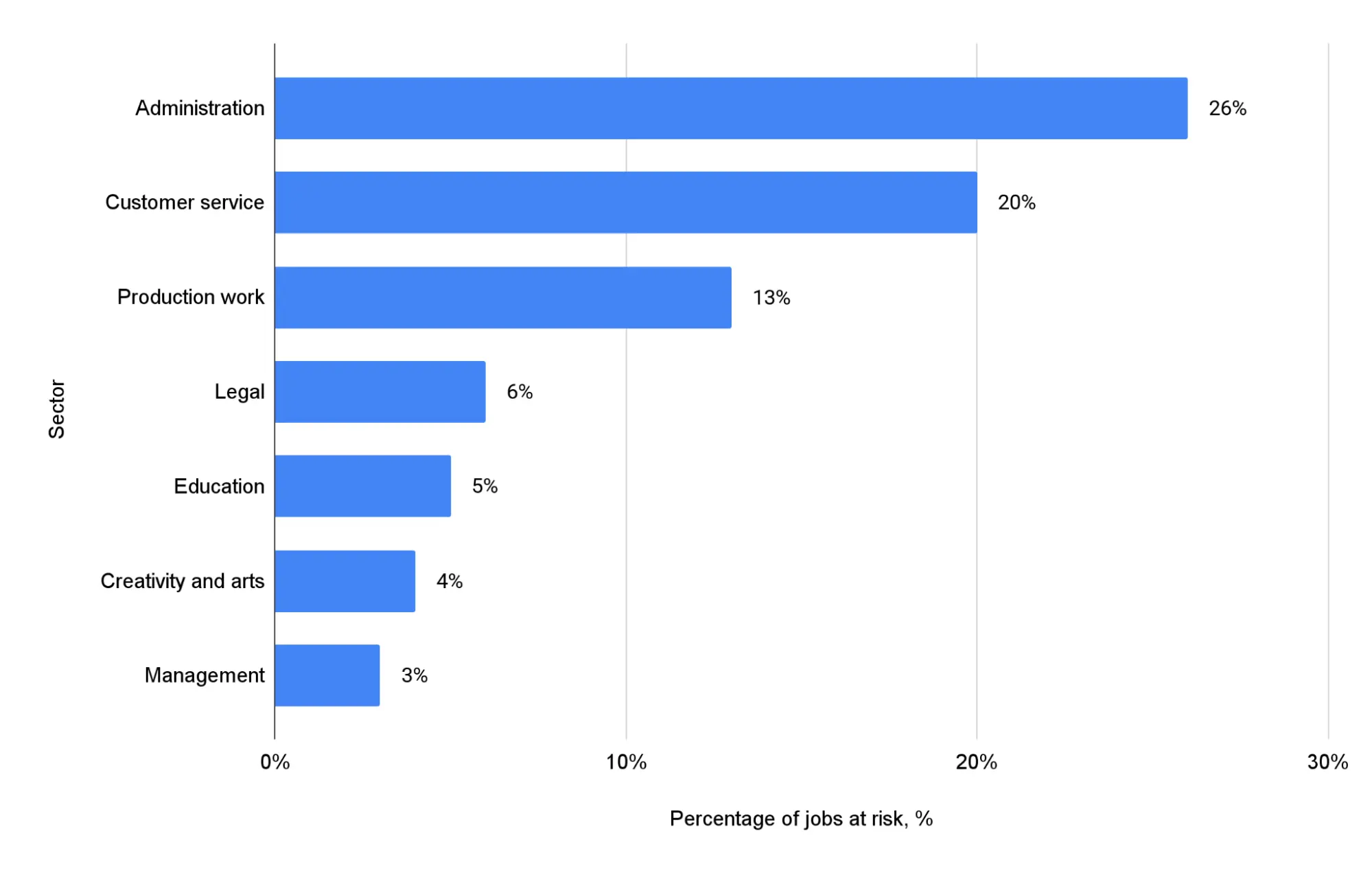
- Administration faces the highest automation exposure, with 26% of jobs at risk, making it the sector most affected in the chart.
- Customer service follows with 20% of jobs at risk, reflecting the vulnerability of routine, interaction-heavy tasks to automation.
- In contrast, higher-skill and creative fields show lower exposure, with Legal roles at 6%, Education at 5%, and Creativity and the arts at 4%.
What jobs has AI already replaced? Automation risk by sector
The data shows that AI-related job replacement is concentrated in sectors dominated by repeatable and standardized tasks. While questions about what jobs AI has already replaced often focus on individual occupations, sector-level exposure reveals a clearer pattern of risk. Overall, understanding how many jobs AI can replace requires looking at where automation pressure is structurally highest rather than evenly spread across the labor market.
After identifying which sectors and roles face the greatest automation risk, it is important to examine how the impact of AI on jobs translates into employment growth across the job market.
AI impact on jobs: Where employment growth is concentrated by 2030
The chart shows job roles with the strongest net employment growth by 2030, highlighting where demand is rising most sharply amid AI-driven transformation. These figures illustrate how the impact of AI on employment is reshaping the job market by shifting growth toward data- and technology-intensive roles.
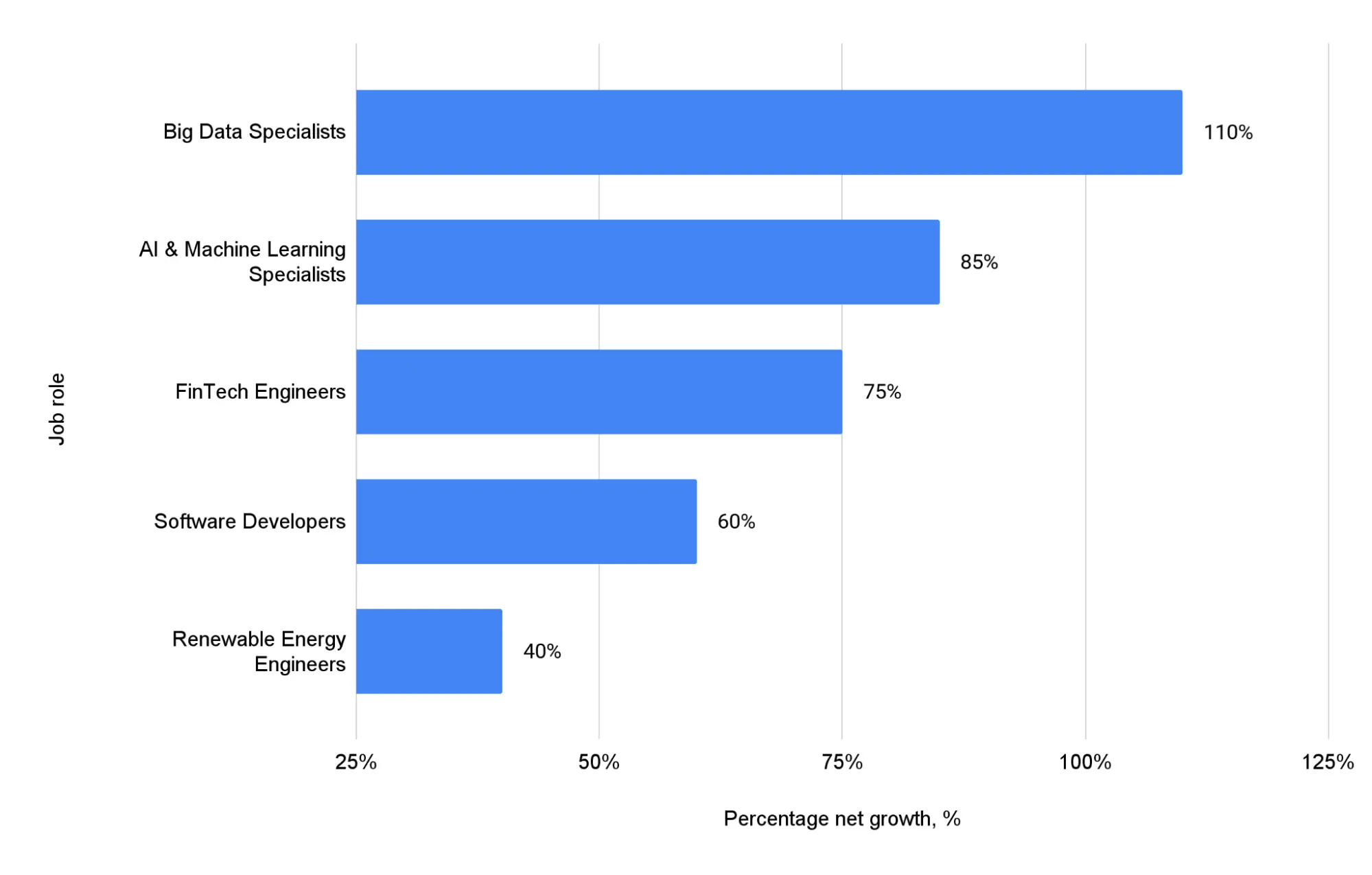
- Big data specialists lead all roles with 117% job growth, making them the fastest-growing occupation in the chart.
- AI specialists follow with 82% growth, reinforcing how the impact of AI on jobs is concentrated in advanced technical fields.
- Core digital roles continue to expand, with software developers growing by 57%, while data analysts (41%), security analysts (39%), and DevOps engineers (38%) also show strong gains.
Impact of AI on employment: Fastest-growing roles in the job market
These growth patterns show that the impact of AI on the job market is not evenly distributed across occupations. Employment expansion is heavily concentrated in roles that build, manage, and secure digital systems rather than in routine or manual work. Overall, understanding how AI will affect jobs requires recognizing that AI-driven change simultaneously reduces demand in some areas while accelerating growth in high-skill, data-centric professions.
Conclusions
- By 2030, artificial intelligence is set to reshape global employment through large-scale structural reallocation rather than outright job destruction. While AI-driven automation is projected to displace 92 million jobs worldwide, it will simultaneously create 170 million new roles, producing a net gain of 78 million jobs. This pattern indicates a labor market characterized by structural reallocation where the pace of change is defined less by absolute losses and more by the speed at which roles are redefined, eliminated, or newly created.
- A defining feature of this transition is the scale of workforce churn. With 22% of all global jobs affected by creation or displacement, AI’s impact extends far beyond a narrow set of occupations. Yet this disruption is uneven. Automation pressures concentrate most heavily on routine, clerical, and transaction-based roles, while growth accelerates in data-intensive, technical, and digital infrastructure positions. The divergence between declining roles, such as data entry and cash handling, and rapidly expanding roles like big data and AI specialists illustrates a clear polarization of labor demand.
- Employer behavior further underscores this pattern. Rather than responding primarily through mass layoffs, organizations are prioritizing adaptation. The strong emphasis on upskilling, talent acquisition, and workforce redeployment signals that job displacement is closely tied to skills mismatch rather than simple job elimination. In this context, employment risk increasingly depends on whether workers can transition into roles aligned with AI-driven productivity gains.
- The U.S. experience highlights the complexity of measuring AI’s labor impact. Estimated job losses of 200,000 to 300,000 positions in 2025 significantly exceed employer-reported figures, suggesting that much of AI-driven displacement occurs indirectly, through attrition, hiring slowdowns, or unfilled vacancies. This gap points to a structural limitation in traditional labor statistics, which are not designed to capture technology-driven substitution in real time.
- Looking ahead, the trajectory of AI’s impact on jobs will depend less on whether automation continues and more on how economies manage transition at scale. Sustained employment growth will hinge on education systems, reskilling capacity, and the ability of labor markets to absorb workers into emerging roles fast enough to offset displacement. If current trends persist, AI is unlikely to eliminate work itself, but it will decisively redefine who works, how work is done, and which skills determine long-term economic relevance.
Sources
- https://reports.weforum.org/docs/WEF_Future_of_Jobs_Report_2025.pdf. Accessed 16 February 2026.
- Elad, Barry. “AI Job Creation Statistics 2025: Remote, Hybrid & High-Paying Roles Revealed.” SQ Magazine, 10 July 2025, https://sqmagazine.co.uk/ai-job-creation-statistics/. Accessed 16 February 2026.
- Shapiro, David. “AI Destroyed 200k to 300k Jobs in 2025 in the US.” David Shapiro’s Substack, https://daveshap.substack.com/p/ai-destroyed-200k-to-300k-jobs-in. Accessed 16 February 2026.


 Built-in AI detector