


 Article fact-checked
-
The global AI market is projected to surge from $0.5 trillion in 2023 to $2.7 trillion by 2032, more than quintupling in size within a decade and surpassing $1 trillion by 2027.
-
Annual AI market growth will remain consistently strong, peaking at 28.6% in 2026 and staying above 16% through 2032, signaling sustained long-term momentum.
-
North America leads the global AI landscape with a 36.9% market share, followed by Europe (26.0%) and Asia Pacific (25.5%), which together capture nearly 89% of global AI activity.
-
AI adoption is most concentrated in Technology & Communication (32%), Automotive & Assembly (29%), and Financial Services (28%), underscoring dominance by data-intensive sectors.
-
Segment-level expansion is driven by Healthcare and Chips: Healthcare is set to grow from $11.1 billion to $136.7 billion by 2029, while the Chips segment will reach $187.9 billion by 2030, making it the fastest-growing category.
-
NVIDIA remains the overwhelmingly dominant market leader with a 92% share, far ahead of Microsoft (39%), AWS (19%), and Google (15%), reflecting a highly concentrated competitive landscape.
The artificial intelligence (AI) market has emerged as one of the most dynamic and rapidly expanding sectors in the global economy. With applications ranging from healthcare and finance to cybersecurity and customer service, AI is transforming industries and driving innovation at a rapid and sustained pace. Understanding the AI market size, AI growth, and AI market share across sectors, technologies, and key players is crucial for businesses, investors, and policymakers seeking to capitalize on AI opportunities.
This article provides a comprehensive overview of the global artificial intelligence market, combining data-driven insights on market forecasts, segment growth, regional distribution, and the leading companies shaping the AI market. Through detailed charts and artificial intelligence data, readers will gain a clear understanding of how the AI industry is evolving, where growth is most pronounced, and which technologies and applications are driving adoption worldwide.
By exploring trends in the AI industries, the article highlights both current market dynamics and future projections, offering actionable insights for strategic planning and investment decisions. Whether you are looking at AI growth rates, market segmentation, or technology adoption, this guide presents a complete picture of the rapidly expanding artificial intelligence sector.
Global ai market size statistics by year: trends and projections
The following graph illustrates the AI market size from 2023 to 2032 in USD trillions. It captures both the current scale and future expansion of the AI market, providing a clear view of expected growth trajectories. By examining forecasts such as the AI market forecast, we can better understand the potential reach and value of artificial intelligence across industries.
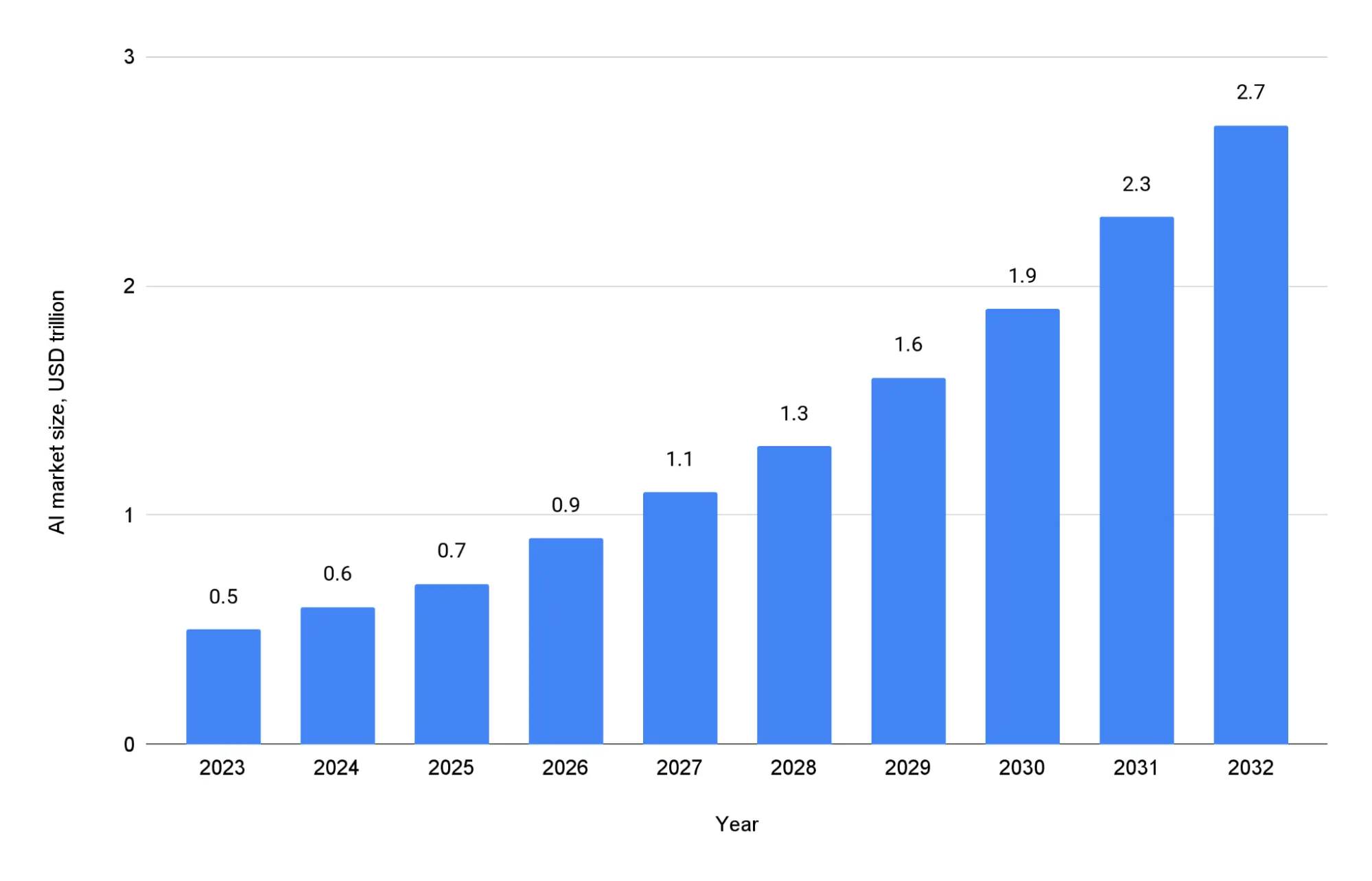
- The AI market is projected to grow from $0.5 trillion in 2023 to $1.1 trillion by 2027, more than doubling over four years.
- By 2030, the AI market size is expected to reach $1.9 trillion, showing a steady year-over-year increase.
- The global AI market could expand to $2.7 trillion by 2032, indicating a more than fivefold growth compared to 2023.
How big will the AI market be by 2032?
How fast is AI growing?
- The AI market is projected to grow from $0.7 trillion in 2025 to $2.7 trillion by 2032, representing a compound annual growth rate (CAGR) of approximately 21.2%.
The forecasted expansion demonstrates that the AI market is on a rapid upward trajectory, with substantial growth expected throughout the 2020s. Such projections underline the increasing economic significance of artificial intelligence, both in terms of investment opportunities and technological adoption. As the AI total addressable market continues to widen, businesses and policymakers should anticipate significant shifts in market dynamics and prepare for the scale of AI’s global impact.
After examining the global AI market size forecast, it is important to understand how this market is distributed across different regions worldwide.
AI market share distribution across regions
The following graph presents the AI market share by region, highlighting the relative contribution of key geographic areas. This breakdown of the AI market provides insight into where AI adoption and investment are currently most concentrated. By analyzing regional distribution, we can see which markets dominate and which have growth potential.
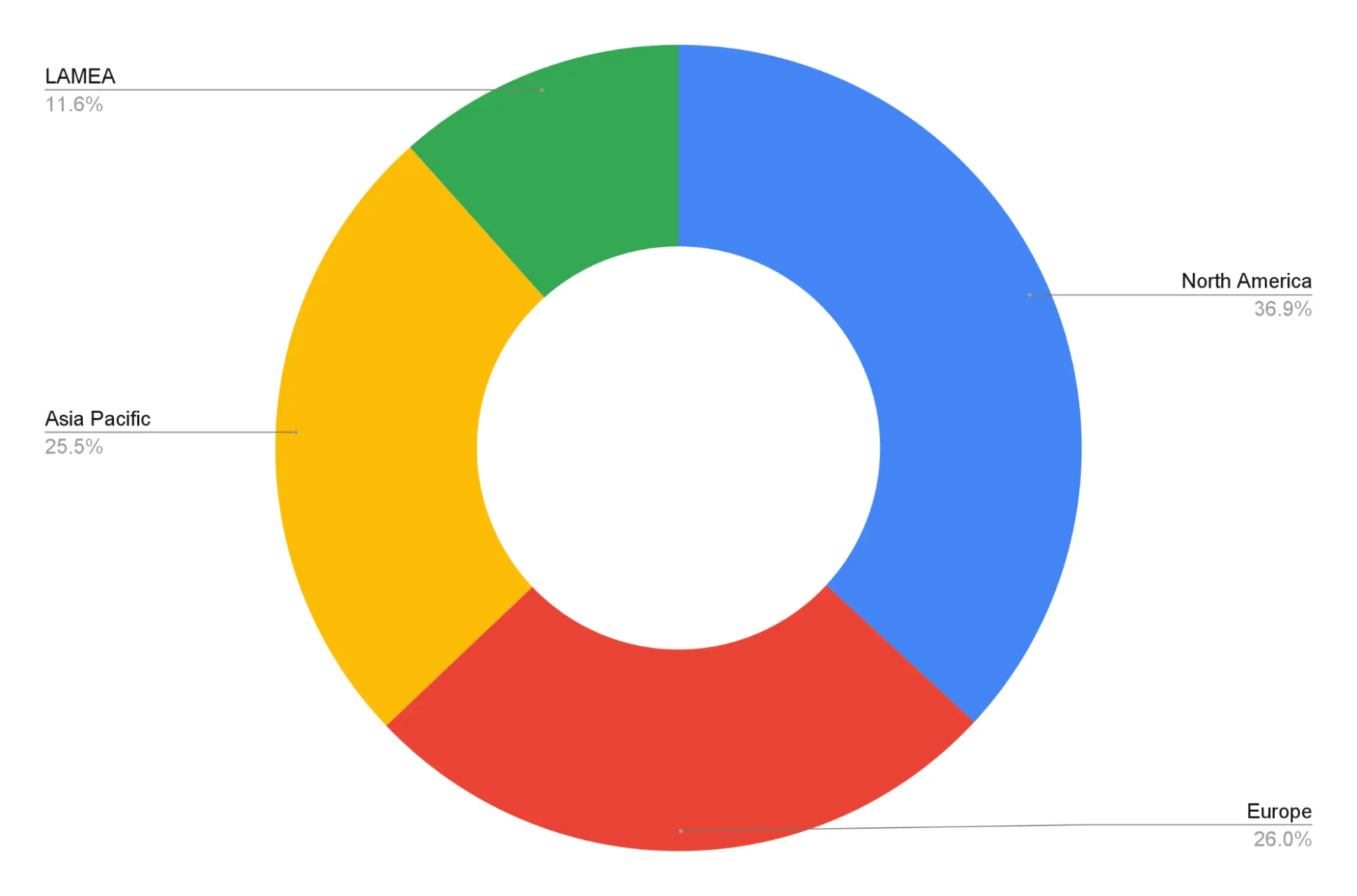
- North America leads the AI market with a 36.9% share, reflecting its strong technology infrastructure and early AI adoption.
- Europe holds 26.0% of the global AI market, slightly surpassing the Asia Pacific region, which accounts for 25.5%.
- The LAMEA region contributes 11.6% of the AI market, highlighting its smaller but growing presence in the global landscape.
How the AI market is divided globally
The regional breakdown indicates that the AI market is heavily concentrated in North America, Europe, and the Asia Pacific, together accounting for nearly 89% of the total market. While LAMEA currently represents a smaller share, there is potential for growth as AI adoption spreads. Understanding these regional dynamics is crucial for businesses and investors looking to capitalize on global AI opportunities.
Having explored the regional distribution of the AI market, we now focus on its expected growth rates over the coming years.
Global AI market growth forecast
The following graph illustrates the AI growth forecast from 2024 to 2032 in percentages. Using artificial intelligence growth statistics and AI growth rate projections, it highlights fluctuations and peaks in the growth of AI across the forecast period. This visualization helps quantify how quickly the global AI market is expanding year by year.
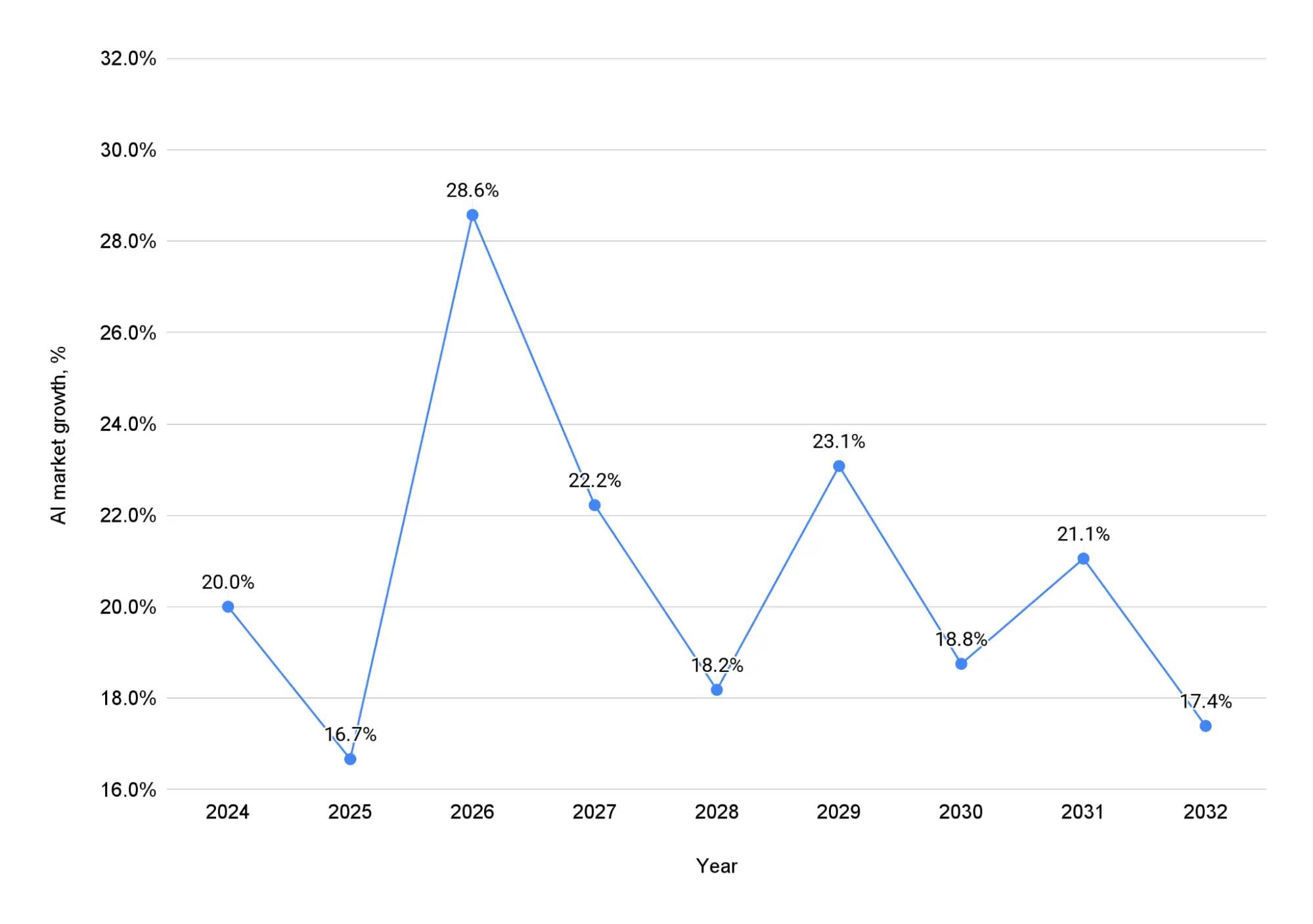
- The AI growth rate is projected to peak at 28.6% in 2026, marking the fastest expansion in the forecast period.
- The growth of AI slows slightly in 2025 to 16.7%, indicating some variability in annual growth.
- Even by 2032, the AI growth remains strong at 17.4%, demonstrating sustained momentum over nearly a decade.
How fast is the AI market growing worldwide?
The forecast shows that the global AI market will experience significant year-over-year growth, with rates ranging from 16.7% to 28.6% between 2024 and 2032. These projections underline the continued acceleration of AI adoption worldwide, with periods of faster growth followed by steady expansion. Businesses and policymakers should anticipate this dynamic market environment when planning investments and strategies.
After analyzing overall global AI growth, it is essential to examine how the AI industry is distributed across different market segments.
AI market size by segment: healthcare and chips
The graph below illustrates the AI market size by segment, focusing on Healthcare and Chips, measured in USD billions from 2021 to 2030. Using AI industry growth and artificial intelligence industry growth data, this visualization highlights which segments are driving the expansion of the AI industry. The comparison provides insights into the most valuable areas of the AI industry over the coming decade.
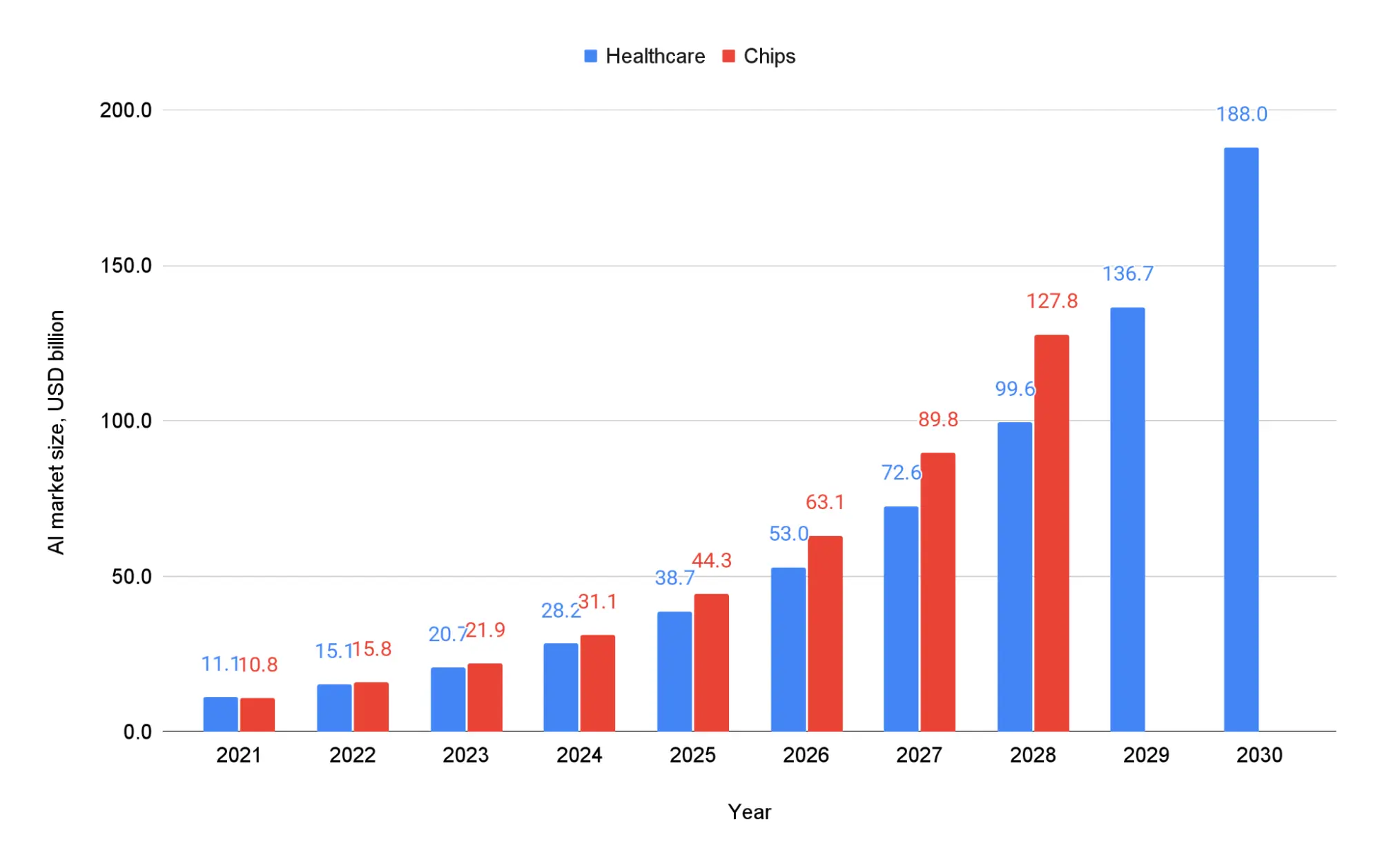
- The AI market in Healthcare is projected to grow from $11.06 billion in 2021 to $136.66 billion by 2029, more than a twelvefold increase.
- The Chips segment is expected to rise from $10.8 billion in 2021 to $187.95 billion by 2030, representing the fastest growth among the segments.
- By 2027, the AI industry will see $72.62 billion in Healthcare and $89.8 billion in Chips, indicating that Chips will surpass Healthcare as the largest AI segment.
How much is the AI industry worth across key segments?
Segment-level analysis reveals that the AI industry is expanding rapidly across both Healthcare and Chips, with Chips showing the fastest growth among the analyzed segments. These trends demonstrate how technological innovation and investment in critical areas are shaping the future AI market size. Understanding segment-specific trajectories is crucial for stakeholders looking to prioritize resources and identify high-value opportunities within the AI industries.
Having explored the AI market size by segment, it is important to analyze the AI industry growth within these segments to understand which areas are expanding most rapidly.
AI market growth by segment: healthcare vs chips
The graph below shows the AI market growth by segment in percentages from 2022 to 2030, focusing on Healthcare and Chips. Using artificial intelligence industry growth and AI industry growth data, this visualization highlights the relative pace at which each segment is developing. Observing these trends helps identify the fastest-growing areas within the AI industry.
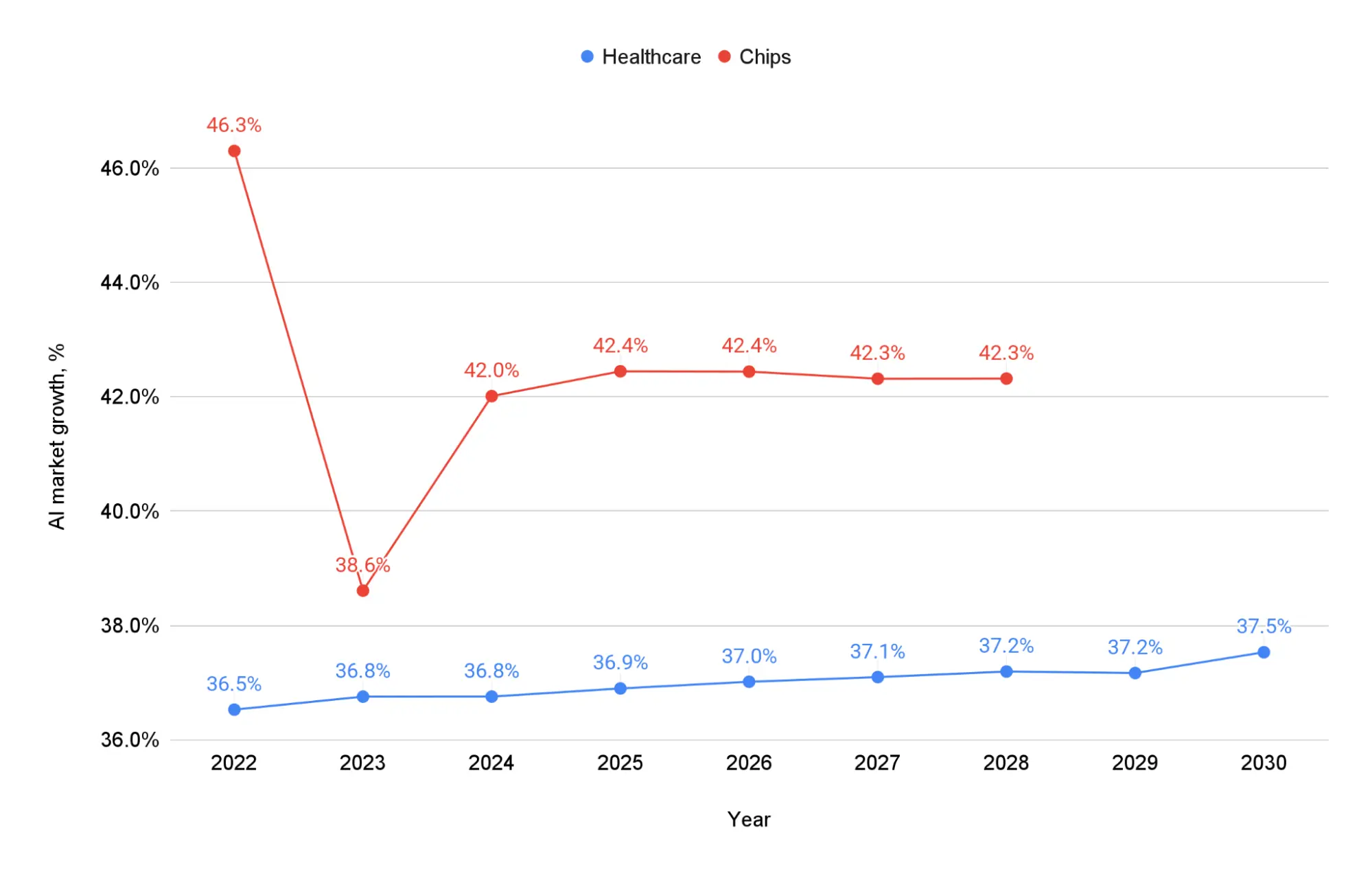
- The Chips segment shows the fastest AI industry growth, reaching 46.3% in 2022 and remaining above 42% through 2030.
- Healthcare maintains steady AI industry growth, increasing from 36.53% in 2022 to 37.53% by 2030, reflecting consistent expansion.
- By 2027, Chips’ growth slightly exceeds 42.3%, while Healthcare growth is at 37.10%, demonstrating that Chips continues to outpace Healthcare in growth rate.
How the AI industry is growing across key segments
Segment-level growth analysis shows that the AI industries are expanding steadily across both Healthcare and Chips, with Chips consistently leading in growth rate. This indicates that investment and innovation in the Chips segment are driving a substantial portion of AI industry growth, while Healthcare continues to demonstrate stable and predictable expansion. Understanding these patterns is critical for companies and investors prioritizing high-growth opportunities within the AI industry.
After examining segment-level growth in the AI industries, it is crucial to explore how the artificial intelligence market is distributed across different sectors.
AI market share across key sectors
The graph below illustrates market AI share by sector, highlighting the largest contributors to the artificial intelligence market. By analyzing intelligence market distribution, we can identify which industries dominate and which have emerging opportunities. This sector-level view provides a clear picture of the structure and concentration of AI markets worldwide.
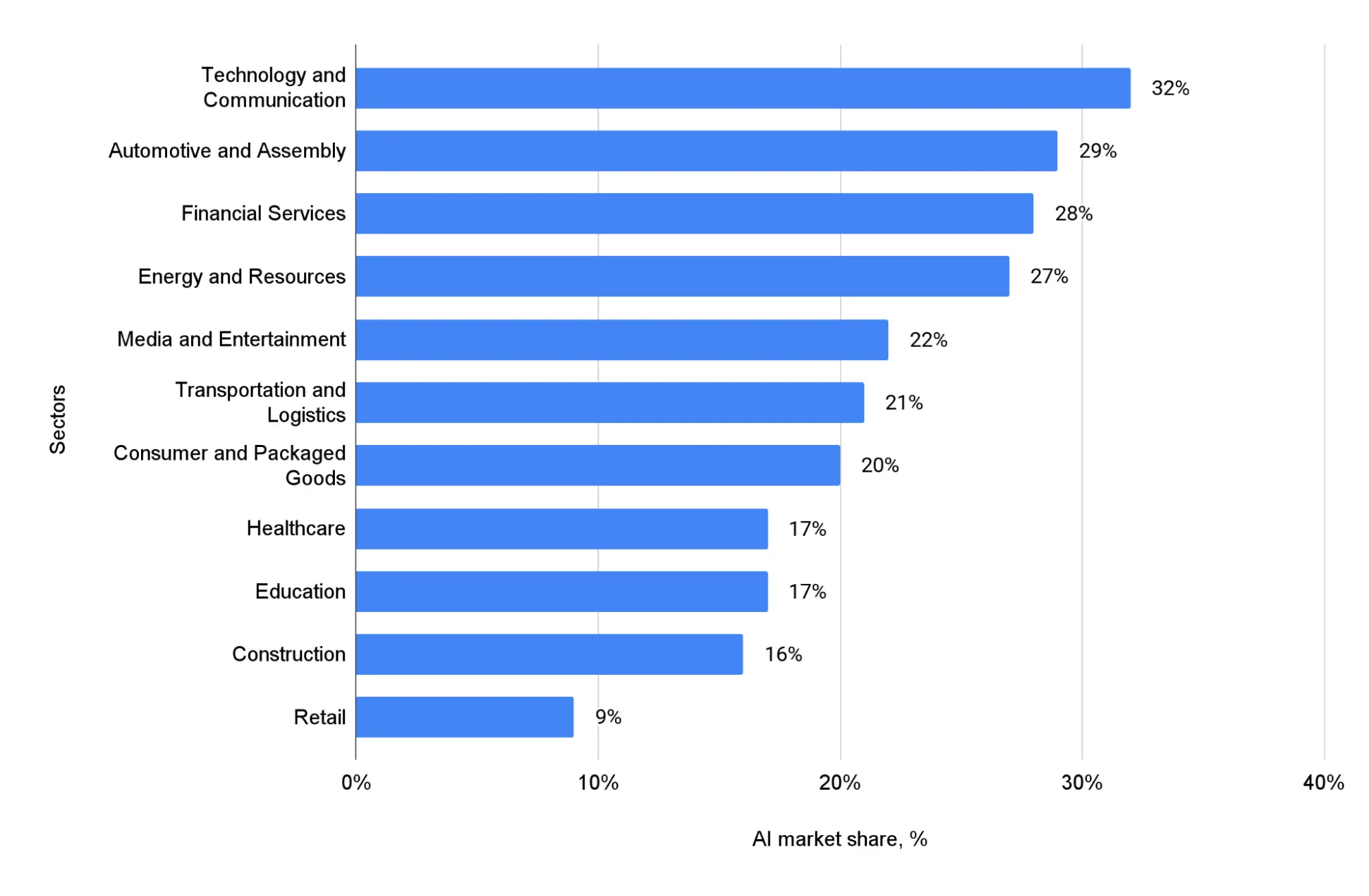
- The Technology and Communication sector leads the artificial intelligence market with a 32% share, making it the largest contributor.
- Automotive and Assembly and Financial Services follow closely with 29% and 28%, respectively, showing strong AI adoption in these industries.
- Retail and Construction have the smallest shares, at 9% and 16%, indicating a lower current penetration of AI technologies.
Artificial intelligence statistics: how the artificial intelligence market is distributed by industry
Sector-level analysis reveals that the artificial intelligence sector is concentrated in a few key industries, with Technology, Automotive, and Financial Services accounting for the majority of the market. Other sectors, such as Healthcare, Education, and Retail, still represent growth opportunities as AI adoption expands. Understanding this distribution helps businesses and investors target the most influential sectors within the AI markets.
After reviewing AI market share by sectors, it is important to examine which companies dominate the artificial intelligence market globally.
AI market share among leading companies
The graph below illustrates the market share of AI held by major companies, highlighting the leading players in the artificial intelligence market. These market share values represent different segments of the AI ecosystem (such as GPUs, cloud AI infrastructure, and foundation model providers), and therefore do not sum to a single unified total. By analyzing the distribution of the intelligence market, we can identify which organizations drive the majority of AI innovation and revenue. This perspective provides insight into the competitive landscape of AI markets worldwide.
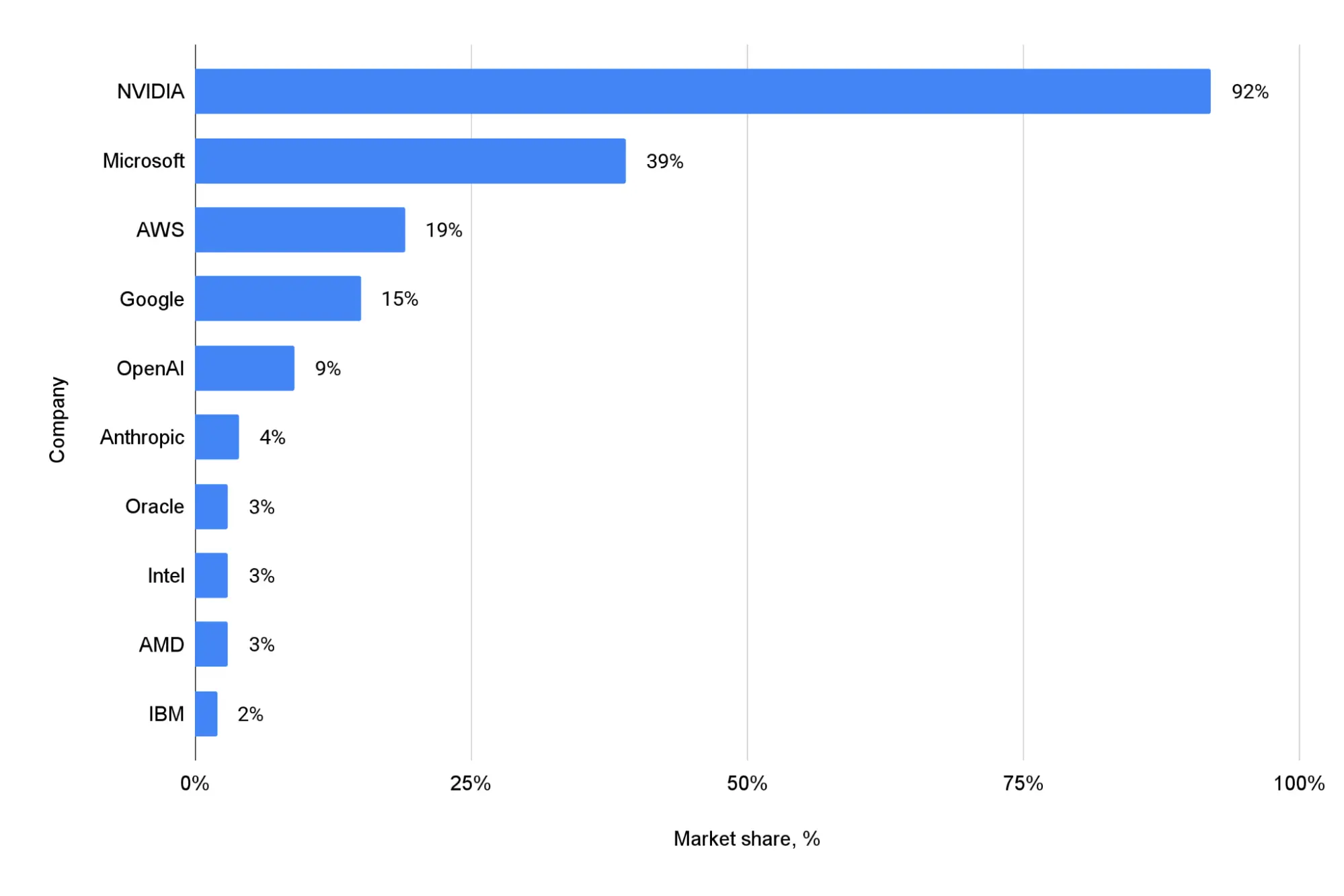
- NVIDIA dominates the artificial intelligence market with a 92% share, making it the largest single player.
- Microsoft follows with 39%, while AWS and Google hold 19% and 15%, respectively.
- Smaller players such as OpenAI, Anthropic, and IBM collectively hold less than 15% of the AI market, indicating a highly concentrated market.
How the artificial intelligence market is divided by key players
The company-level breakdown highlights that the artificial intelligence sector is dominated by a few key players, with NVIDIA clearly leading. The concentration of market share among a handful of companies underscores the competitive nature of the AI markets and suggests that innovation and scale are critical for success. Emerging players may find opportunities in niche applications, but large incumbents currently shape the global AI landscape.
Building on the analysis of AI market share by key players, it is equally important to explore which areas of application are driving adoption within the artificial intelligence market.
AI market share across key application areas
The graph below illustrates the market AI share by key application areas, showing which uses of AI are most prevalent. By examining intelligence market data, we can identify leading areas such as Customer Service, Cybersecurity Management, and ChatBots, which dominate the AI markets. This provides insight into the functional distribution of AI adoption across industries
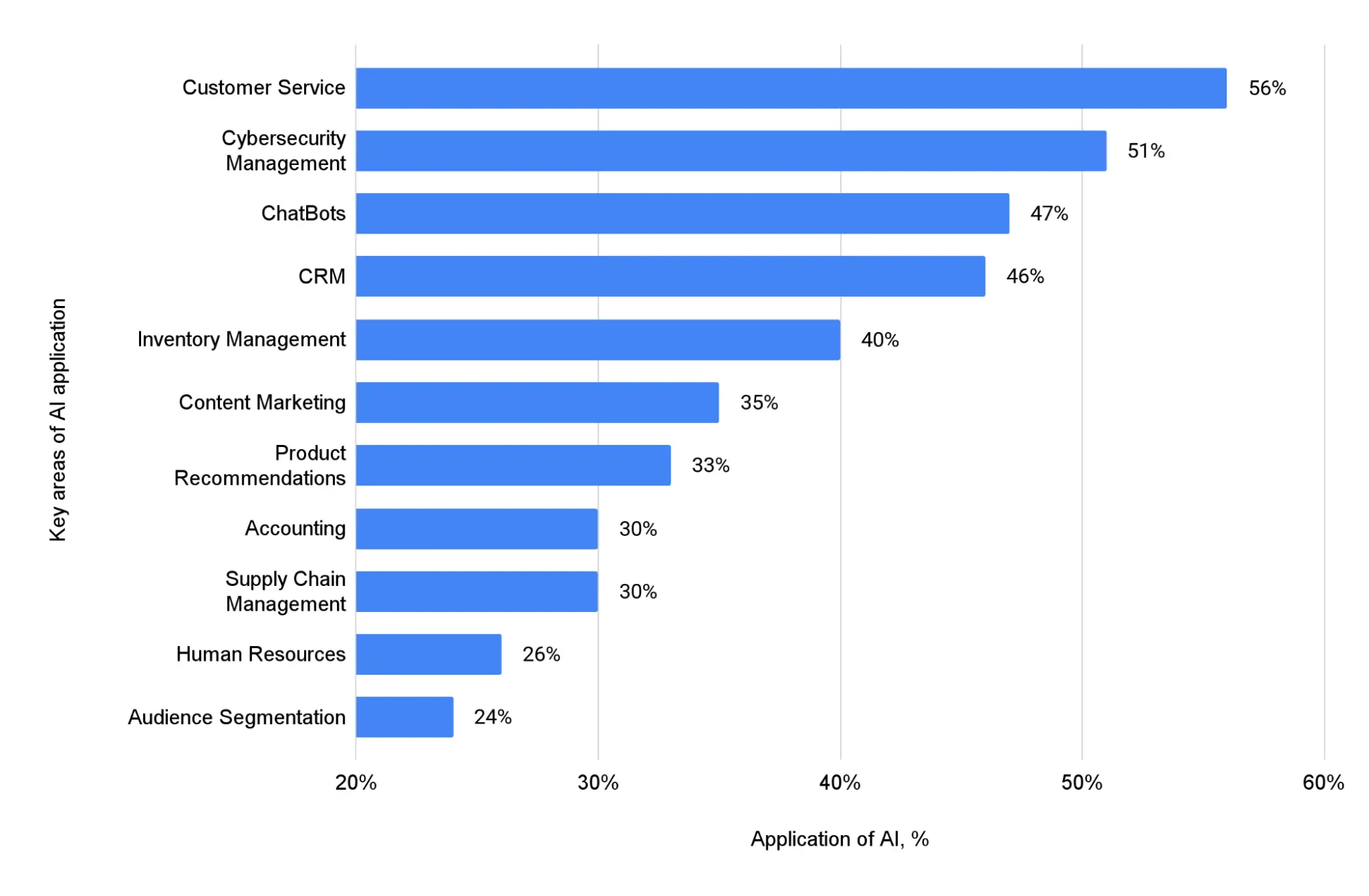
- Customer Service leads the artificial intelligence market with a 56% share, representing the top application of AI.
- Cybersecurity Management and ChatBots follow closely with 51% and 47%, respectively, indicating strong adoption in security and interaction applications.
- Human Resources and Audience Segmentation are among the smaller areas, with 26% and 24% of the AI markets, showing emerging but growing usage.
How artificial intelligence is used by industry functions
The distribution of AI markets by application highlights that customer-facing and security functions are currently the most dominant areas of AI adoption. Other functions, such as HR, supply chain, and accounting, show moderate penetration, suggesting growth opportunities. Understanding the functional allocation of the artificial intelligence sector helps organizations prioritize implementation and identify high-impact areas for AI deployment.
Following the examination of AI adoption by key areas, it is important to analyze how different technologies contribute to the artificial intelligence market.
AI market share by technology type
The graph below illustrates the market AI share by technology, highlighting the distribution of AI across major technological domains. By examining intelligence market data, we can see which technologies, such as Deep Learning, Machine Learning, NLP, and Machine Vision, are leading the AI markets. This provides insight into the technological foundation of the artificial intelligence sector.
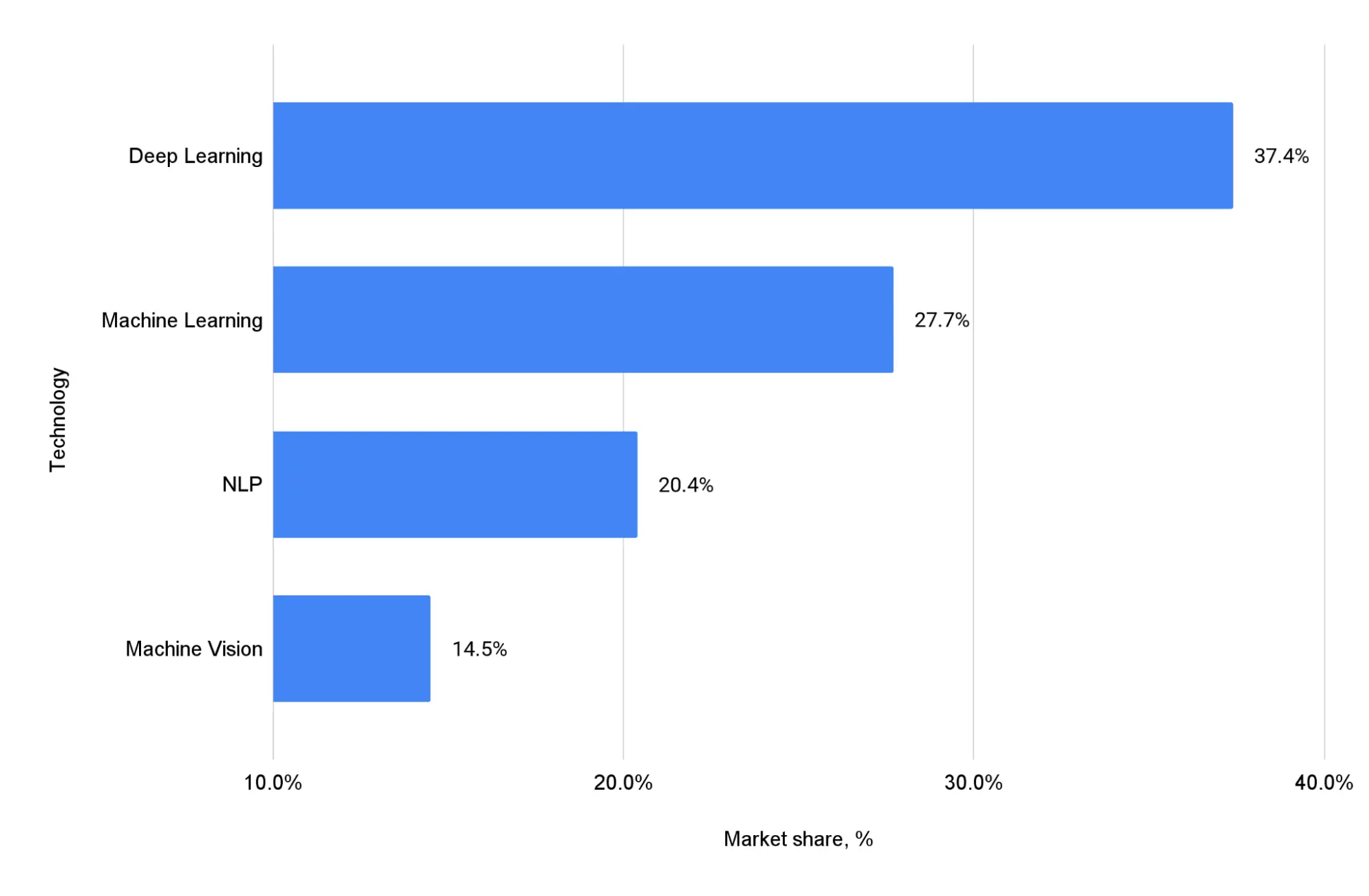
- Deep Learning holds the largest share of the artificial intelligence market at 37.4%, leading the technological adoption.
- Machine Learning follows with 27.7%, indicating significant usage in AI applications.
- NLP and Machine Vision account for 20.4% and 14.5%, respectively, showing smaller but important contributions to the AI markets.
How artificial intelligence is distributed across technologies
Technology-level analysis reveals that the artificial intelligence sector is primarily driven by Deep Learning and Machine Learning, which together make up over 65% of the market. NLP and Machine Vision play critical supporting roles, reflecting the diversity of AI technologies in current applications. Understanding the technological distribution within AI markets helps stakeholders prioritize investments and development efforts in high-impact AI areas.
Conclusions
- By the early 2030s, the global AI market will continue to advance into a phase of sustained structural growth, characterised by predictable expansion patterns, increasingly mature adoption across industries, and a clear consolidation of technological leadership. What began as rapid, innovation-driven acceleration has evolved into a stable, long-horizon growth trajectory, with the market set to expand from $0.5 trillion in 2023 to $2.7 trillion by 2032. This shift reflects not only rising investment volumes but also a broader institutional readiness to embed AI technologies into core business operations and national digital strategies.
- A defining development in this period is the divergence between early experimental use of AI and the more standardised, sector-specific integration visible today. Industries such as Technology & Communication, Automotive & Assembly, and Financial Services now demonstrate entrenched AI adoption, accounting for the majority of market share worldwide. Meanwhile, regions with advanced digital infrastructure, especially North America, Europe, and the Asia Pacific, exhibit consistent, long-term leadership, together capturing nearly 89% of the global AI market. This geographic concentration underscores both the maturity and the competitiveness of these ecosystems.
- Despite this stability, structural variability persists across segments. Healthcare and Chips illustrate contrasting but complementary growth profiles: Healthcare shows steady, predictable expansion, while the Chips segment is undergoing a rapid scale-up, with annual growth rates consistently exceeding 42%. Such dynamics point to an AI market that is both diversified and deeply reliant on foundational technologies, particularly advanced hardware and algorithmic innovation.
- Long-term trends indicate a clear transition from isolated AI deployments toward systematic, large-scale integration across economic sectors. The dominance of Deep Learning and Machine Learning, together accounting for over 65% of the technological base, reflects the consolidation of core methodologies that drive modern AI systems. At the same time, the overwhelming market leadership of NVIDIA, with a 92% share, highlights the strategic importance of compute capacity in shaping global AI capabilities.
- Looking forward, the trajectory of the AI market will depend on the sector’s ability to maintain high growth rates as adoption expands into more regulated, data-sensitive, and operationally complex domains. While the foundational drivers of growth remain strong, long-term competitiveness will hinge on accelerated infrastructure investments, enhanced model efficiency, and the global distribution of compute resources. If current trends continue, AI is positioned to remain one of the most influential engines of economic transformation, shaping productivity, innovation, and technological progress across the world.
Sources
- “AI Market Size Statistics (2025-2032).” Exploding Topics, 10 Oct. 2025, https://explodingtopics.com/blog/ai-market-size-stats. Accessed 08 December 2025.
- Zoting, Learn. Artificial Intelligence (AI) Market Size to Hit USD 3,680.47 Bn by 2034. https://www.precedenceresearch.com/artificial-intelligence-market. Accessed 08 December 2025.


 Built-in AI detector