




 Article fact-checked
-
ChatGPT’s global user base expanded from 358 million in January 2025 to 810 million by November 2025, adding over 450 million monthly active users in less than a year and confirming its transition into a mainstream digital platform.
-
With 5.6 billion monthly visits, chatgpt.com ranks among the top five most visited websites worldwide, matching Instagram and surpassing Reddit and Wikipedia, highlighting AI’s rapid rise alongside legacy internet giants.
-
Weekly active users reached 800 million by April 2025, nearly matching monthly usage levels, indicating unusually high engagement and habitual use rather than sporadic experimentation.Daily usage is estimated between 114 million and 193 million users, demonstrating deep integration of ChatGPT into everyday workflows at a scale comparable to the world’s largest consumer platforms.
-
Adoption is globally diversified: the United States and India each account for 16% of users, while more than 60% of traffic comes from countries outside the top five, underscoring broad international reach.
-
Usage skews toward younger audiences, with over 50% of users aged 18–34, and shows a balanced gender split, reinforcing ChatGPT’s appeal across core digital-native demographics.Non-work activities dominate usage (73%), but professional tasks such as research, coding, and email writing account for more than a quarter of activity, highlighting ChatGPT’s dual role as both a consumer and productivity tool.
-
Monetization is accelerating rapidly: revenue grew from $1.0 billion in 2023 to a projected $11.6 billion in 2025, driven primarily by Plus subscriptions, while enterprise plans show the highest long-term retention.
Since its launch, ChatGPT has rapidly grown into one of the world’s most widely used AI platforms. This article provides a comprehensive overview of ChatGPT users’ statistics, including global adoption trends, demographic profiles, device preferences, and usage behavior. We analyze monthly and weekly active users, traffic sources, task breakdowns, and subscription retention rates, offering a clear picture of how ChatGPT is being used across the globe. By examining user engagement, geographic distribution, and revenue streams, this article highlights the platform’s widespread impact and evolving role in both personal and professional contexts.
Top 20 Websites by Number of Visits Worldwide (November 2025)
The chart illustrates the top 20 websites by number of visits worldwide as of November 2025, ranked by total monthly traffic. It highlights the dominance of search engines, social platforms, and content hubs, while also revealing how AI-driven platforms are positioning themselves among long-established digital leaders.
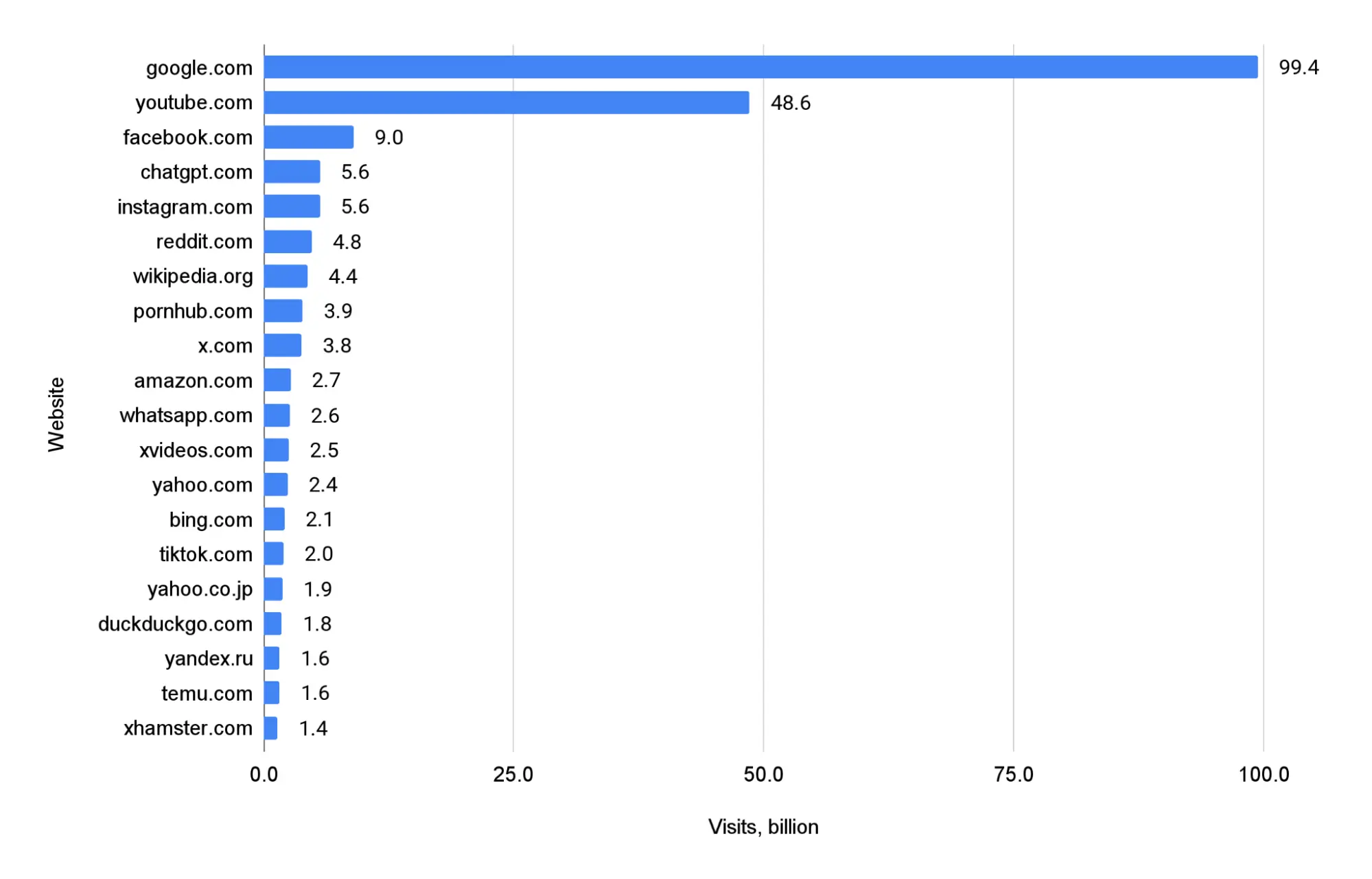
- Google.com leads the ranking with 99.4 billion visits, generating more traffic than the combined visits of all websites ranked from third to twentieth.
- chatgpt.com ranks 4th globally with 5.6 billion visits, matching instagram.com and surpassing platforms such as reddit.com (4.8 billion) and wikipedia.org (4.4 billion).
- The traffic gap between the top two sites is substantial, with Google.com receiving 50.8 billion more visits than YouTube.com, which records 48.6 billion visits.
Most visited websites globally: top 20 rankings by traffic volume
The data shows an extreme concentration of web traffic among a small number of platforms, with Google and YouTube operating at a scale far beyond the rest of the internet. At the same time, the presence of chatgpt.com in the top five demonstrates how quickly AI-native products can achieve mass adoption and compete directly with legacy social and content platforms. Overall, the ranking reflects a shift toward multifunctional platforms that combine search, content consumption, and interactive experiences at global scale.
While traffic rankings show how often users visit ChatGPT, monthly active user data provides a clearer view of how many people consistently use the platform over time.
ChatGPT user base
ChatGPT monthly active users worldwide: growth in 2025
The chart presents chatgpt monthly active users worldwide throughout 2025, tracking how the number of ChatGPT users worldwide evolved on a month-by-month basis. These ChatGPT user statistics highlight sustained growth in platform adoption rather than short-term traffic spikes.
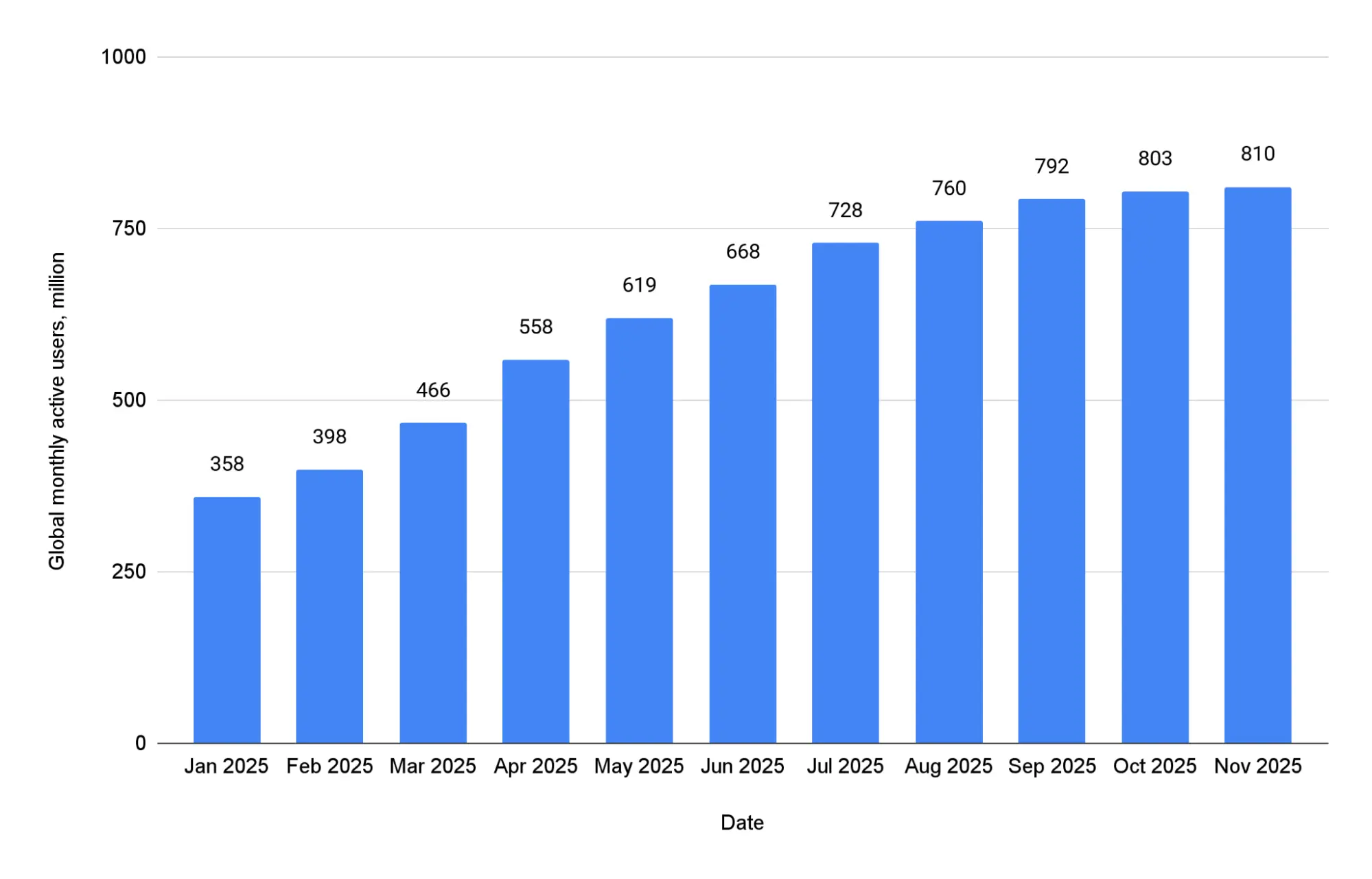
- The number of ChatGPT users increased from 358 million in January 2025 to 810 million in November 2025, representing a net gain of 452 million users.
- Chatgpt monthly active users surpassed 500 million in April 2025 and reached 728 million by July 2025, adding 170 million users in just three months.
- Growth began to moderate in the second half of the year, with ChatGPT user count rising from 792 million in September 2025 to 810 million in November 2025, an increase of 18 million users.
ChatGPT monthly active users: global usage trends in 2025
The data confirms that ChatGPT experienced rapid global adoption throughout 2025, especially in the first half of the year when user growth accelerated sharply. As the platform approached 800+ million monthly active users, expansion continued but at a slower pace, suggesting a transition from explosive early adoption to more mature usage dynamics. Overall, these ChatGPT usage statistics 2025 indicate that ChatGPT has established itself as a mainstream digital platform with a massive and stable global user base.
While monthly metrics show long-term retention, weekly engagement reveals how frequently users return to ChatGPT within shorter usage cycles.
ChatGPT weekly active users: rapid adoption timeline
The chart tracks chatgpt weekly active users over time, illustrating how the number of ChatGPT users worldwide engaging with the platform every week has expanded since early 2023. These ChatGPT user statistics help explain how rising monthly adoption translated into increasingly habitual usage.
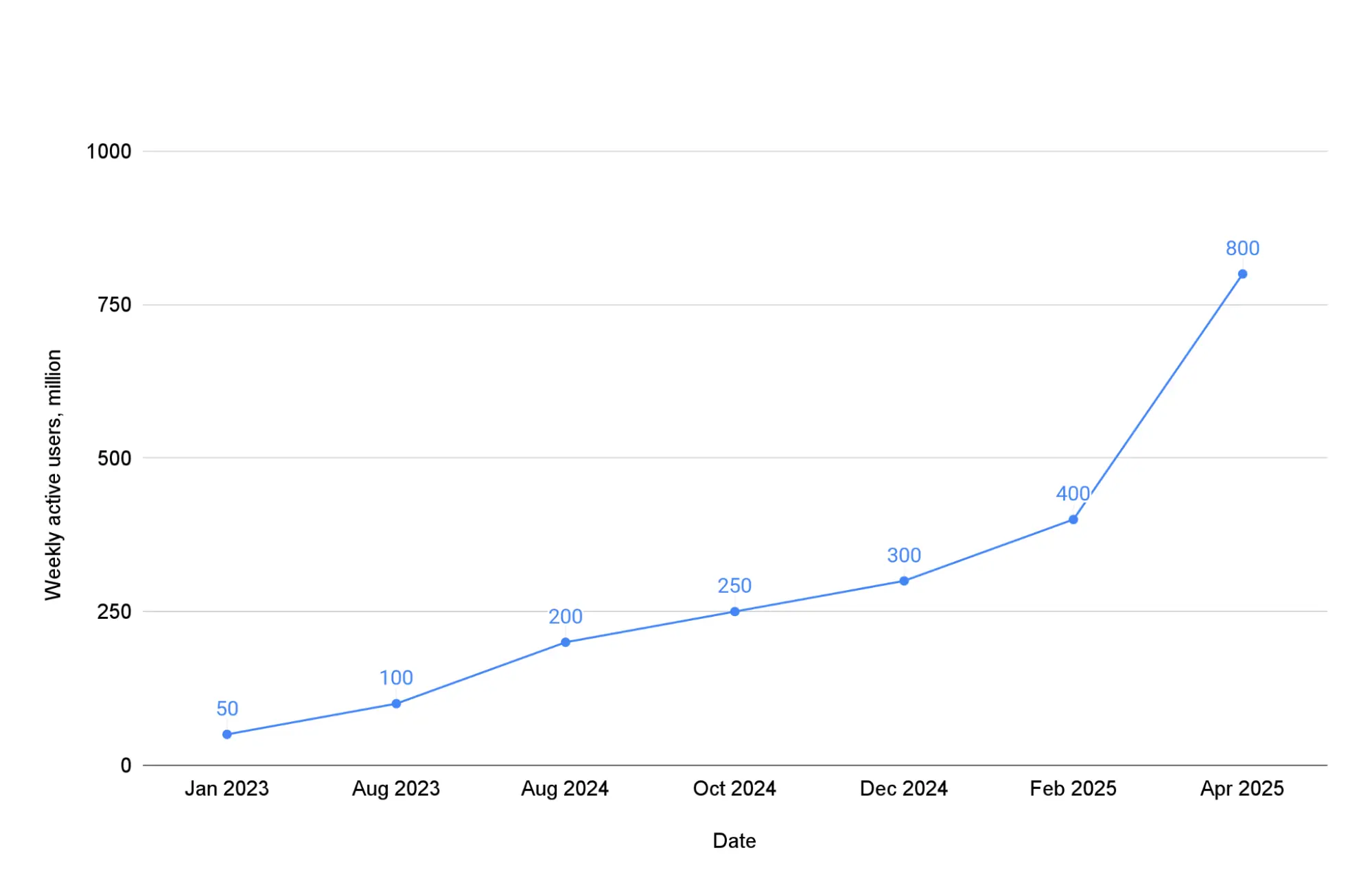
- Chatgpt weekly active users grew from 50 million in January 2023 to 400 million by February 2025, reflecting an eightfold increase over just two years.
- Weekly engagement accelerated sharply in 2025, with ChatGPT user count doubling from 400 million in February 2025 to 800 million in April 2025.
- By April 2025, weekly usage nearly matched reported ChatGPT monthly active users, indicating that most ChatGPT users were active on the platform every week. This convergence suggests that a large share of monthly users were returning every week, rather than monthly growth being driven by infrequent or one-time usage.
ChatGPT weekly active users worldwide: growth from 2023 to 2025
The weekly data underscores how quickly ChatGPT shifted from an occasional tool to a high-frequency product. The convergence of weekly and monthly usage levels suggests unusually high engagement, with a large share of ChatGPT users returning on a near-daily or weekly basis. Overall, these ChatGPT usage statistics 2025 position ChatGPT among the most actively used digital platforms in the world in terms of user engagement intensity.
After analyzing weekly engagement patterns, daily usage estimates provide a more granular view of how frequently users interact with ChatGPT.
ChatGPT daily active users: estimating daily engagement levels
The chart compares two estimates of ChatGPT’s daily active users, calculated using different aggregation methods based on annual and weekly data. These ChatGPT user statistics help frame the realistic range of how many ChatGPT users interact with the platform daily.
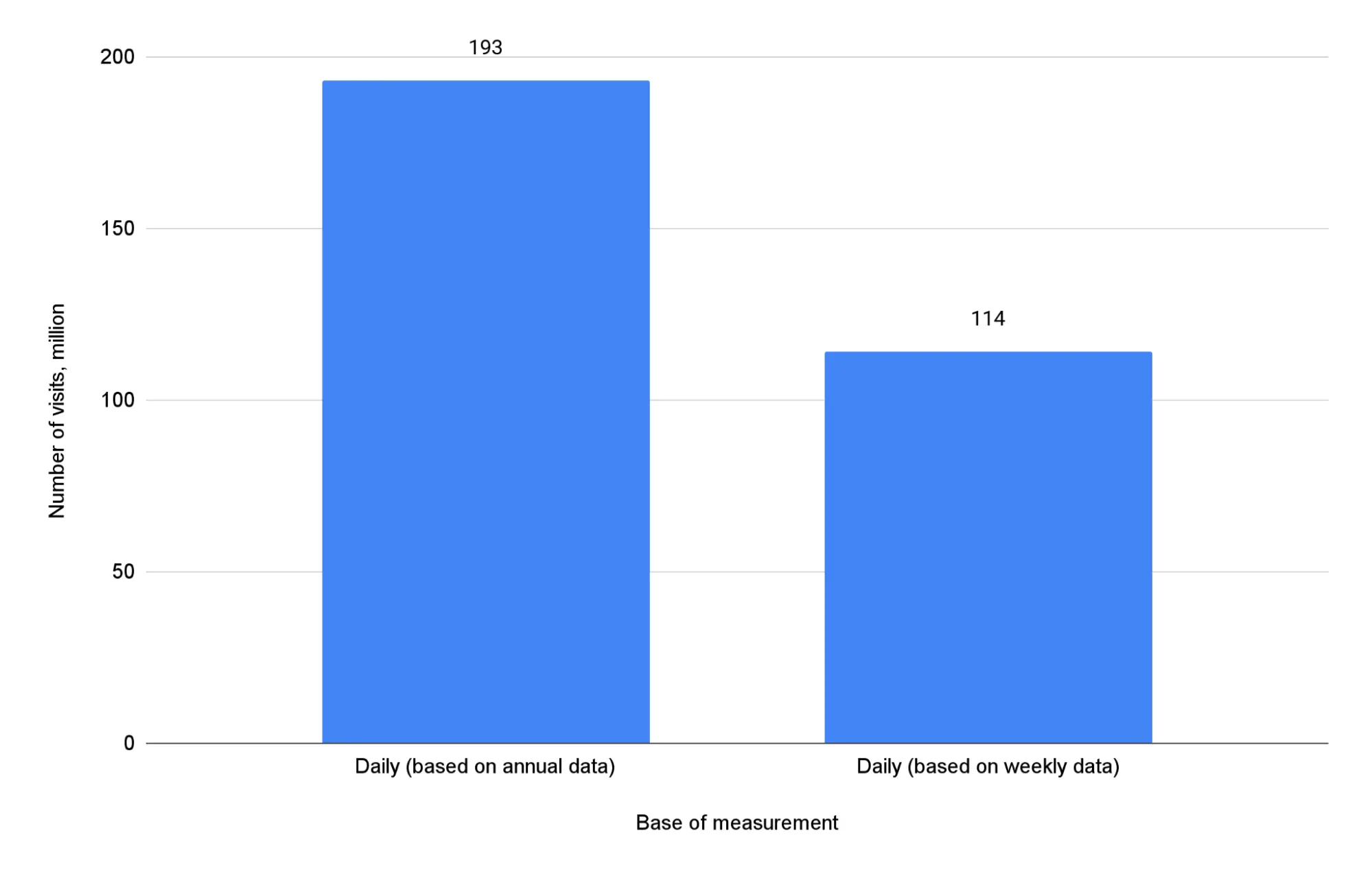
- Based on annualized data, chatgpt daily active users are estimated at 193 million, representing the upper bound of daily engagement.
- Using weekly-based calculations, daily usage is lower, with 114 million ChatGPT users estimated to be active each day.
- The gap between the two methods equals 79 million users, highlighting how assumptions in methodology significantly affect ChatGPT user count estimates.
ChatGPT daily active users worldwide: usage intensity overview
Daily usage estimates indicate that ChatGPT sustains a very large and consistent active audience, even under more conservative assumptions. Whether measured at 114 million or 193 million daily users, the platform demonstrates high engagement relative to its total number of ChatGPT users. Overall, these ChatGPT usage statistics 2025 confirm that ChatGPT is not only widely adopted but also deeply integrated into users’ daily workflows.
While daily engagement highlights usage intensity, month-over-month growth rates reveal how quickly the overall ChatGPT user count expanded throughout 2025.
Month-over-month growth rate of ChatGPT users in 2025
The chart shows the month-over-month growth rate of ChatGPT’s monthly active users during 2025, capturing changes in the pace of user acquisition over time. These ChatGPT user statistics illustrate how growth dynamics evolved as the number of ChatGPT users increased.
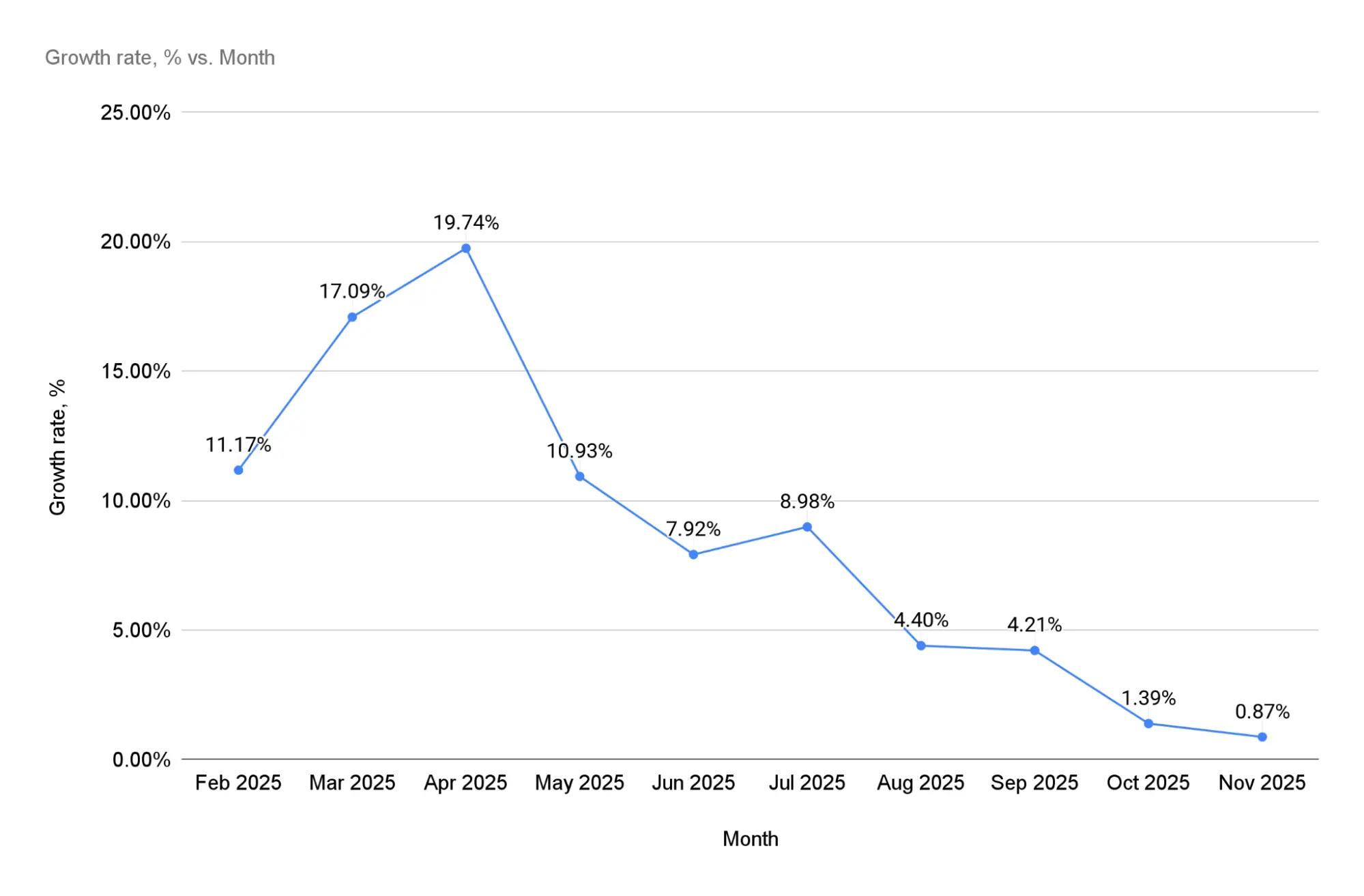
- Growth peaked in April 2025 at 19.74%, marking the fastest monthly expansion in ChatGPT users during the year.
- After May 2025, growth slowed steadily, declining from 10.93% in May to 4.21% in September 2025.
- By November 2025, the month-over-month growth rate fell to 0.87%, signaling near-saturation in chatgpt monthly active users growth.
ChatGPT user growth rate by month: 2025 trend analysis
The growth-rate data show a clear transition from hypergrowth to maturation over the course of 2025. Early-year surges rapidly expanded the number of ChatGPT users, while later months reflected a slowdown as the platform reached a massive global scale. Overall, these ChatGPT usage statistics 2025 suggest that future growth is likely to be driven more by retention, monetization, and engagement depth than by sheer user acquisition.
While growth rates explain how quickly the user base expanded, geographic distribution shows where the number of ChatGPT users worldwide is concentrated today.
ChatGPT users by country: global distribution of visitors
The chart illustrates ChatGPT users by country, showing the share of total visitors attributed to each market. These ChatGPT user statistics by country highlight how global adoption is distributed across major regions rather than being dominated by a single geography.
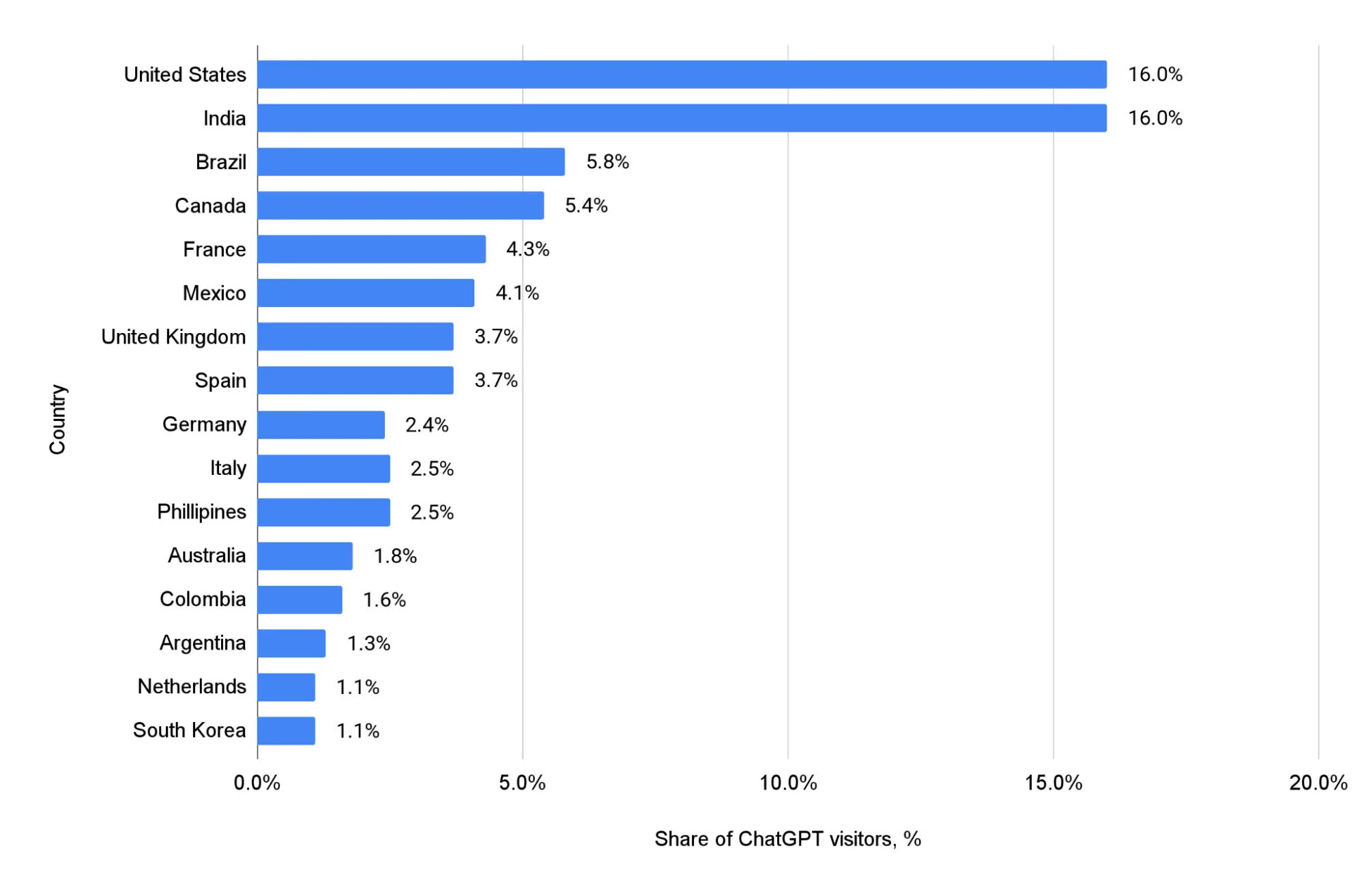
- The United States and India are tied as the two largest markets, each accounting for 16.0% of total ChatGPT users, or 32.0% combined. These figures reflect the share of total visitors by country, rather than the share of total traffic volume.
- Brazil (5.8%) and Canada (5.4%) form the second tier of adoption, together representing 11.2% of global visitors.
- European countries, including France (4.3%), the United Kingdom (3.7%), Spain (3.7%), and Germany (2.4%), collectively account for 14.1% of the global ChatGPT user count.
Geographic breakdown of ChatGPT users worldwide
The country-level distribution shows that ChatGPT adoption is both global and diversified, with no single market exceeding one-sixth of total usage. Strong representation across North America, Europe, and emerging markets underscores the platform’s broad appeal and scalability. Overall, these ChatGPT usage statistics 2025 suggest that future growth opportunities may increasingly come from international markets rather than reliance on a single dominant country.
After examining where ChatGPT users are located globally, it is important to understand how fast ChatGPT has grown compared with other major digital platforms.
Rapid adoption: milestones in ChatGPT user growth
Time to reach 1 million users: how fast ChatGPT took off
The chart compares how long leading digital platforms needed to reach their first one million users, providing context for ChatGPT’s growth relative to historic consumer apps. These benchmarks help explain when did chatgpt become popular.
- ChatGPT reached 1 million users in just 5 days, significantly outperforming platforms such as Facebook (10 months) and Netflix (42 months).
- Only Instagram Threads, which achieved 1 million users in 1 hour, grew faster than ChatGPT, highlighting the exceptional pace of ChatGPT user growth.
- Compared to Instagram (2 months) and Spotify (5 months), ChatGPT’s adoption timeline was at least 12 times faster, underscoring its one of the fastest adoption rates observed among consumer platforms.
How long did it take ChatGPT to get 1 million users?
The data clearly positions ChatGPT as one of the fastest-adopted consumer applications in digital history. Reaching one million users in five days explains how fast ChatGPT grew and why early ChatGPT growth rate metrics far exceeded those of traditional social and content platforms. Overall, these benchmarks provide a strong foundation for understanding the scale and velocity behind subsequent milestones, such as when ChatGPT reaches 100 million users.
After seeing how quickly ChatGPT reached its first million users, the next milestone shows how ChatGPT’s growth scaled beyond early adopters into mass-market adoption.
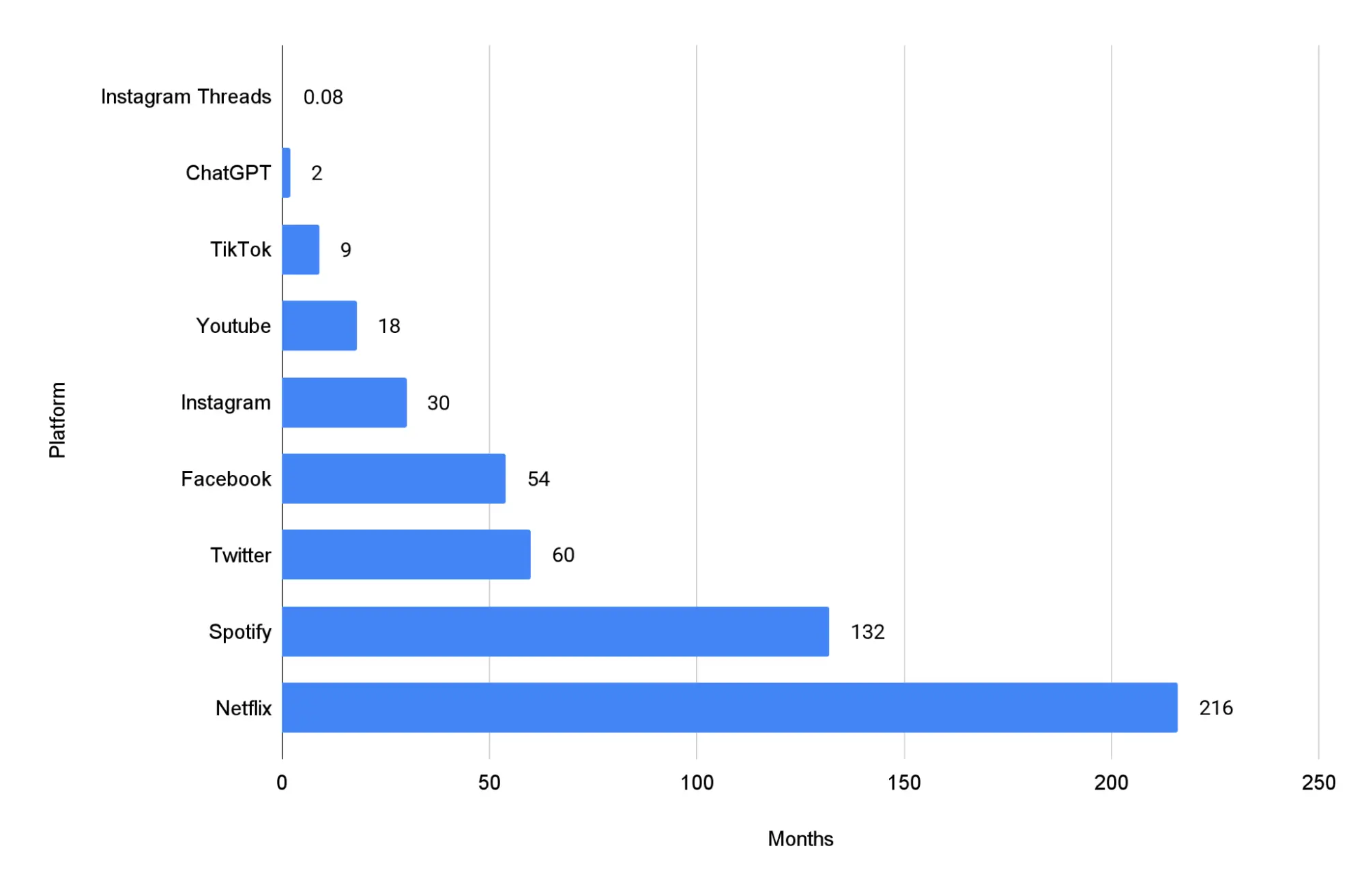
Time to reach 100 million users: ChatGPT vs other platforms
The chart compares how long major digital platforms needed to reach 100 million users, placing chatgpt user growth in a broader historical context. These benchmarks clarify when ChatGPT became popular and why it is frequently labeled the fastest-growing app.
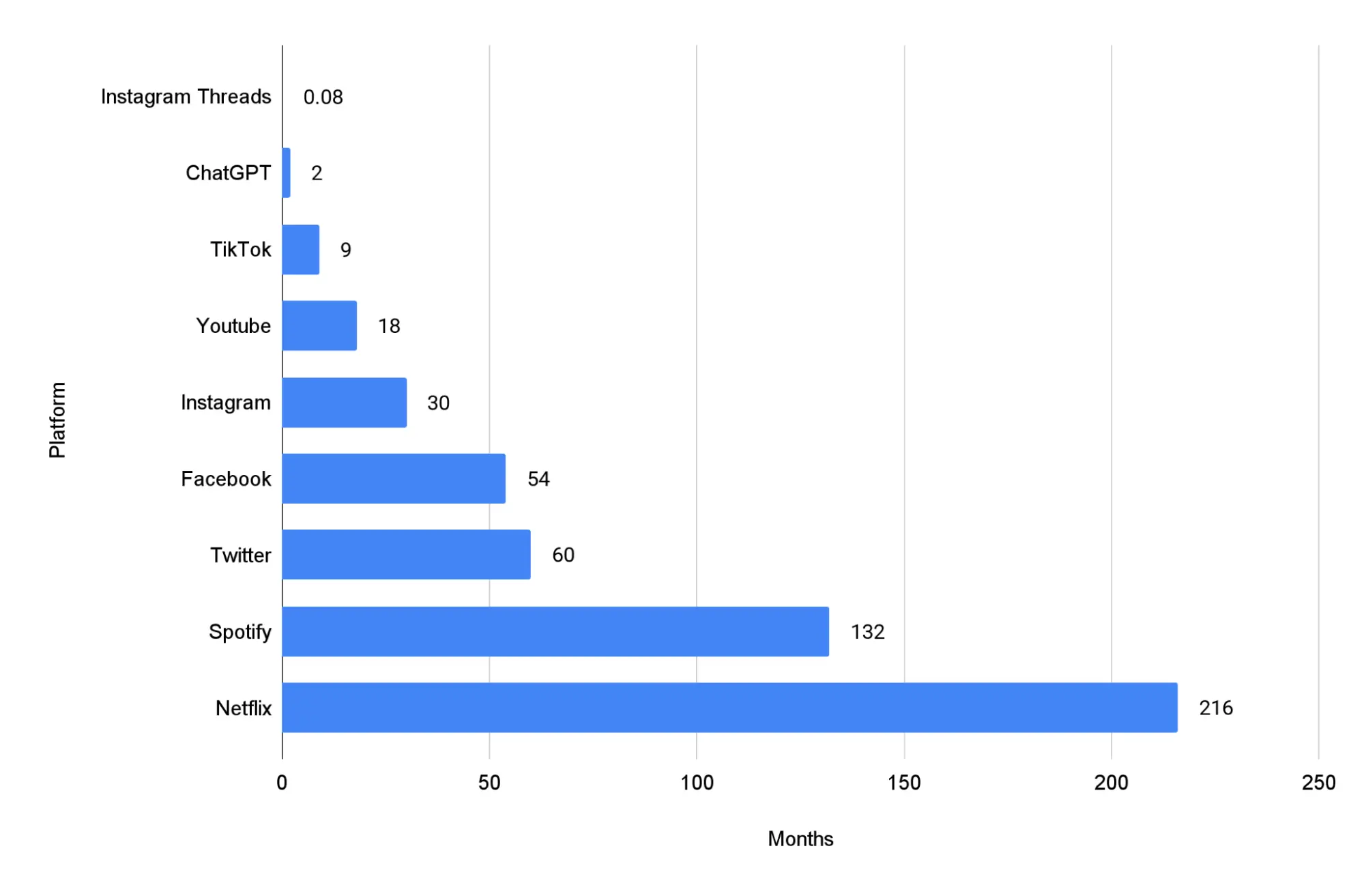
- ChatGPT reached 100 million users in just 2 months, significantly faster than TikTok (9 months) and YouTube (18 months).
- Among large-scale platforms, only Instagram Threads, which reached 100 million users in 2 days, expanded faster than ChatGPT.
- Compared with legacy social platforms, ChatGPT’s adoption was extreme, outperforming Instagram (30 months), Facebook (54 months), and Twitter (60 months) by more than an order of magnitude.
How long did it take ChatGPT to get 100 million users?
Reaching 100 million users in two months underscores how fast ChatGPT has grown and highlights a step-change in modern platform adoption dynamics. This pace far exceeds historical norms, confirming one of the fastest adoption rates observed among consumer platforms driven by global demand rather than regional network effects. Overall, these benchmarks explain why ChatGPT’s early trajectory significantly altered expectations around viral growth and large-scale user acquisition.
After reviewing how quickly ChatGPT scaled its user base, website traffic data shows how that adoption translated into sustained usage at the domain level.
ChatGPT website traffic and engagement trends
Monthly website visits to ChatGPT.com: traffic growth over time
The chart tracks ChatGPT website visits every month, highlighting how overall platform adoption converted into repeat web usage. This ChatGPT usage graph reflects long-term engagement patterns rather than short-lived viral spikes.
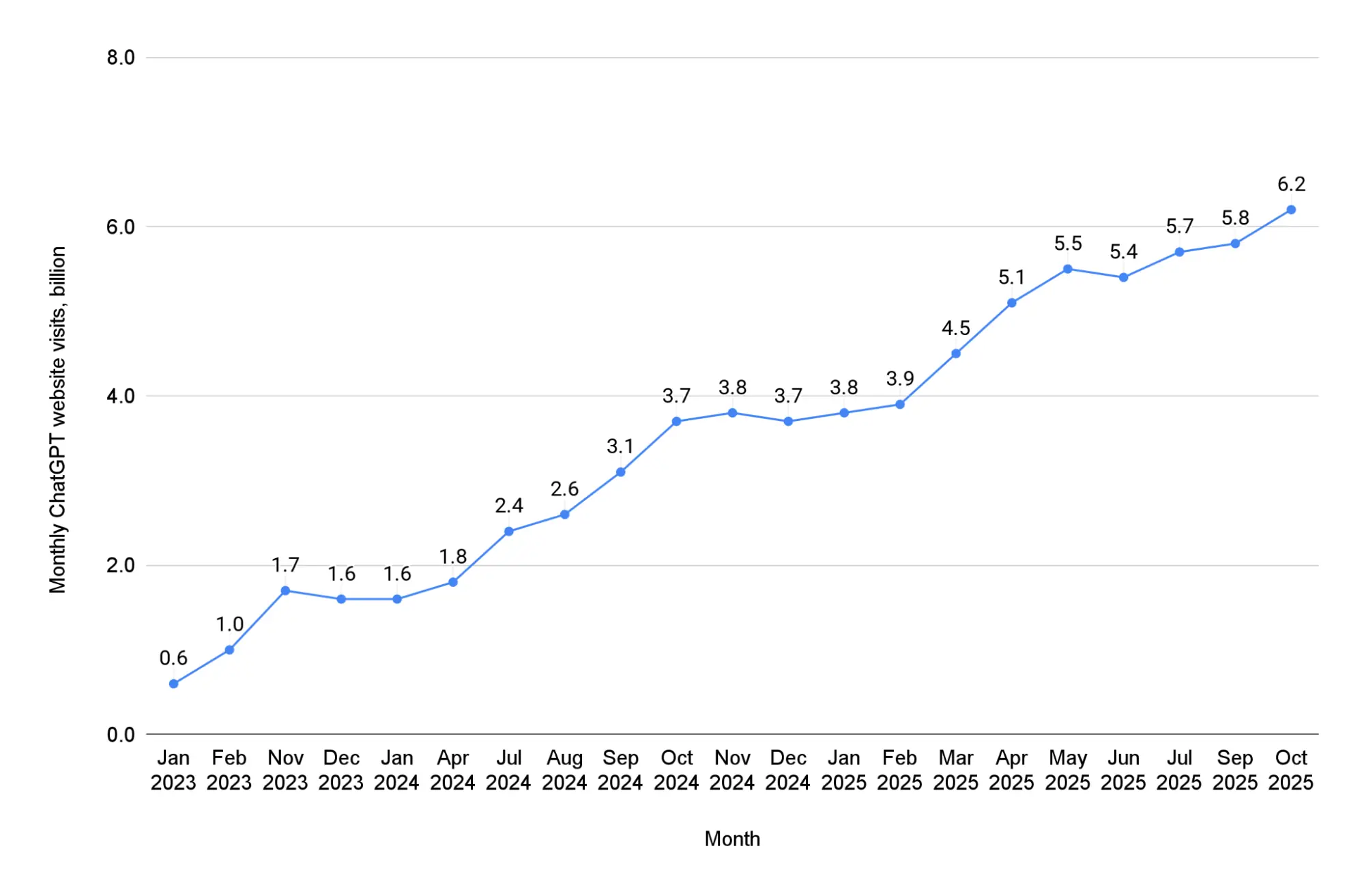
- Monthly ChatGPT traffic increased from 0.6 billion visits in January 2023 to 6.2 billion visits in October 2025, representing more than a 10x increase.
- Traffic accelerated sharply during 2025, rising from 3.8 billion visits in January 2025 to 5.5 billion in May 2025, an increase of 1.7 billion visits in four months.
- By late 2025, the number of ChatGPT website visits stabilized at a high level, with 5.8 billion visits in September 2025 and a new peak of 6.2 billion in October 2025.
ChatGPT.com monthly website visits: long-term traffic trends
The traffic data confirms that ChatGPT’s growth was not limited to user sign-ups but translated into sustained and increasing web usage. Reaching over six billion monthly visits places ChatGPT among the most visited websites globally, reinforcing its position as a daily-use product. Overall, these ChatGPT website traffic statistics show a transition from early experimentation to entrenched, high-frequency usage at internet scale.
After analyzing total ChatGPT website visits, it is useful to examine how deeply users interact with the platform during each session.
ChatGPT page views per visit
The chart ranks websites by pages per visit, showing how many pages users view on average per session. This ChatGPT usage graph highlights user engagement depth, allowing comparison of ChatGPT traffic with other major digital platforms.
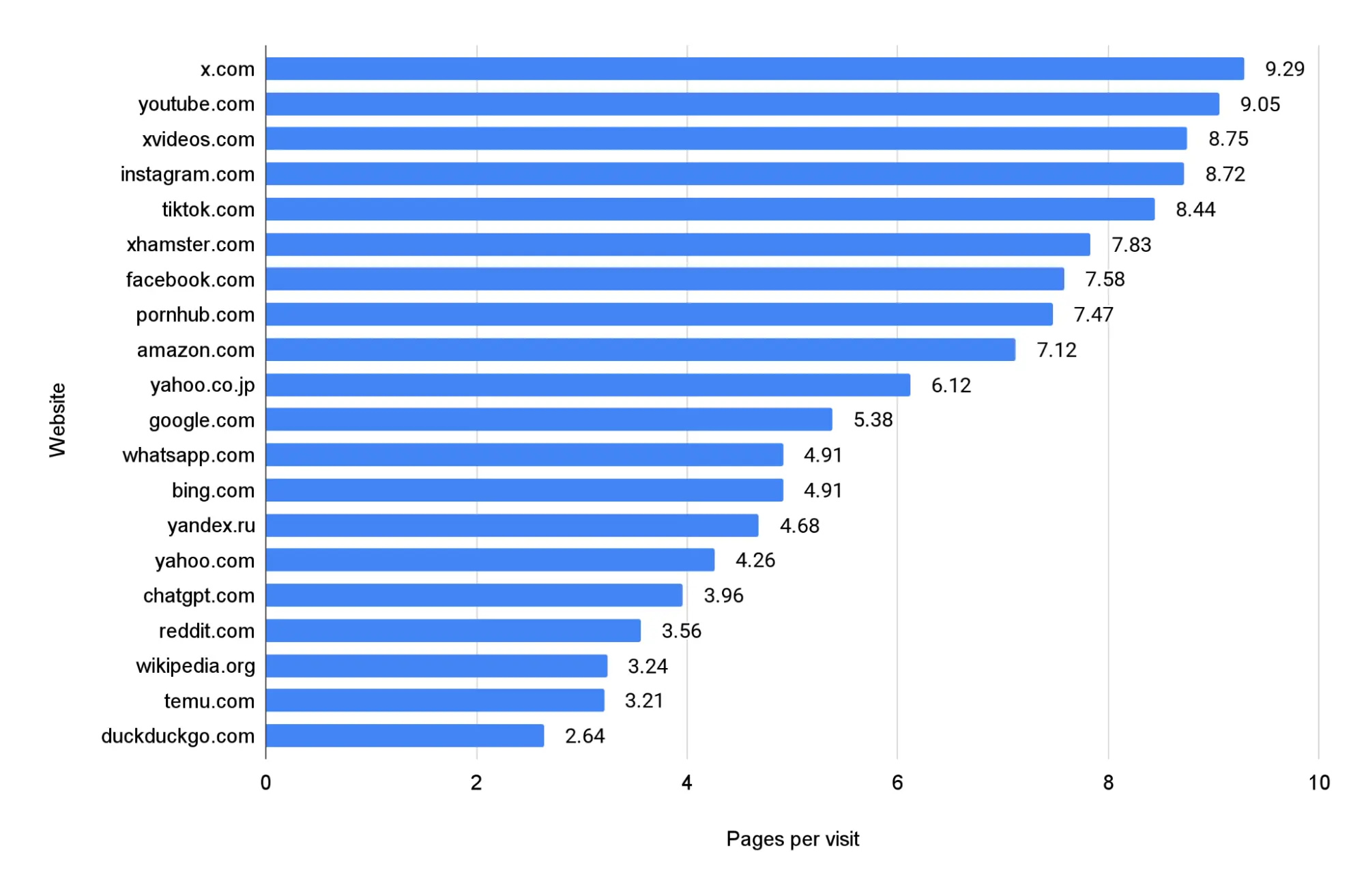
- Chatgpt.com ranks 16th with an average of 3.96 pages per visit, below social and adult platforms such as x.com (9.29) and youtube.com (9.05).
- Platforms like reddit.com (3.56) and wikipedia.org (3.24) show slightly lower engagement than ChatGPT, indicating comparable but modest session depth.
- While pages per visit are lower than on social platforms, ChatGPT traffic remains highly significant due to the platform’s massive volume of monthly visitors, reflecting a broad reach combined with concise engagement.
Pages per visit on ChatGPT.com compared to top websites
While ChatGPT’s pages per visit are lower than highly interactive social or content platforms, the metric reflects the nature of its use, focused, task-oriented interactions rather than content browsing. Combined with its enormous monthly traffic, these ChatGPT website traffic statistics suggest that ChatGPT’s value lies in high-frequency, goal-driven engagement rather than deep multi-page exploration. Overall, this pattern underscores the efficiency and utility-driven nature of user behavior on ChatGPT.com.
Beyond web-based usage, app downloads reveal how users are accessing ChatGPT on mobile devices, complementing overall platform adoption.
ChatGPT app engagement trends
ChatGPT global app downloads: monthly trends
The chart presents monthly global downloads of the ChatGPT app, showing fluctuations in adoption over time. These ChatGPT usage statistics highlight periods of rapid uptake as well as seasonal moderation in downloads.
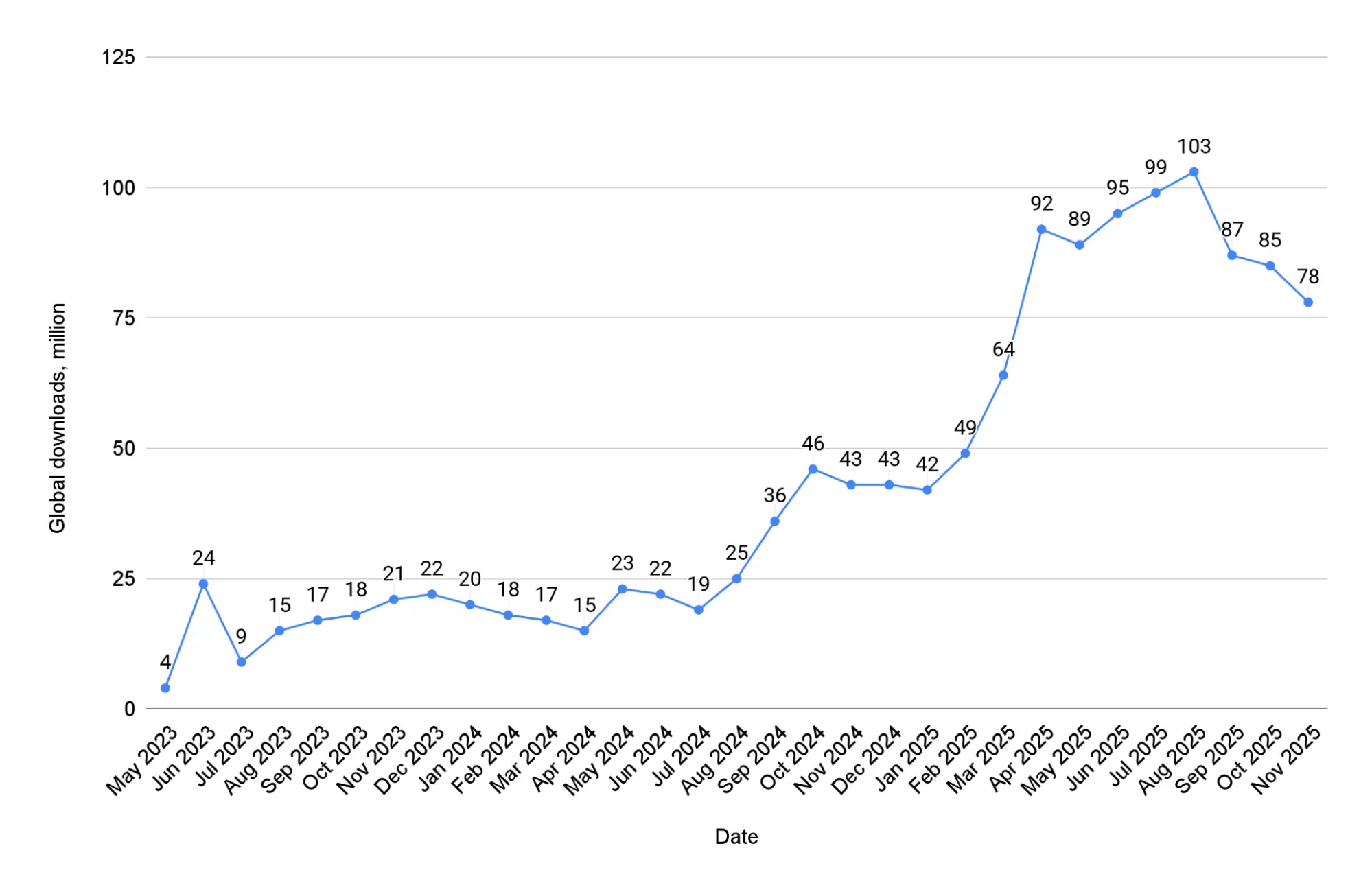
- ChatGPT app downloads surged in April 2025, reaching 92 million downloads, the highest in the dataset.
- Downloads consistently remained high in mid-2025, with 99 million in July and 103 million in August, reflecting sustained user demand.
- By November 2025, global downloads declined to 78 million, indicating a moderation from peak adoption while maintaining strong absolute numbers.
Monthly ChatGPT downloads worldwide: growth overview
The global download trends demonstrate ChatGPT’s massive adoption on mobile platforms, reinforcing its reach beyond desktop or web usage. Peaks in spring and summer 2025 suggest periods of intensified interest, while sustained download volumes highlight ongoing engagement. Overall, these ChatGPT usage statistics indicate that ChatGPT has become a mainstream mobile app with broad international adoption.
After examining global downloads, it is important to understand how users are accessing ChatGPT, whether via desktop or mobile platforms.
Share of ChatGPT access: desktop vs mobile
The chart shows the share of ChatGPT access by device type, highlighting the proportion of users interacting via desktop computers versus mobile devices. These ChatGPT usage statistics provide insight into user behavior and platform preferences.
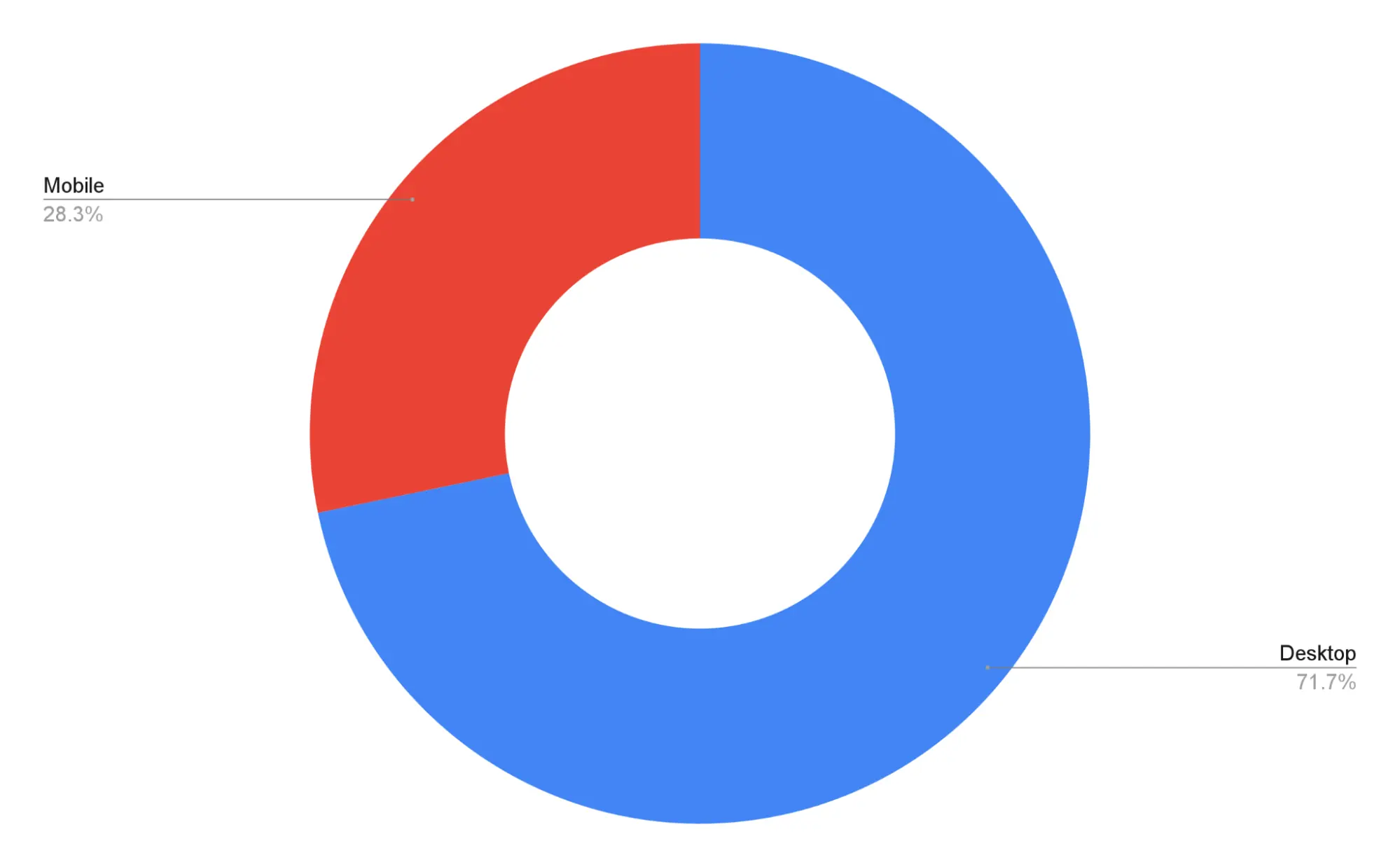
- The majority of ChatGPT users access the platform on desktop (71.74%), reflecting the prevalence of desktop usage for this tool.
- Mobile devices account for 28.26% of ChatGPT access, showing that nearly one-third of users rely on smartphones or tablets.
- Desktop usage exceeds mobile by a factor of approximately 2.5x, emphasizing the platform’s strength in professional and productivity contexts.
ChatGPT usage by device: desktop and mobile distribution
The data indicates that while ChatGPT has a substantial mobile audience, desktop remains the dominant mode of access. This likely reflects the productivity-oriented nature of the platform, where users prefer larger screens and full keyboard input. Overall, these ChatGPT usage statistics suggest that desktop-first design considerations remain crucial for the platform’s continued engagement and feature development.
Beyond device preferences, understanding who uses ChatGPT helps reveal the demographic composition of the platform’s global user base.
Who uses ChatGPT: age, gender, and location
Age distribution of ChatGPT users
The chart shows the age distribution of ChatGPT users, highlighting which age groups are most actively engaging with the platform. These ChatGPT user demographics statistics provide insight into who uses ChatGPT the most and inform targeted engagement strategies.
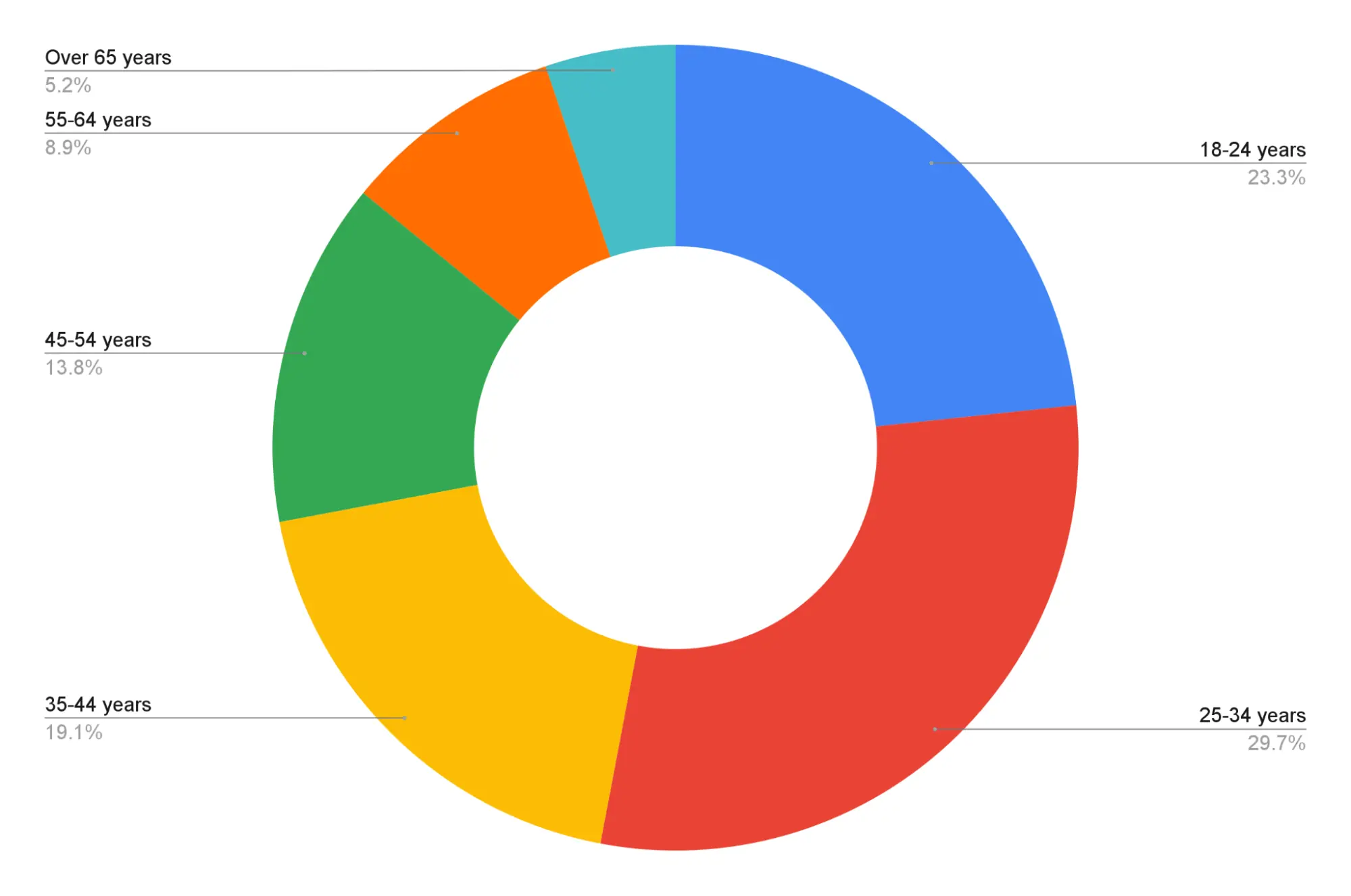
- The largest segment of ChatGPT users is aged 25-34 years (29.67%), representing nearly one-third of the total user base.
- Users aged 18-24 years account for 23.32%, while the 35-44 age group represents 19.06% of all users.
- Older users are less represented, with 55-64 years at 8.88% and over 65 years at 5.23%, highlighting a predominantly younger user base.
ChatGPT users by age group: demographics overview
The age distribution indicates that ChatGPT is most popular among young adults, particularly those in the 18-34 age range, which together account for over 50% of users. Middle-aged and older adults participate less frequently, reflecting both technological adoption trends and platform appeal. Overall, these ChatGPT user demographics statistics suggest that the platform resonates strongly with younger, digitally native audiences while retaining modest adoption among older users.
After exploring age demographics, it is important to examine ChatGPT users by country to understand where the platform’s audience is concentrated globally.
ChatGPT users by country: global traffic share
The chart shows the share of ChatGPT traffic by country, highlighting major markets and the relative size of other regions. These ChatGPT user demographics statistics by country provide insight into who uses ChatGPT and where the platform is most widely adopted.
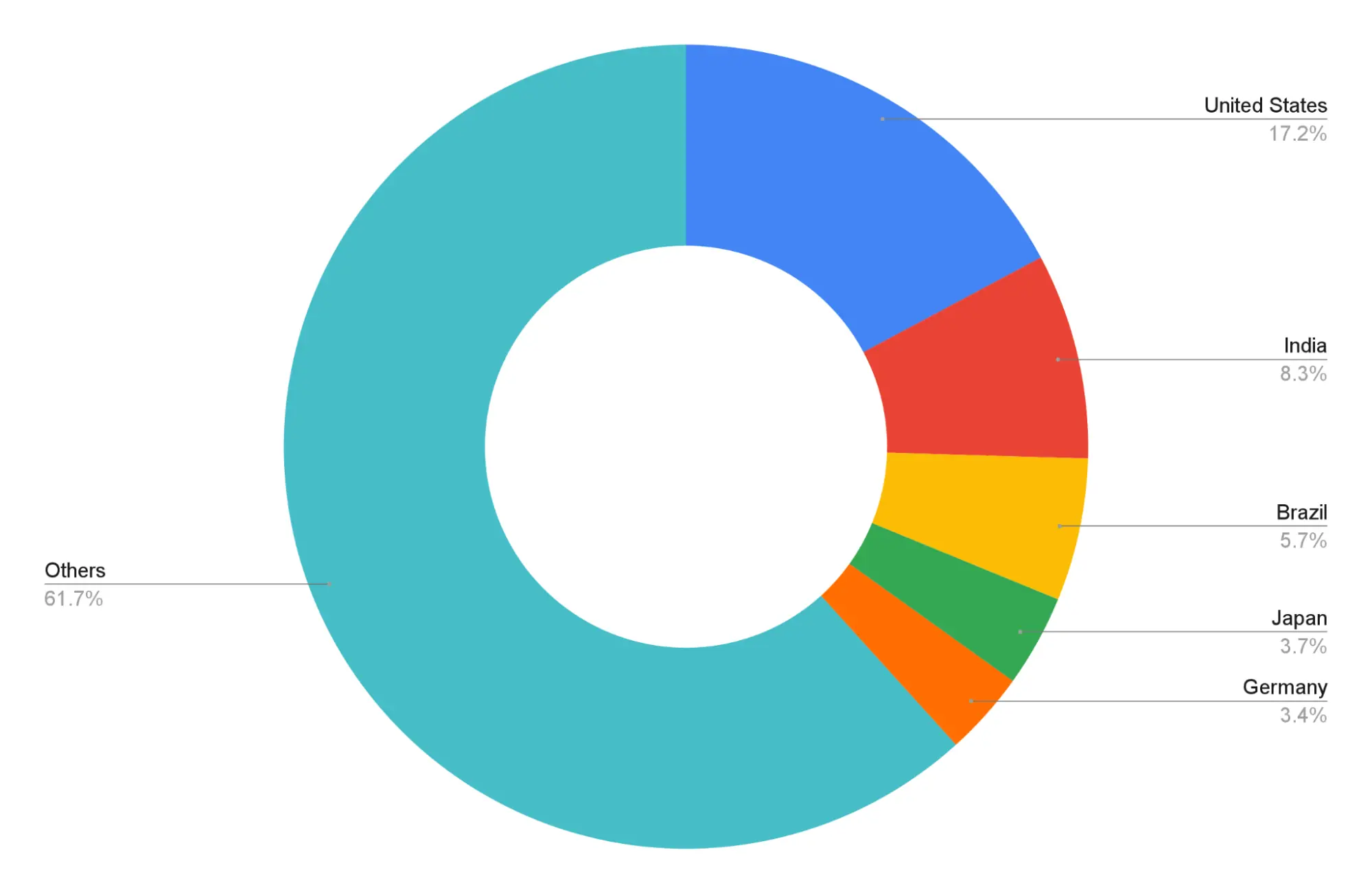
- The United States accounts for the largest share of ChatGPT traffic at 17.20%, making it the single largest national market. Unlike the previous country-level breakdown, this section measures traffic share rather than unique users, which explains the different country percentages.
- India follows with 8.27%, while Brazil contributes 5.73% of total users.
- Combined, Japan (3.70%) and Germany (3.39%) represent a modest 7.09%, with the remaining 61.71% coming from other countries worldwide
Geographic distribution of ChatGPT users worldwide
The data highlights that ChatGPT has a globally diversified user base, with strong representation in North America, Asia, and South America. While the United States remains the largest market, over 60% of traffic originates from countries outside the top five, emphasizing the platform’s international reach. Overall, these ChatGPT users by country statistics indicate broad global adoption and opportunities for further expansion in emerging markets.
After analyzing geographic distribution, examining ChatGPT user distribution by gender provides additional insight into the platform’s demographic composition.
ChatGPT gender distribution: male vs female users
The chart shows the gender distribution of ChatGPT users, indicating the relative share of male and female users. These ChatGPT user demographics statistics reveal who is using ChatGPT and the balance of engagement across genders.
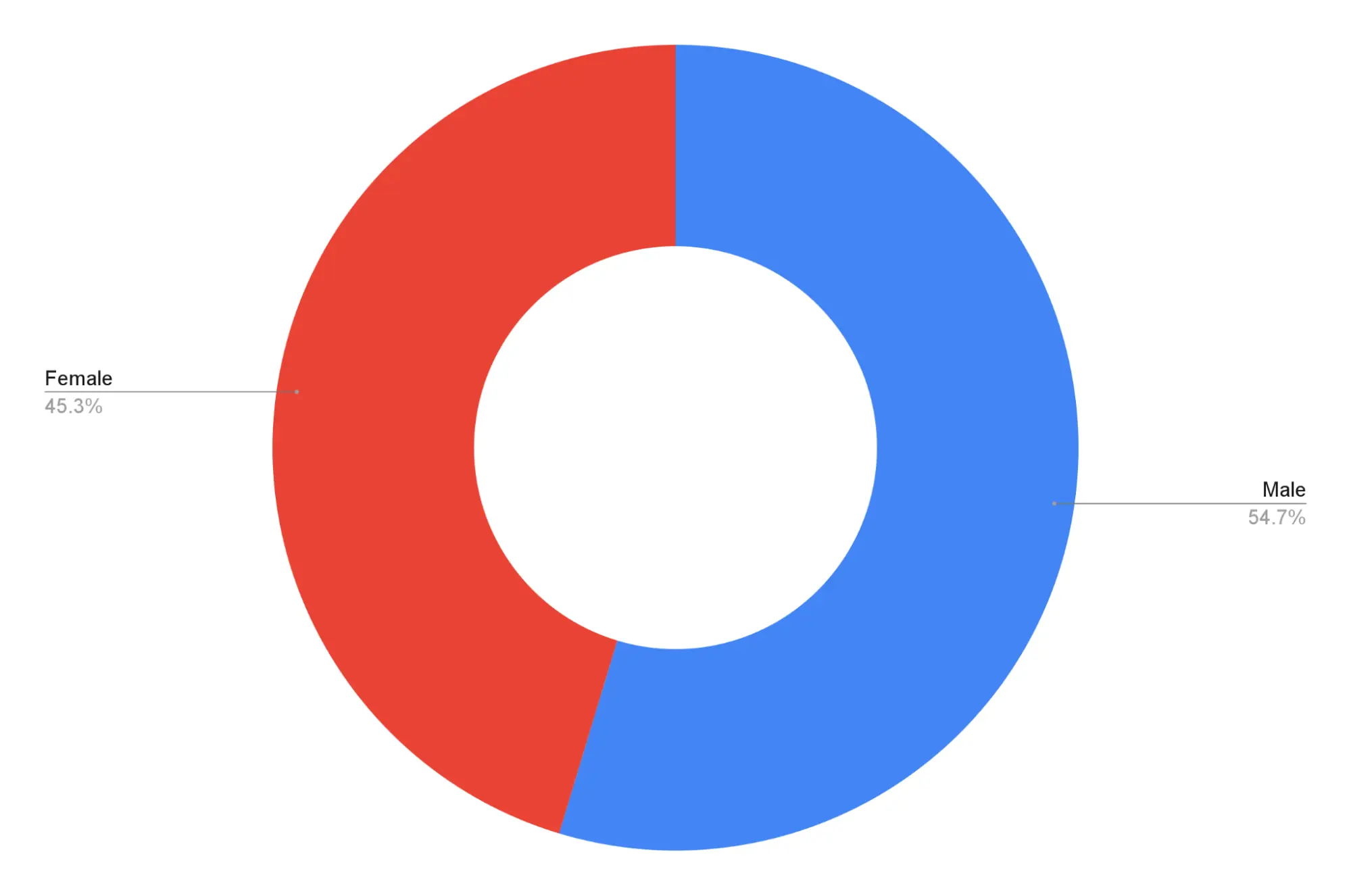
- Male users constitute 54.66% of ChatGPT’s total user base, making up the slight majority.
- Female users represent 45.34%, showing that engagement is relatively balanced across genders.
- The difference between male and female users is approximately 9.32 percentage points, highlighting a modest skew toward male users.
Who uses ChatGPT? gender breakdown of users
The gender distribution data indicates that ChatGPT attracts a broadly balanced audience, with only a small majority of male users. This balance suggests the platform appeals across genders, supporting its position as a widely relevant tool for diverse audiences. Overall, these ChatGPT user demographics statistics demonstrate that both men and women actively engage with the platform, reflecting inclusive adoption patterns.
After exploring demographic patterns, understanding ChatGPT traffic by source type shows how users are finding and accessing the platform.
Where users come from: traffic channels and social referrals
Beyond traffic volumes and referral sources, usage intensity can also be measured through interaction frequency. ChatGPT users collectively generate approximately 2.5 billion prompts per day worldwide, highlighting the platform’s role as a high-frequency, task-oriented service rather than a passive content destination.
How many prompts per day does ChatGPT worldwide receive?
- ChatGPT receives 2.5 billion prompts from global users every day.
ChatGPT traffic by source type: how users access the platform
The chart illustrates the distribution of ChatGPT visits by source type, highlighting the dominant channels that drive user access. These ChatGPT trends and ChatGPT referral traffic share insights reveal the relative importance of direct access, search, and referral pathways.
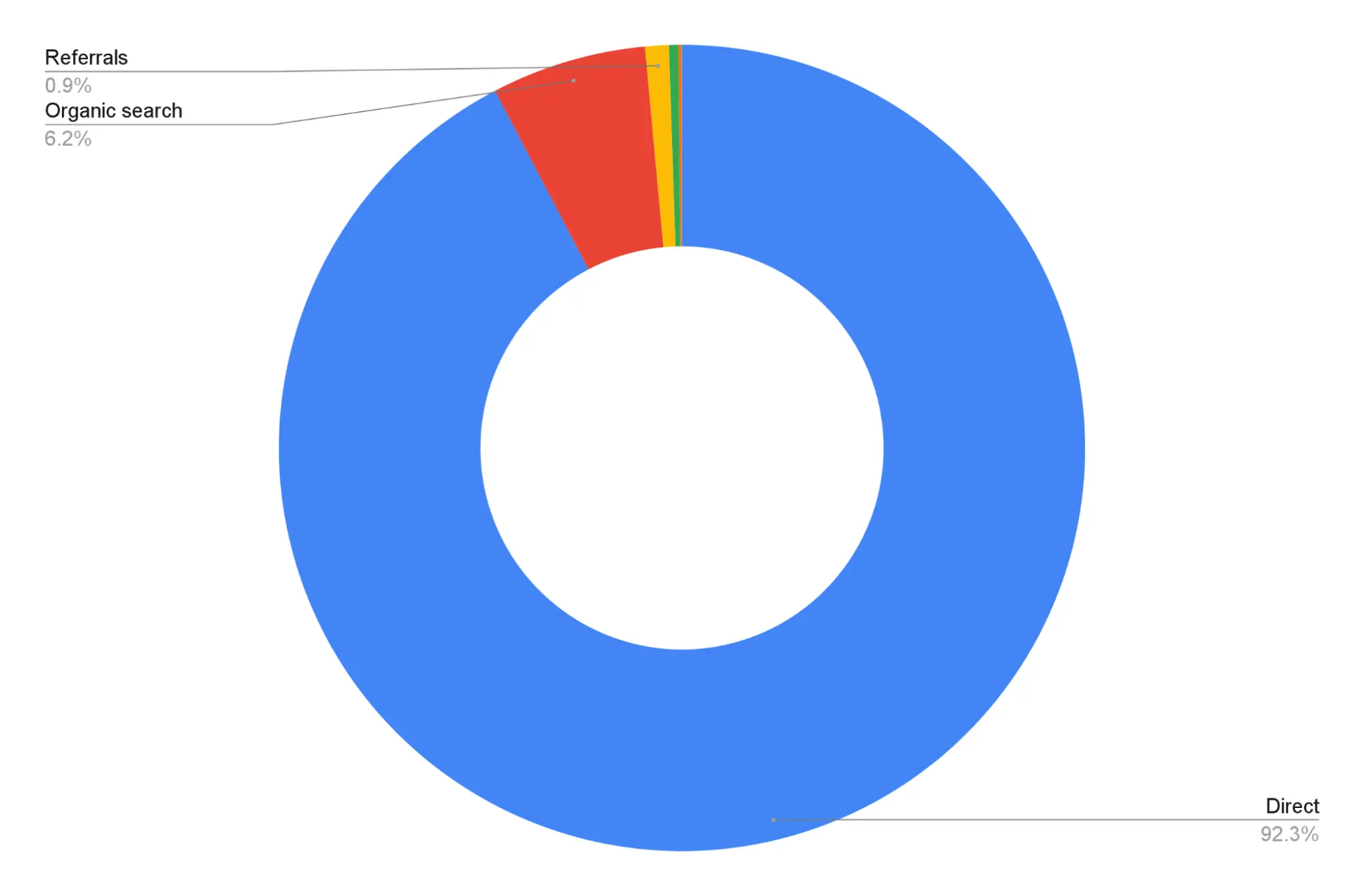
- Direct traffic dominates ChatGPT visits, accounting for 92.33% of total access.
- Organic search contributes 6.21%, making it the second-largest source of ChatGPT traffic.
- Other channels, including referrals (0.95%), social (0.38%), and mail (0.12%), play a minimal role in driving user engagement.
Sources of ChatGPT traffic: direct, search, and referral breakdown
The data shows that ChatGPT relies overwhelmingly on direct access, indicating strong brand recognition and habitual usage. Organic search provides a modest supplementary source of traffic, while referrals, social, and paid channels contribute very little. Overall, these ChatGPT trends suggest that users primarily navigate to the platform intentionally, reflecting both chatgpt popularity and a loyal user base.
After examining overall traffic sources, it is insightful to explore the ChatGPT referral component specifically through social channels.
Social referral traffic breakdown for ChatGPT
The chart shows the distribution of ChatGPT referral traffic share across major social platforms. These ChatGPT trends highlight which networks contribute most to users discovering and engaging with the platform through social referrals.
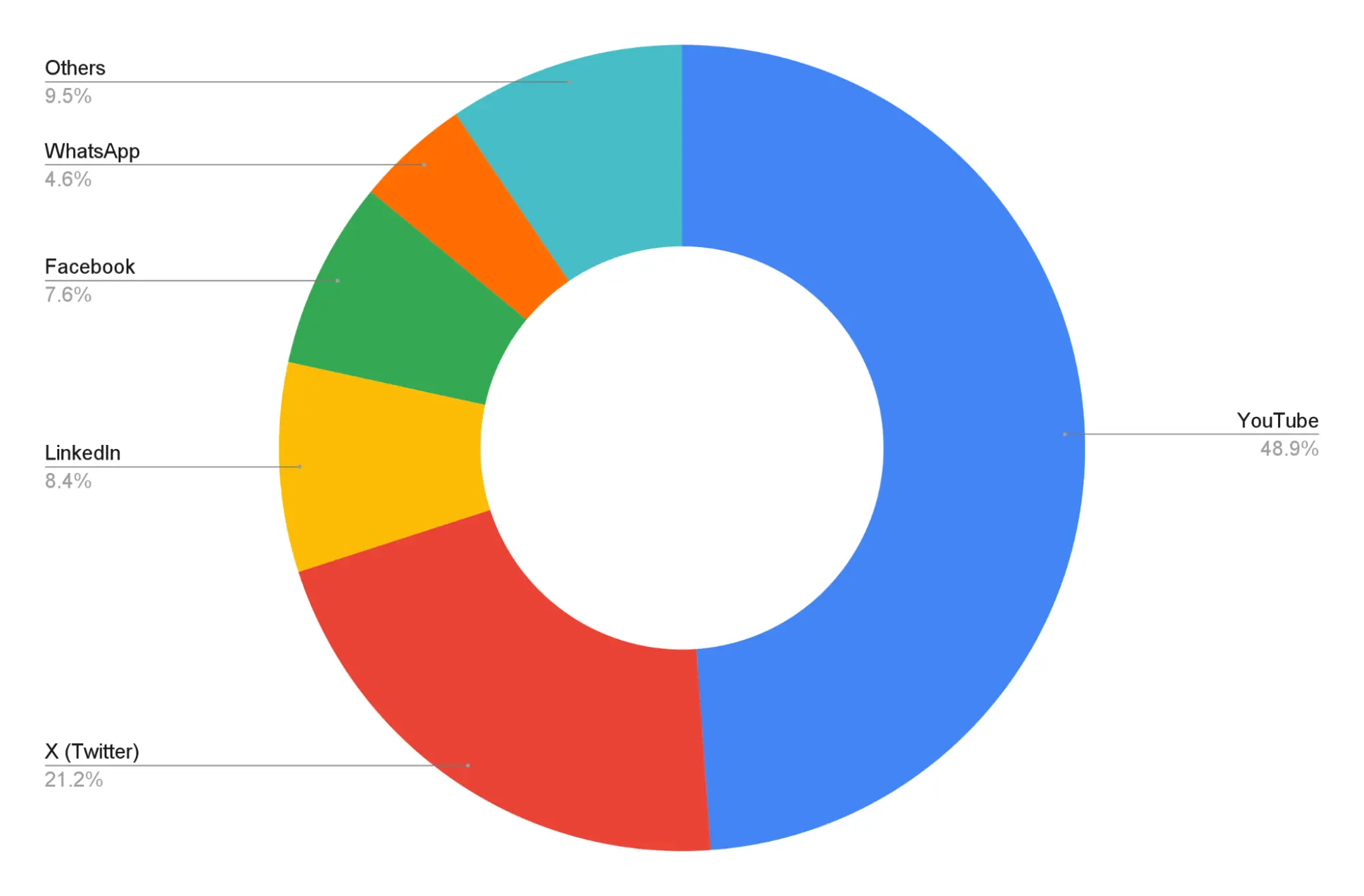
- YouTube is the leading social referrer, accounting for 48.86% of ChatGPT social referral traffic.
- X (Twitter) contributes 21.16%, while LinkedIn (8.40%) and Facebook (7.55%) provide smaller but notable shares.
- Other platforms, including WhatsApp (4.55%) and miscellaneous sources (9.48%), together represent roughly 14% of social referral traffic.
ChatGPT social referrals: platform-level distribution
The data indicates that ChatGPT’s social referral traffic is concentrated heavily on YouTube and X, with professional and mainstream networks like LinkedIn and Facebook playing secondary roles. This pattern suggests that content-driven and news-driven platforms are the most effective at driving social discovery. Overall, these ChatGPT trends demonstrate the importance of targeting high-visibility social channels to maintain awareness and drive ChatGPT referral engagement.
Beyond understanding how users discover ChatGPT, examining how they use the platform provides insight into the contexts in which it is most valuable.
How ChatGPT is used: work vs non-work tasks and popular use cases
ChatGPT usage share: work vs non-work activities
The chart shows the split between non-work and work usage of ChatGPT, highlighting the primary contexts in which users engage with the platform. These ChatGPT usage statistics help illustrate whether the platform is primarily a professional tool or used more for personal
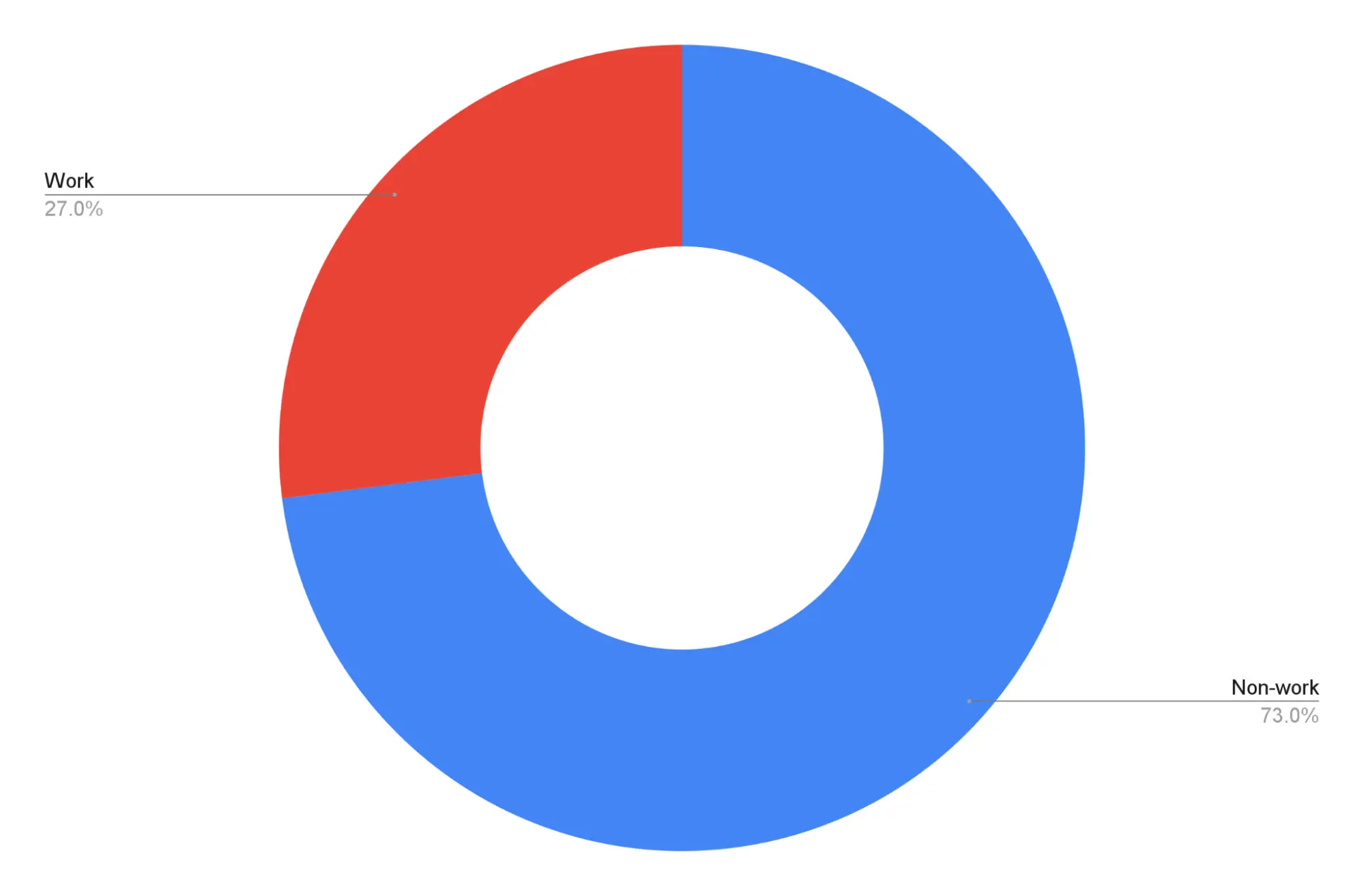
- The majority of ChatGPT users engage in non-work activities (73%), reflecting widespread personal use.
- Work-related usage accounts for 27% of sessions, indicating a smaller but significant professional audience.
- Non-work usage exceeds work usage by a factor of approximately 2.7×, highlighting its dominant role in everyday digital interactions.
Non-work vs work usage of ChatGPT: user behavior overview
The data demonstrates that ChatGPT is primarily used for non-professional purposes, suggesting that its appeal extends beyond workplace productivity. While a notable portion of users employ the platform for work, the dominant usage context is personal, creative, or exploratory activities. Overall, these ChatGPT usage statistics underline the platform’s versatility as both a personal assistant and a tool with emerging professional applications.
After reviewing overall work vs non-work usage, it is useful to examine how users are applying ChatGPT across different tasks and activities.
ChatGPT task breakdown: how users employ the platform
The chart shows the monthly breakdown of ChatGPT use cases, including general research, academic research, coding assistance, email composition, commercial research, and marketing copywriting. These ChatGPT usage statistics provide insight into the practical ways the platform supports both personal and professional tasks.
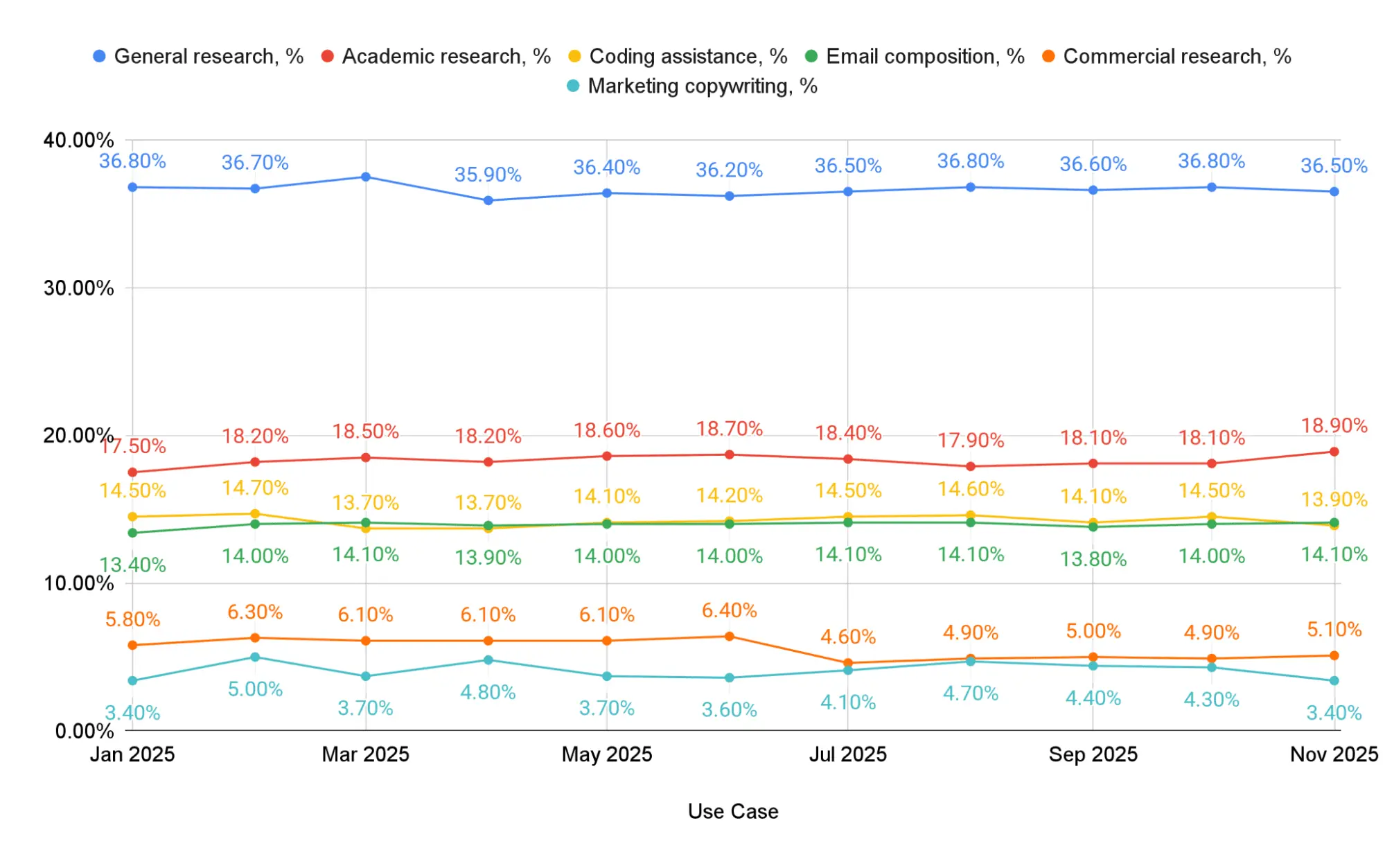
- General research consistently represents the largest use case, averaging around 36-37% of monthly activity in 2025.
- Academic research and coding assistance are also significant, with academic tasks contributing roughly 17-19% and coding 13-15% each month.
- Email composition, commercial research, and marketing copywriting collectively account for roughly 25% of activity, with individual shares ranging from 3.4% to 14.1%, showing diverse but smaller-scale usage.
Use cases of ChatGPT: monthly distribution of activities
The task breakdown highlights that ChatGPT is primarily used for information gathering and problem-solving, with general and academic research making up over half of all activity. Professional tasks like coding, email drafting, and marketing applications also feature prominently, demonstrating the platform’s versatility. Overall, these ChatGPT usage statistics illustrate that ChatGPT supports a broad spectrum of personal and work-related tasks, catering to both casual and specialized users.
Beyond usage patterns, understanding ChatGPT’s retention rate provides insight into how long users continue to engage with the platform across different subscription tiers.
Monetization insights: subscription plans, retention, and revenue trends
ChatGPT retention rate by subscription tier
The chart shows the retention rate for ChatGPT Plus, Team, and Enterprise subscriptions over 3 months, 6 months, and 1 year. These ChatGPT usage statistics highlight user loyalty and long-term engagement across different tiers.
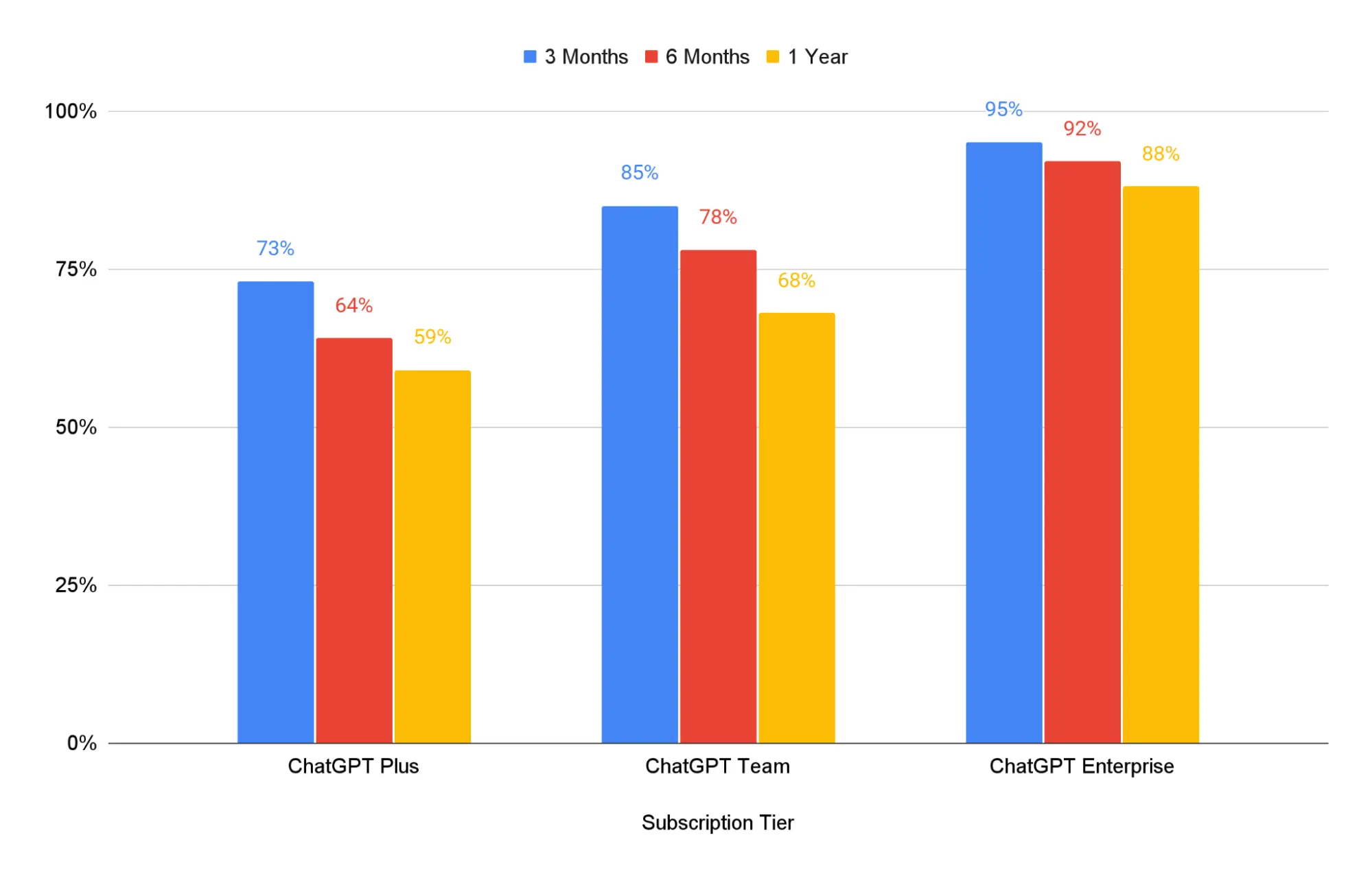
- ChatGPT Plus retains 73% of users at 3 months, declining to 59% after 1 year.
- ChatGPT Team shows stronger retention, with 85% at 3 months and 68% after 1 year.
- ChatGPT Enterprise exhibits the highest retention, maintaining 95% at 3 months and 88% after 1 year.
User retention across ChatGPT Plus, team, and enterprise
The data indicates that retention improves significantly with higher-tier subscriptions, reflecting the greater investment and organizational reliance on the platform. Enterprise users demonstrate exceptionally high loyalty, while Plus users exhibit moderate attrition over a year. Overall, these ChatGPT usage statistics suggest that both individual and organizational engagement remains strong, particularly for professional and enterprise-level subscriptions.
Following retention analysis, total revenue illustrates how user engagement and subscription adoption translate into financial performance for ChatGPT.
ChatGPT total revenue: growth over time
The chart shows ChatGPT’s annual total revenue from 2023 through 2025 (projected). These ChatGPT usage statistics highlight the platform’s rapid monetization and scaling of paid subscriptions.
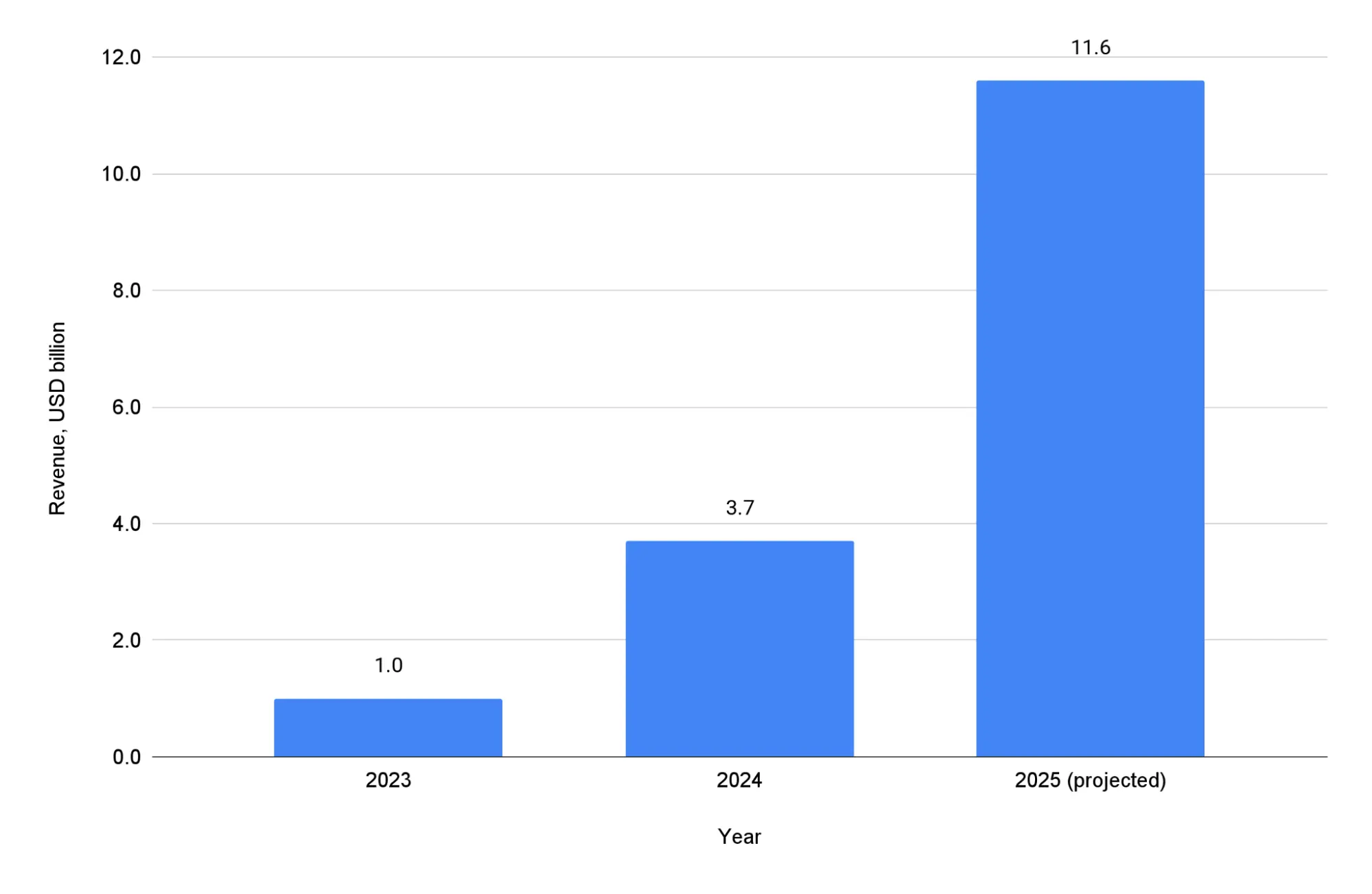
- ChatGPT generated $1.0 billion in revenue in 2023, marking its initial monetization milestone.
- Revenue nearly quadrupled to $3.7 billion in 2024, reflecting strong subscription uptake and user adoption.
- Projected revenue for 2025 is $11.6 billion, indicating a 3.1x increase over 2024 and continued exponential growth.
ChatGPT revenue trends: 2023-2025
The revenue trajectory underscores ChatGPT’s rapid monetization and the strong adoption of paid tiers. Growth from $1 billion in 2023 to a projected $11.6 billion in 2025 reflects both a large user base and effective monetization strategies. Overall, these ChatGPT usage statistics demonstrate that the platform is transitioning from a popular tool to a significant revenue-generating enterprise.
After reviewing total revenue, examining the revenue breakdown highlights which sources contribute most to ChatGPT’s financial performance.
ChatGPT revenue breakdown by source
The chart shows the distribution of ChatGPT revenue across Plus subscriptions, Enterprise, API usage, and Team subscriptions. These ChatGPT usage statistics reveal how different monetization channels support the platform’s growth.
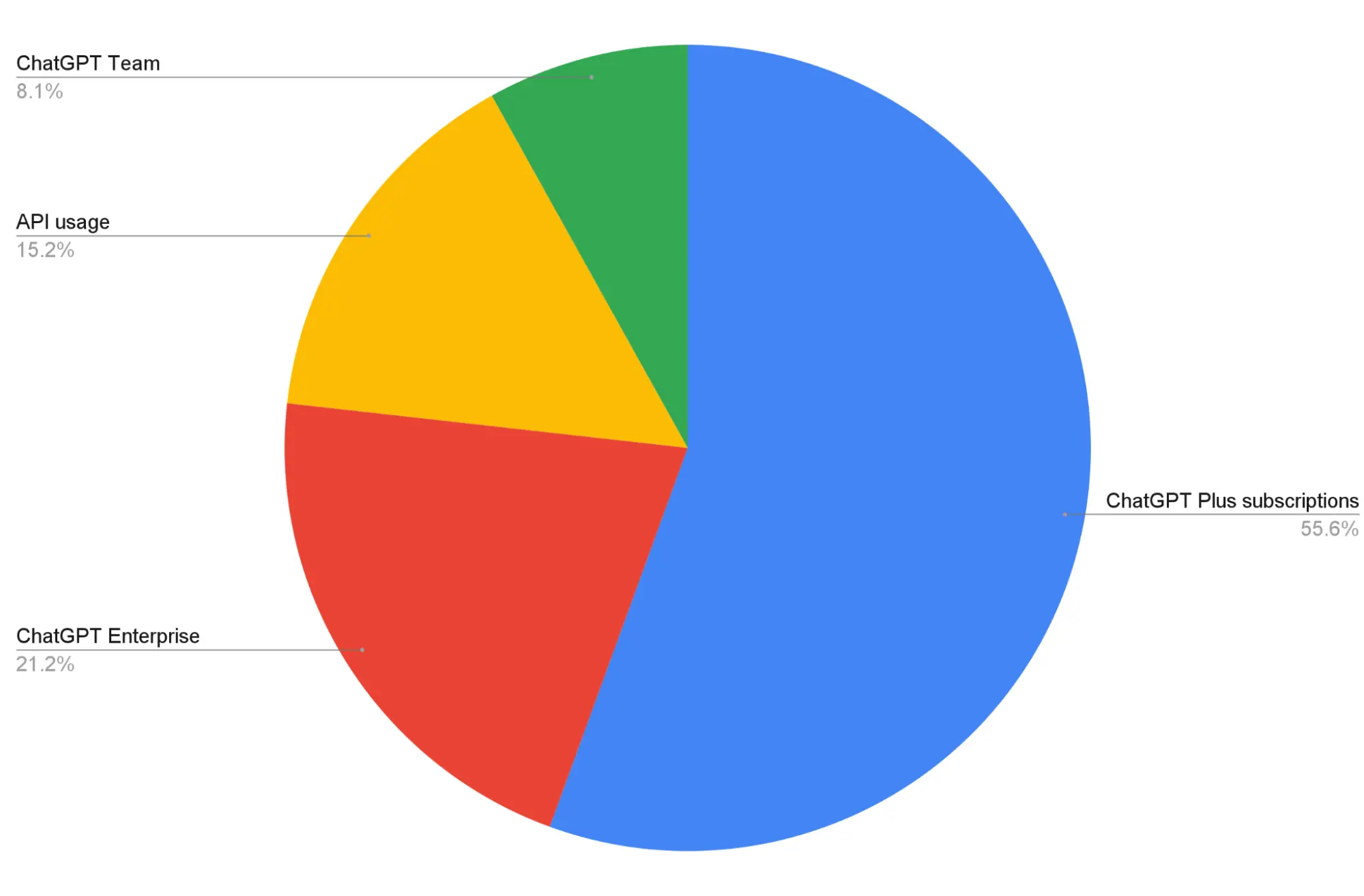
- ChatGPT Plus subscriptions account for the majority of revenue at 55%, making it the primary revenue driver.
- Enterprise revenue contributes 21%, reflecting strong organizational adoption.
- API usage (15%) and Team subscriptions (8%) provide additional, smaller revenue streams, collectively contributing 23% of total revenue.
How ChatGPT generates revenue: subscriptions and API usage
The revenue breakdown demonstrates that ChatGPT relies primarily on individual subscriptions, while organizational and API-based revenue further diversifies its income. Enterprise and Team subscriptions, though smaller in share, indicate strong B2B adoption potential. Overall, these ChatGPT usage statistics highlight a balanced monetization strategy combining consumer subscriptions with professional and developer-focused revenue channels.
Conclusions
- By the mid-2020s, ChatGPT has moved beyond the phase of explosive novelty-driven adoption into a period of large-scale, structurally stable growth. What began as an experimental consumer AI tool has evolved into a global digital platform with over 800 million monthly active users, sustained weekly engagement, and traffic volumes comparable to the world’s most established internet destinations. This transition signals not only the normalization of generative AI in everyday life but also its consolidation as a core layer of the modern internet.
- A defining shift in this phase is the convergence of reach and engagement. Unlike earlier platforms that scaled primarily through traffic, ChatGPT demonstrates unusually high usage intensity, with weekly active users nearly matching monthly figures and daily activity exceeding 100 million users even under conservative estimates. This pattern reflects habitual, task-driven use rather than passive consumption, positioning ChatGPT closer to a utility than a traditional content platform.
- Geographically, adoption has stabilized into a diversified global footprint. While the United States and India remain the largest individual markets, the majority of usage now originates outside the top countries, underscoring the platform’s international scalability and cultural adaptability. At the same time, demographic concentration among younger, digitally native users highlights where long-term engagement and innovation are most likely to emerge.
- From a functional perspective, ChatGPT’s usage profile reveals a clear bifurcation between personal and professional contexts. Non-work activities dominate overall volume, yet a substantial and growing share of usage is embedded in research, coding, communication, and commercial analysis. This duality suggests that ChatGPT is evolving simultaneously as a mass-market consumer product and as an infrastructure tool for knowledge work.
- Monetization trends reinforce this structural maturation. Rapid revenue growth, coupled with exceptionally high enterprise retention rates, indicates that organizational adoption is deepening even as consumer growth begins to moderate. This shift points toward a future in which long-term value is increasingly driven by professional, team, and enterprise integrations rather than pure user acquisition.
- Looking ahead, ChatGPT’s trajectory will depend less on expanding its audience and more on increasing engagement depth, workflow integration, and institutional reliance. As generative AI becomes embedded across education, business, and digital services, ChatGPT is positioned to function not merely as a popular application, but as a foundational interface for interacting with information, software, and knowledge at global scale.
Sources
- Aiprm. 100+ ChatGPT Statistics 2024 · AIPRM. 1 Feb. 2024, https://www.aiprm.com/chatgpt-statistics/. Accessed 15 December 2025.
- Bailyn, Evan. “ChatGPT Usage Statistics: December 2025 – First Page Sage.” First Page Sage, 3 Dec. 2025, https://firstpagesage.com/seo-blog/chatgpt-usage-statistics/. Accessed 15 December 2025.
- “Latest ChatGPT Statistics: 800M+ Users, Revenue (Oct 2025) | Nerdynav.” Nerdynav, 5 Oct. 2025, https://nerdynav.com/chatgpt-statistics/. Accessed 15 December 2025.
- “Most Visited Websites in the World – Updated November 2025 | Exploding Topics.” Exploding Topics, https://analytics.explodingtopics.com/website. Accessed 15 December 2025.
- Perez, Sarah. “ChatGPT’s User Growth Has Slowed, Report Finds | TechCrunch.” TechCrunch, 5 Dec. 2025, https://techcrunch.com/2025/12/05/chatgpts-user-growth-has-slowed-report-finds/. Accessed 15 December 2025.
- Silberling, Amanda. “ChatGPT Users Send 2.5 Billion Prompts a Day | TechCrunch.” TechCrunch, 21 July 2025, https://techcrunch.com/2025/07/21/chatgpt-users-send-2-5-billion-prompts-a-day/. Accessed 15 December 2025.
- https://cdn.openai.com/pdf/a253471f-8260-40c6-a2cc-aa93fe9f142e/economic-research-chatgpt-usage-paper.pdf. Accessed 15 December 2025.


 Built-in AI detector