



I’ve never thought that finding the right AI to grade essays could be so challenging. There are dozens of tools claiming to evaluate your writing, but only some of them deliver useful feedback.
Students and educators are often at a crossroads: Is this tool going to give me a fair grade, or just a random number? Below, I’ve broken down the current landscape of AI for grading papers to help you find an effective tool that fits your specific workflow.
What Is an AI Essay Grader?
An AI essay grader is a software tool that uses artificial intelligence to analyze your academic writing and return structured feedback. Depending on the tool, this feedback might include a numerical score or flags for potential plagiarism and AI-generated content.
The most important thing to understand is that AI essay graders are not simply enhanced grammar checkers. While a tool like Grammarly might tell you that you missed a comma, an AI grader will tell you if your conclusion fails to mirror your introduction or if your academic tone is too informal for a research paper.
That distinction matters because it changes how you should use these tools. If you only run your essay through a grammar checker, you might catch surface-level errors but miss the structural weaknesses.
Not all essay grading AI tools do this equally well, and some are more effective within specific contexts, which is why you need to understand how they work before committing to one.
How AI Essay Graders Evaluate Academic Writing
Most AI grading tools evaluate written work across several grading criteria.
Structure and coherence
AI tools assess whether your essay has a recognizable standard structure and whether the transitions between sections hold them together logically. Some tools will flag missing topic sentences or conclusions that do not adequately address what was set up in the introduction.
Argument strength and clarity
This is where AI marking essays becomes more nuanced and even more limited. Evaluating whether an argument is strong requires understanding the subject matter and the quality of the evidence. The results here are less reliable than structural analysis, and human judgment remains important.
Language and academic tone
Academic writing has specific conventions such as formal register, precise vocabulary, avoidance of colloquial expressions, etc. AI tools can identify informal phrasing, flag overly casual language, and suggest more discipline-appropriate alternatives. The best AI essay grader can go further by checking for consistency in tense and voice.
TOP 5 Best AI Essay Graders (Reviewed)
I based the following reviews on hands-on use and graded the same essay with every tool on this list. I’ve tried to summarize what each genuinely does well and where its limitations lie.
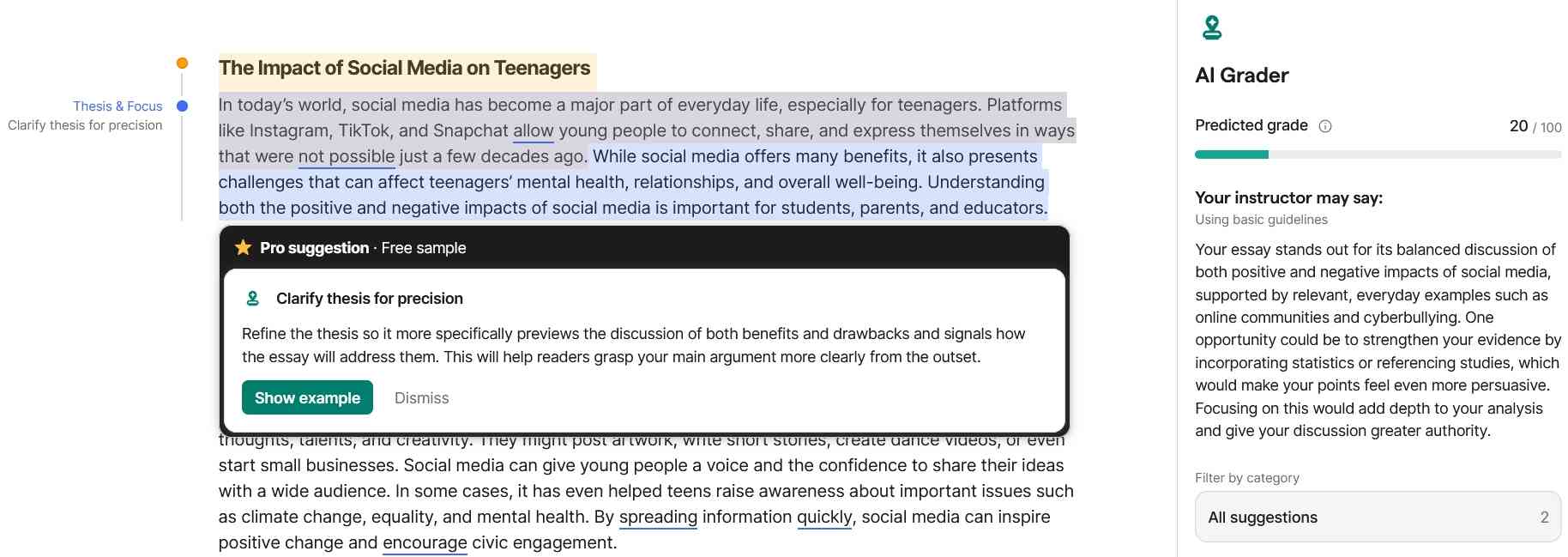
#1 Grammarly (essay feedback features)
Grammarly has moved far beyond red underlines and offers many helpful tips on how to make your essays clearer and more engaging.
What the tool does:
The platform offers clarity scores and suggestions for improving sentence structure and overall readability. Its Goals feature allows you to set parameters around audience, formality, and intent.
What it evaluates best:
Grammarly does a great job at identifying the overuse of passive voice, wordiness, unclear antecedents, and tonal inconsistency.
Who it is best suited for:
Students who need real-time suggestions while drafting to make sure their language remains professional. Educators may also find it useful as a supplementary tool to reduce the volume of surface-level errors before they begin marking.
Key limitations:
Grammarly does not evaluate argument structure or the depth of academic reasoning. Using it as your only feedback mechanism may lead to polished essays that argue nothing in particular.
#2 AHelp
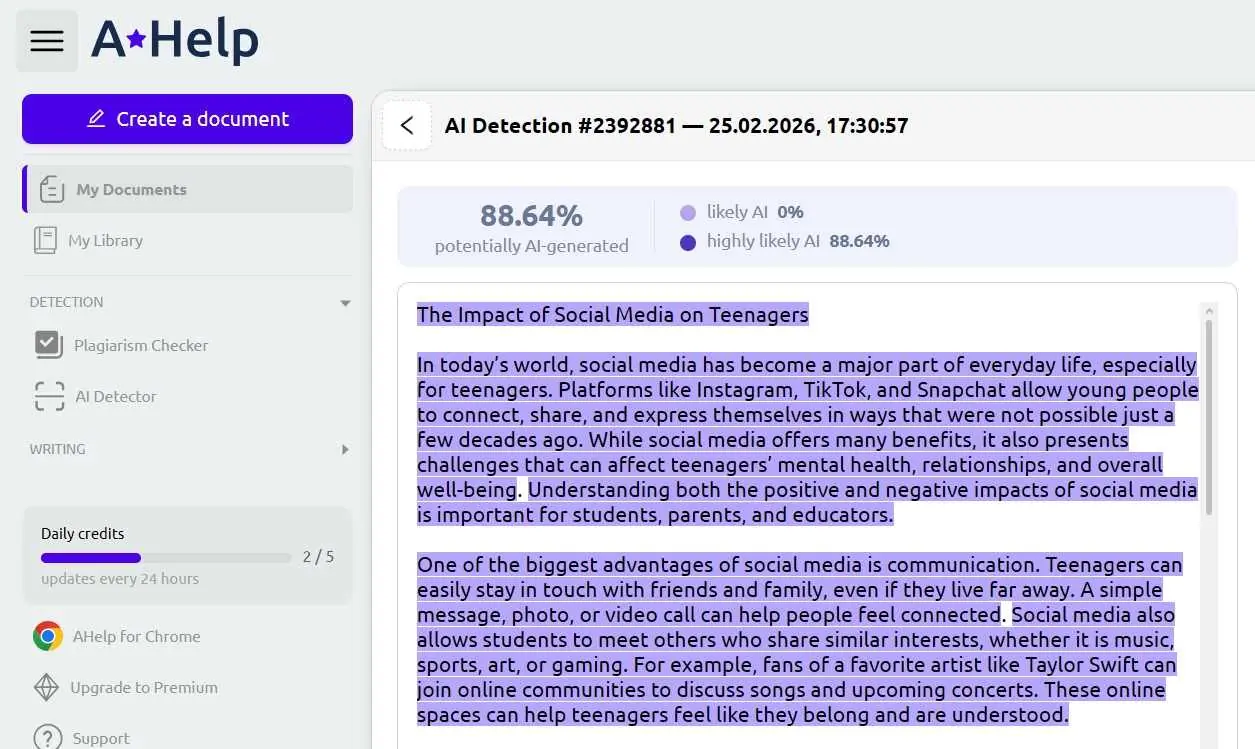
AHelp’s Essay Checker has many helpful features for the student experience and offers multilingual support.
What the tool does:
AHelp is an academic-focused platform that offers AI-powered essay review with AI detection and plagiarism checking capabilities. The platform is designed with students in mind and has a paraphrase option for quick rewrites.
What it evaluates best:
Its feedback tends to be surface-level, meaning that you can see the highlighted parts of your text that resemble AI-generated or plagiarized content.
Who it is best suited for:
Students looking for a pre-submission check to see where their work might fall short of an A grade.
Key limitations:
This AI grader for essays cannot assess the factual accuracy of claims or evaluate the quality of sources cited.
#3 Textero
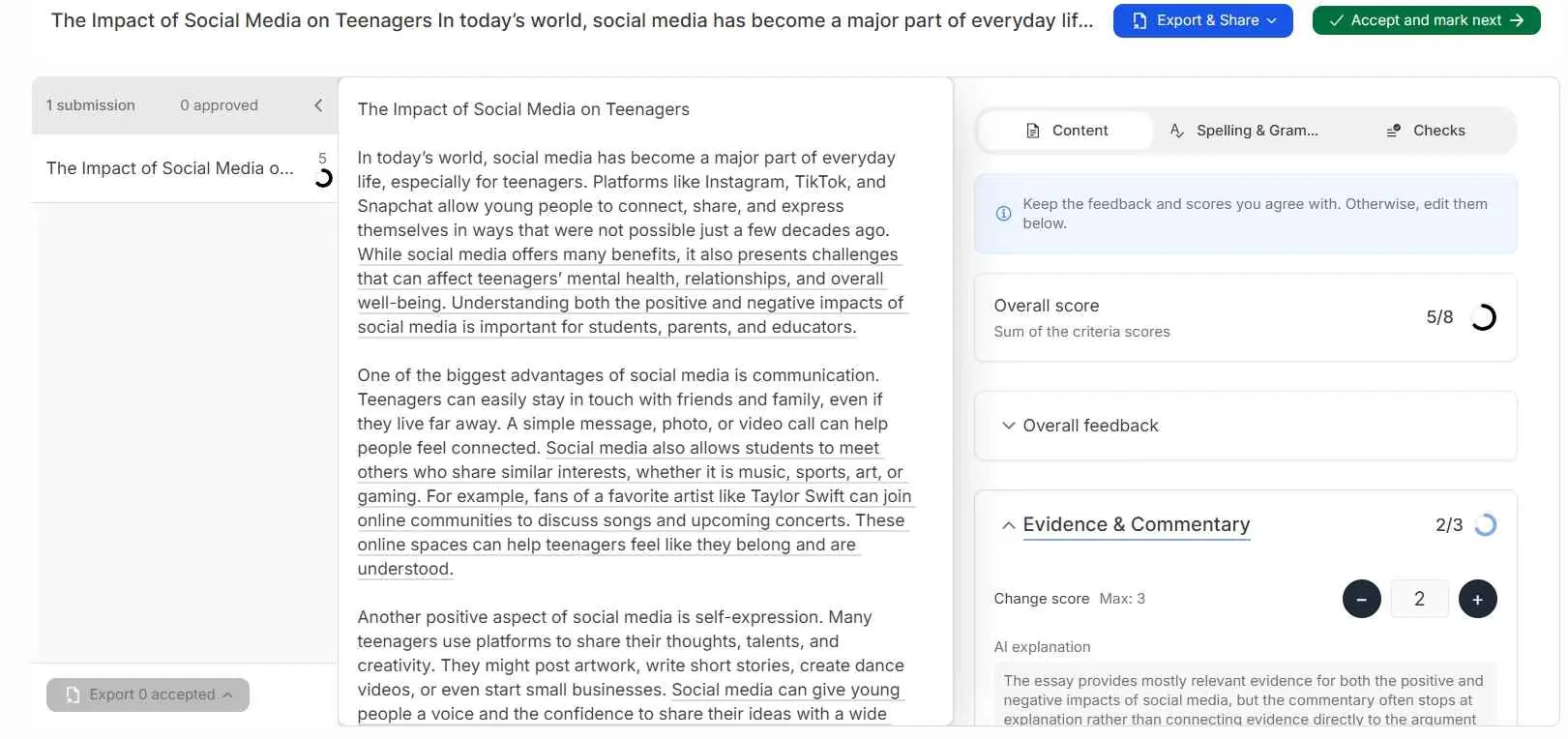
As you might already know, Textero AI Essay Grader is a full-cycle academic assistant, focusing on the research and structure phase as much as the grading phase.
What the tool does:
You can submit drafts and receive suggestions for improving argument development and refining academic language. The platform supports the writing process iteratively and is rather useful for students who are working through multiple drafts.
What it evaluates best:
Textero performs well at identifying gaps in argument development and suggesting where additional evidence or explanation is needed. Its suggestions for expanding ideas are more detailed than many comparable tools, which makes it the best essay grader in the drafting stages of an essay.
Who it is best suited for:
Students who are working on longer essays or research papers and want support throughout the writing process, not just focusing on the proofreading stage and feedback-based revision.
Key limitations:
The free version is quite restrictive in terms of word counts.
#4 GPTZero
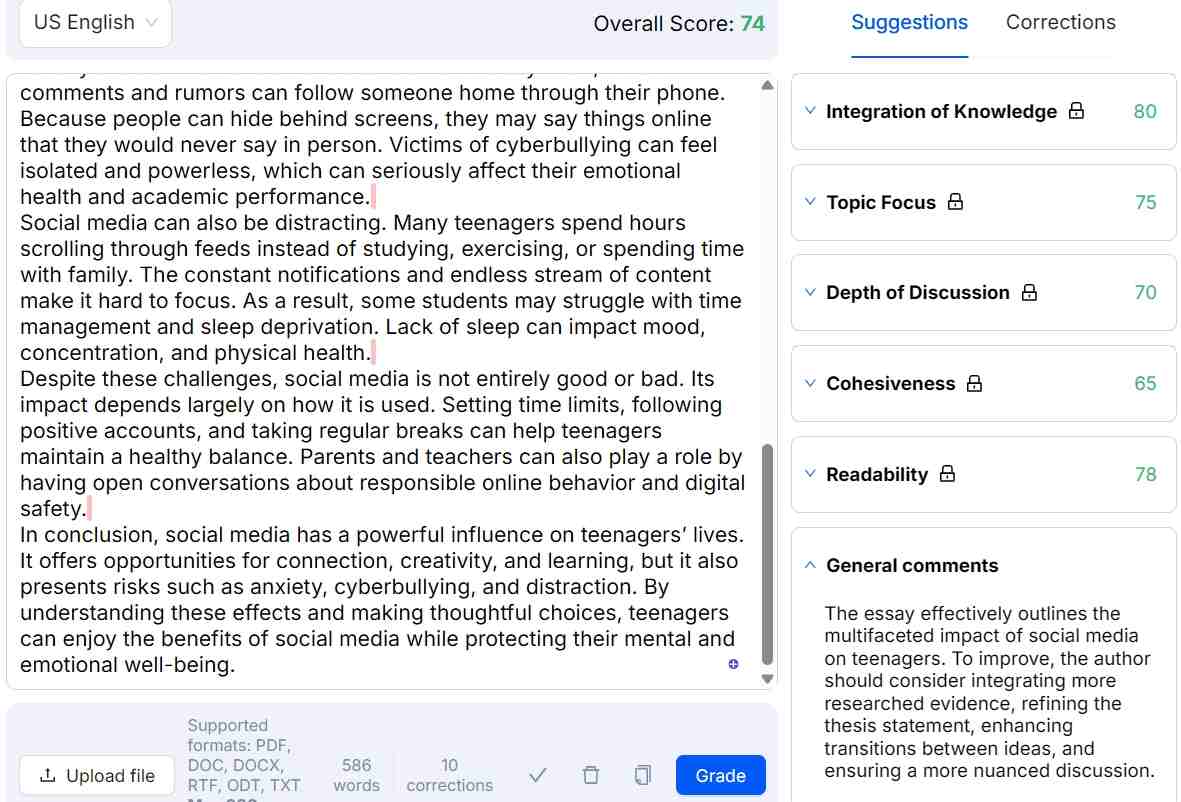
Originally famous for its AI detection capabilities, GPTZero has expanded into a sophisticated AI essay grader for teachers and students.
What it evaluates best:
Adherence to specific rubrics and consistency in feedback. You can upload your own grading standards or choose from educational templates (like AP English) to ensure the AI calibrates to the right level of rigor.
Best suited for:
Educators and institutions looking for an assistant. It is also excellent for students who want to see how their work measures up against a formal rubric (in terms of coherence and clarity, for example) before they submit it.
Key limitations:
While it is highly accurate for common academic formats, the essay grader may struggle with highly creative or non-traditional writing styles that don’t fit into a standard essay rubric.
#5 Scribbr
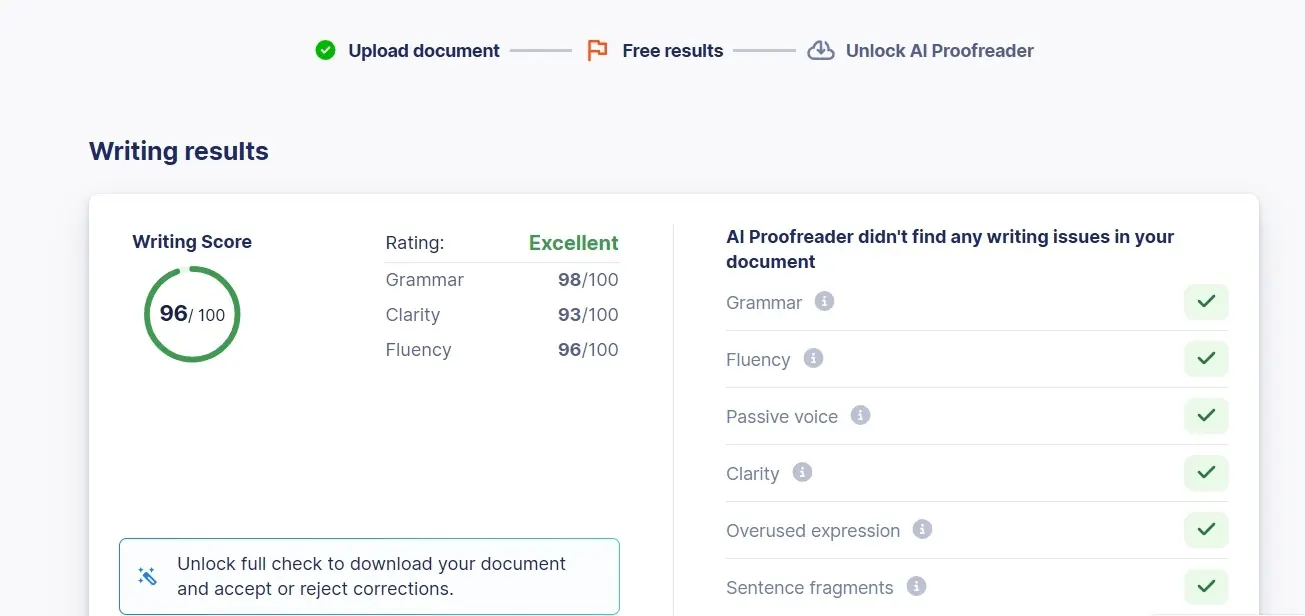
Scribbr combines AI-powered tools with a heavy focus on academic integrity. Their AI Proofreader can be an excellent thesis grader because it’s trained on academic papers.
What the tool does:
Scribbr stands out from the rest because it combines AI-powered tools with highly qualified human editors. Its platform includes a grammar checker, a plagiarism checker, an APA and MLA citation checker, and a proofreading service with experienced human editors.
What it evaluates best:
Scribbr’s citation checker is one of the most useful features for academic writers, as it automatically identifies formatting errors.
Who it is best suited for:
Graduate students, thesis writers, and researchers who need comprehensive feedback on both technical accuracy and argumentation.
Key limitations:
The human editing service comes at a cost and involves turnaround time, which makes it less suitable for last-minute revision. The AI-only tools on the platform are useful but comparable to other checkers on this list.
In the evolving landscape of higher education assessment, AI essay graders are shifting the focus from simple score generation to providing granular, rubric-based feedback that helps students master complex academic conventions.
A Comparison of AI Essay Graders
The table below summarizes how each tool differs across the dimensions most relevant to the students and educators choosing between them.
Tool | Primary Purpose | Best Use Case | Feedback Type |
Grammarly | Writing enhancement | Real-time writing | Explanatory |
AHelp | Self-assessment | Pre-submission check | Score-based |
Textero | AI writing and drafting support | Multi-draft essay development | Score-based and explanatory |
GPTZero | Feedback/Integrity | Rubric-based grading | Multi-layered (AI + Rubric) |
Scribbr | Academic editing and citation | Thesis and dissertation writing | Score-based and explanatory |
Limitations of AI Essay Graders
When you are looking for the best AI for academic writing and grading, you need to be aware of the possible limitations of such tools.
- Subject knowledge. An AI tool cannot tell you whether your interpretation of a historical event is accurate or whether your philosophical argument makes valid assumptions.
- Unconventional writing. Academic writing in some disciplines may use rhetorical strategies that do not fit standard essay templates. Therefore, an AI tool trained on conventional academic formats may flag unusual stylistic choices as errors.
- Rubric alignment. An AI tool assessing general academic writing quality may give you strong feedback, but it does not know what your specific assignment rubric requires.
Finally, human feedback captures things AI cannot: the way the argumentation resonates intellectually and whether the student has engaged meaningfully with the course material. These are the dimensions that often matter most in academic assessment, especially when you need to write a scholarship essay and showcase exceptional writing skills.
Common Mistakes When Using AI Essay Graders
If you use AI essay graders carelessly, they can give you false confidence in work that still needs significant revision. Here are some of the most common mistakes worth avoiding.
Treating AI feedback as a final grade
An AI assessment is a set of automated observations about your writing that may or may not align with how a human reader will evaluate the work.
Fixing grammar but ignoring argument quality
It is easy to spend time implementing all the grammatical suggestions an AI tool provides and feel like you have done a thorough revision. But if your thesis is vague or your conclusion fails to summarize the key points, grammatical polish will not help you score high on your essay.
Submitting work without checking the rubric alignment
AI feedback tools do not know your assignment rubric. Before submitting any work, check it against the specific marking criteria your instructor has provided.
Practical Checklist for Students
Before submitting any academic essay, work through the following checklist that you can use alongside AI feedback.
- Clear thesis statement. Your introduction should state a specific argument or position, not just a topic.
- Logical paragraph structure. Each paragraph must have a clear topic sentence and contribute to the overall argument.
- Evidence-based arguments. Your claims are evidence-based instead of being just assertions.
- Consistent academic tone. The register is formal and appropriate throughout.
- Proper citations. Make sure you’ve cited all sources correctly in the required referencing style, both in-text and in the reference list.
- Conclusion check. Your conclusion should synthesize your argument instead of simply repeating it or introducing new claims.




 Built-in AI detector