



I hadn’t even noticed how testing AI writing tools to understand how they actually function in academic contexts has transformed from my hobby into a professional responsibility. My background in SEO and content strategy means I approach these tools with a fairly critical eye because I’m looking at what they deliver versus what their advertising promises. I decided to test Writeless AI after noticing it appearing higher and higher in search results.
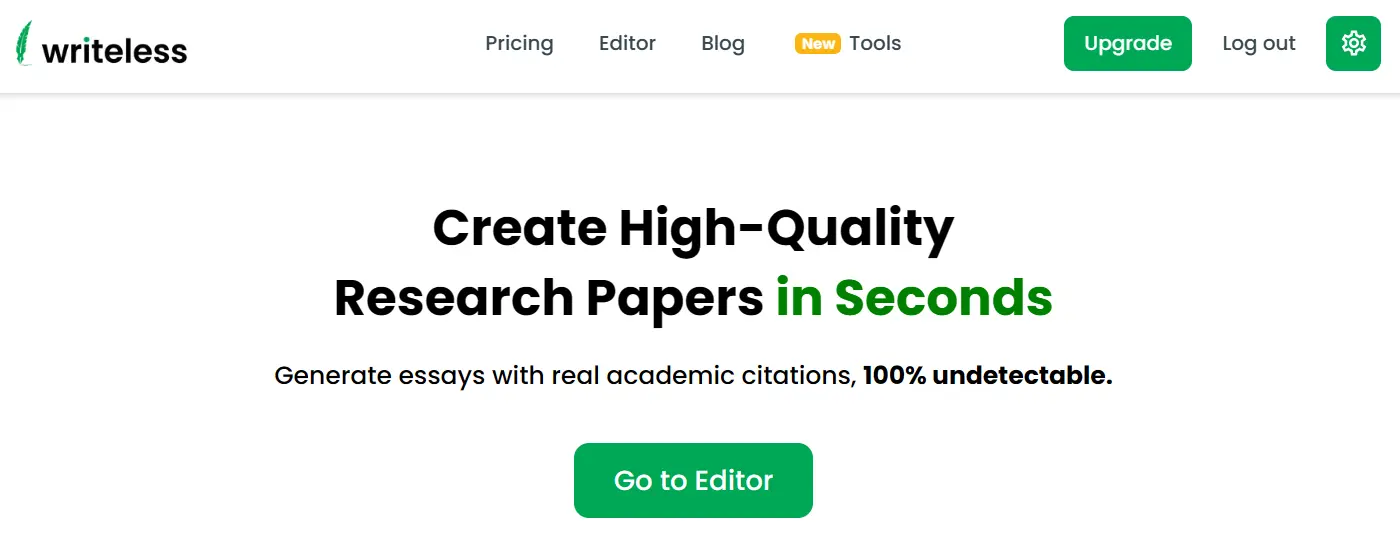
Why I Decided to Test Writeless AI
First and foremost, I wanted to understand what students encounter when they search for these tools and whether the Writeless AI essay writer offers legitimate academic support or just creates generic content. Is it really a responsible academic writing assistant or just a waste of time for anyone interested in creating high-quality papers?
Why “AI essay writer” tools are so popular
The demand for AI essay writers has exploded over the past two years, and it’s not difficult to understand why. Students are juggling multiple courses with heavy workloads, part-time jobs to cover rising tuition costs, family responsibilities, and the constant pressure to maintain competitive GPAs.
I’ve watched the search volume for terms like “AI essay writer” and “write my essay AI” increase dramatically in my SEO work. The problem is that many tools that advertise themselves as solutions are either ineffective or unethical. That’s why I decided to write an objective Writeless AI review that can help students decide whether it is the tool they want to use.
What made Writeless AI stand out
Writeless AI caught my attention for a few specific reasons. Their marketing positions the tool explicitly as a research paper writer rather than a writing assistant, which is a meaningful distinction. Also, I noticed the tool appearing in search results alongside more established AI writing assistants, so it’s easy for students to find it when they look for academic help.
What I expected before testing it
My expectations were frankly quite low. I’ve seen similar tools that usually prioritize content generation over supporting actual learning. I expected the Writeless AI tool would probably generate trivial papers quickly, but with content that would be easily detectable by plagiarism checkers or AI detectors.
Most importantly, I expected that any essay it generated would require so much revision and fact-checking that students wouldn’t actually save time. I approached this test wanting to be proven wrong, so let’s see what results I actually got.
What Writeless AI Is and How It Works
Is Writeless AI legit? This is one of the popular questions I came across while looking for information on this tool. The platform’s biggest marketing hook (and the one I approached with the most caution) is the promise to create undetectable AI content that can bypass standard detectors. As someone deeply invested in SEO and content strategy, I’ve learned that these claims are often more about marketing hype than technical reality, so I was eager to see if the output actually felt human. Spoiler alert: it didn’t.
When I tested the essay generation process, it was clear that the developers prioritized speed. The tool’s editor guides you through the process by letting you choose the relevant characteristics of your academic assignment.
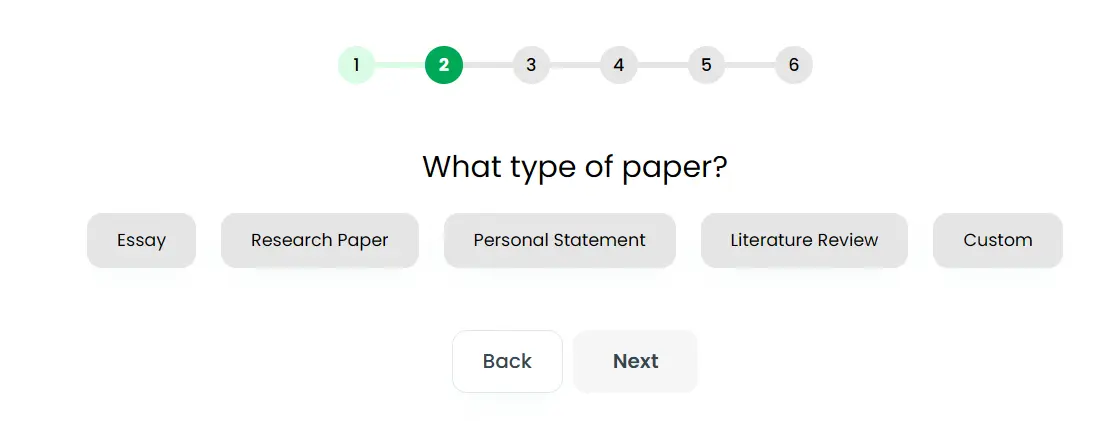
You can choose the type and length of the paper you want Writeless AI to generate, the specific writing style (standard, argumentative, academic, or custom) you want it to use, and the number of citations to include, along with the required formatting style. You can even choose a minimum year for citations to make sure the tool does everything possible to find relevant references for your project. Therefore, it’s safe to say that the Writeless AI essay writer with citations can be a helpful assistant for students.
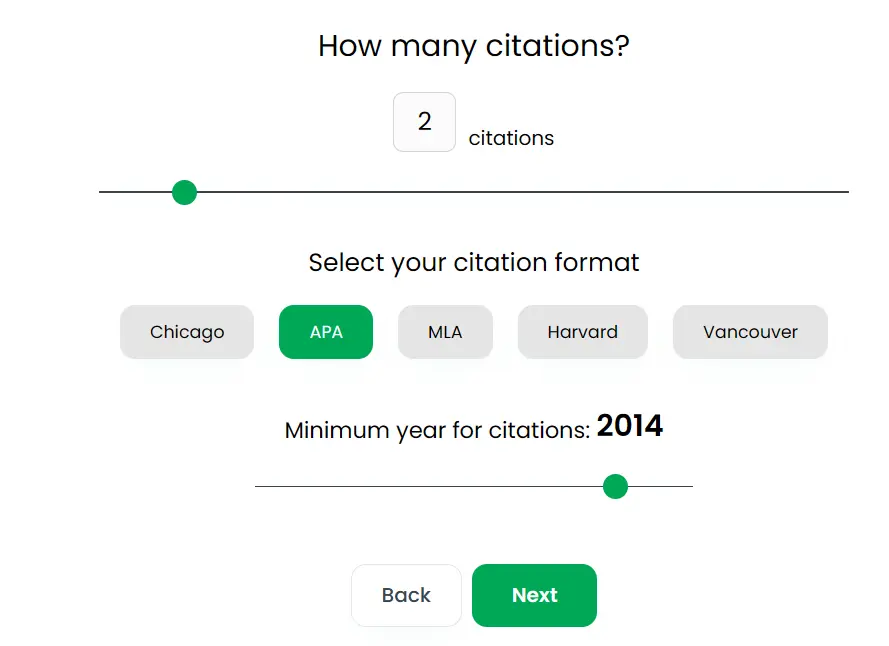
While the interface is clean and straightforward, I noticed that the quality of the final essay depended heavily on how detailed my initial prompt was: if I gave it a generic topic, the result was equally superficial.
Testing Writeless AI — Real Use Cases
While there are many Writeless AI reviews without any specific use cases, I don’t believe reading those gives you any useful insights. Therefore, I wanted my review to rely on seeing all the Writeless AI features in action.
When I put the Writeless AI writing tool to the test, I decided to run a scenario that many undergraduates face: generating a 500-word essay on the stages of psychological development in children.
The very first disadvantage I noticed was a significant friction point in the user journey. Despite the “Try for free” buttons scattered across their landing page, the tool doesn’t actually allow you to generate a single full essay for free. To see a complete result, you need to choose one of the paid plan options, and I must admit that the Writeless AI pricing isn’t the lowest you can find on the market:
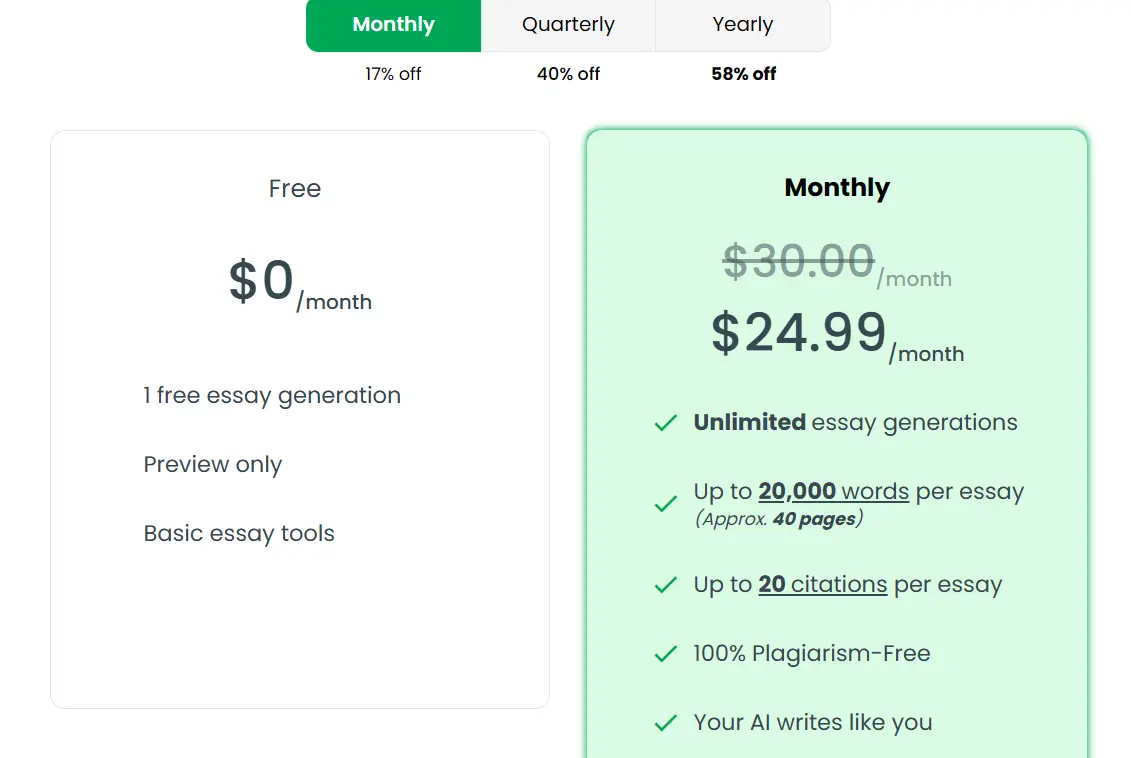
As a strategist, I find this lack of transparency a bit concerning, as you are essentially buying a pig in a poke. The only thing available without a credit card is a limited essay preview, which is far too sparse to give you a clear idea of the tool’s true capabilities.
Output Quality and Academic Soundness
Based on the preview of my psychology essay, the output was nothing extraordinary. The writing felt like standard text you might find on a generic scholarly website. You can find factually correct information there, but you won’t see any unique perspective or critical edge.
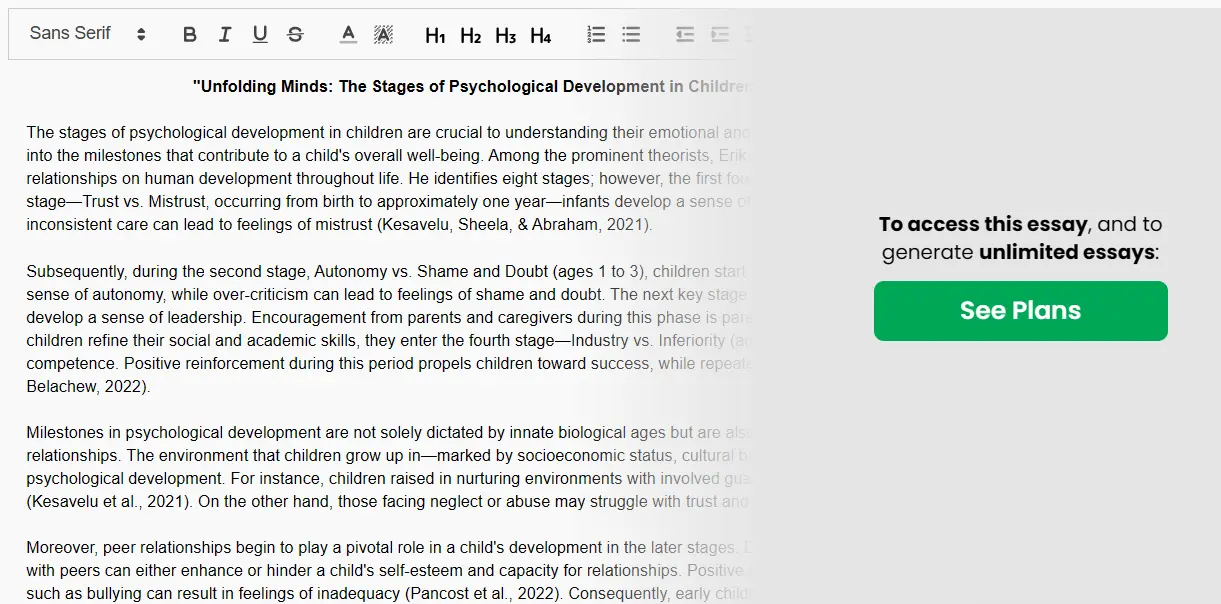
What stood out most to me, even though I’m in no way a professional editor, was the heavy reliance on passive voice. The text lacked the engaging flow that a student would naturally bring to the topic. In other words, you need to rewrite many sentences to make them readable and appealing.
However, there was a silver lining: the citations. The tool pulled verifiable sources that were relevant to developmental psychology. While I wouldn’t trust the text to stand on its own, those references serve as excellent guidance for a student to begin their own legitimate research study. On top of that, you can generate citations in different formats within seconds if you decide to buy one of the paid plans, although you can find plenty of options that are below the Writeless AI price point.
Pros and Cons of Writeless AI
Using all of the Writeless AI tool features helped me identify a few key strengths and several significant red flags. From my perspective in the AI writing industry, these are the trade-offs you need to consider before integrating this tool into your workflow.
What works well
In terms of pure efficiency, the speed of generation is the tool’s biggest selling point. If you experience writer’s block, it can produce a full draft in a matter of seconds and help you find a way out of a dead end.
I also found the surface-level structure to be quite clear, as the AI has a solid grasp of where every part of an essay belongs.
Finally, the platform is undeniably easy to use. The interface is clean, and the step-by-step process is intuitive enough that no learning curve is required.
Where the risks lie
My primary concern is that Writeless encourages a dangerous overreliance on AI. When a tool positions itself as a one-click solution, it tempts students to skip the critical thinking process entirely. This leads directly to significant risks for academic integrity because, despite any marketing claims about being undetectable, using AI-generated text as your own is a gamble that can have serious consequences.
Content-wise, the output had many generic arguments and examples, which I didn’t expect after seeing the Writeless AI cost. For this reason, the text is absolutely not suitable for direct submission (if you were considering this option in the first place, of course, which I don’t recommend doing, no matter what AI tool you use). Without a heavy dose of human editing to add original insights and a personal voice, the work will almost certainly fall short of university standards.
Is Writeless AI Safe for Students?
This is the most important question I needed to answer during my testing. The conclusion I can make is that using Writeless AI as a tool to generate essays you submit as your own work carries significant risks that students need to understand before trying it. After using it, I can state that there is not much difference if we compare Writeless AI vs ChatGPT head-to-head, as both tools make mistakes and often don’t pass AI detection.
There’s a meaningful difference between using AI to help you brainstorm ideas and submitting that content as your own work. The latter replaces learning and violates academic integrity policies at virtually every educational institution.
Writeless AI markets itself as creating undetectable essays, which is both its main selling point and its biggest red flag. Another frustrating part of my user experience was that even after I bought a monthly plan and ran the generated essay through GPTZero, the text was recognized as AI-generated. According to other reviews on Writeless AI, my case isn’t an exception, and other users often get such disappointing results as well.
So, is Writeless AI undetectable after all? I don’t think so. Only occasional undetectability is not the same as reliable safety, and detection technology is constantly improving.
Writeless AI vs Responsible Academic AI Tools
After testing Writeless AI, I kept comparing it to what I consider responsible academic AI tools. The core distinction for me comes down to whether a tool generates complete work for you or helps you develop your own ideas more effectively.
Content generators like Writeless AI operate on a replacement model: you provide a topic, and the tool produces a finished essay. That means you don’t engage with research or practice academic writing skills.
Academic assistants, by contrast, help you generate research questions, organize your ideas, improve your sentence structure, or overcome writer’s block while you do all the thinking required to manage the assignments yourself.
I’ve seen this approach work effectively with platforms like Textero, which help students structure their research and develop their arguments rather than generating completed essays. If you want to learn more about other AI writing tools, you can read this review on The Good AI that focuses on the platform’s key strengths and weaknesses.
When Writeless AI Might Be Useful — and When It’s Not
I want to be fair here: there are limited scenarios where Writeless AI could come in handy for students, though these aren’t how the tool markets itself.
If you’re completely stuck on how to start an essay and need to see what a basic structure might look like, generating an example could help you understand how introductions, body paragraphs, and conclusions fit together.
Similarly, if you need brainstorming help and want to see what angles or arguments exist on your topic, looking at generated content can spark ideas you hadn’t considered. However, Writeless AI should absolutely NOT be used to generate content you submit as your own work.
Final Verdict — Would I Use Writeless AI Again?
Honestly, I wouldn’t use Writeless AI as a primary writing tool again, but as a comprehensive writing assistant for students, it falls short in too many critical areas, especially after you find out the answer to the question: “How much is Writeless AI?” Is Writeless AI detectable? It sure is, just like the majority of AI generation tools. Still, to me it looks like there are better, more responsible alternatives that actually help you learn while completing your assignments rather than simply producing content you didn’t create.
FAQ
Is Writeless AI safe to use for college assignments?
No, not if you’re using it to generate content you plan on submitting as your own work. During my testing, I found that AI-generated essays don’t consistently get past detection tools, and more importantly, they often contain factual errors.
Is Writeless AI considered cheating?
Yes, if you submit AI-generated content as your own work, as most universities explicitly prohibit this in their academic integrity policies.
Does Writeless AI produce original content?
The content Writeless AI generates is technically original in that the tool doesn’t copy it verbatim from existing sources, so it won’t trigger traditional plagiarism detectors. However, you may come across fabricated citations and sources that don’t exist, which is academic fraud. Therefore, double-check all the information the tool presents.
Can Writeless AI replace writing an essay yourself?
Technically, it can generate text that resembles an essay, but it cannot replace the critical thinking and skill development that writing your own essay provides. I found that essays generated by Writeless AI lack depth and miss the nuanced understanding that comes from actually studying your course material.
Are there alternatives to Writeless AI that focus on responsible academic help?
Yes, several tools take a more ethical approach to supporting student writing and can be an excellent Writeless AI alternative. Textero, for example, focuses on helping students structure their research and organize their thinking rather than generating whole essays in one click. In addition, tools like Grammarly help with editing and clarity without doing the writing for you, while Zotero assists with citation management.




 Built-in AI detector